
Personalized Medication Risk Calculator
Understand Your Medication Risk
This tool helps you understand your personalized risk and benefit for common medications based on your health profile, similar to tools mentioned in the article.
Your Personalized Risk Analysis
Your Risk of Heart Attack
Your personal 10-year risk is 7.2%
Based on your health profile compared to average patients
Medication Benefit Estimate
3.2% reduction in heart attack risk
If you take this medication as prescribed
Potential Side Effects
1.5% chance of muscle pain, 0.7% chance of liver issues
Your Personalized Decision Summary
Based on your profile, this medication may be appropriate for you. Consider discussing with your doctor whether this aligns with your personal priorities and lifestyle.
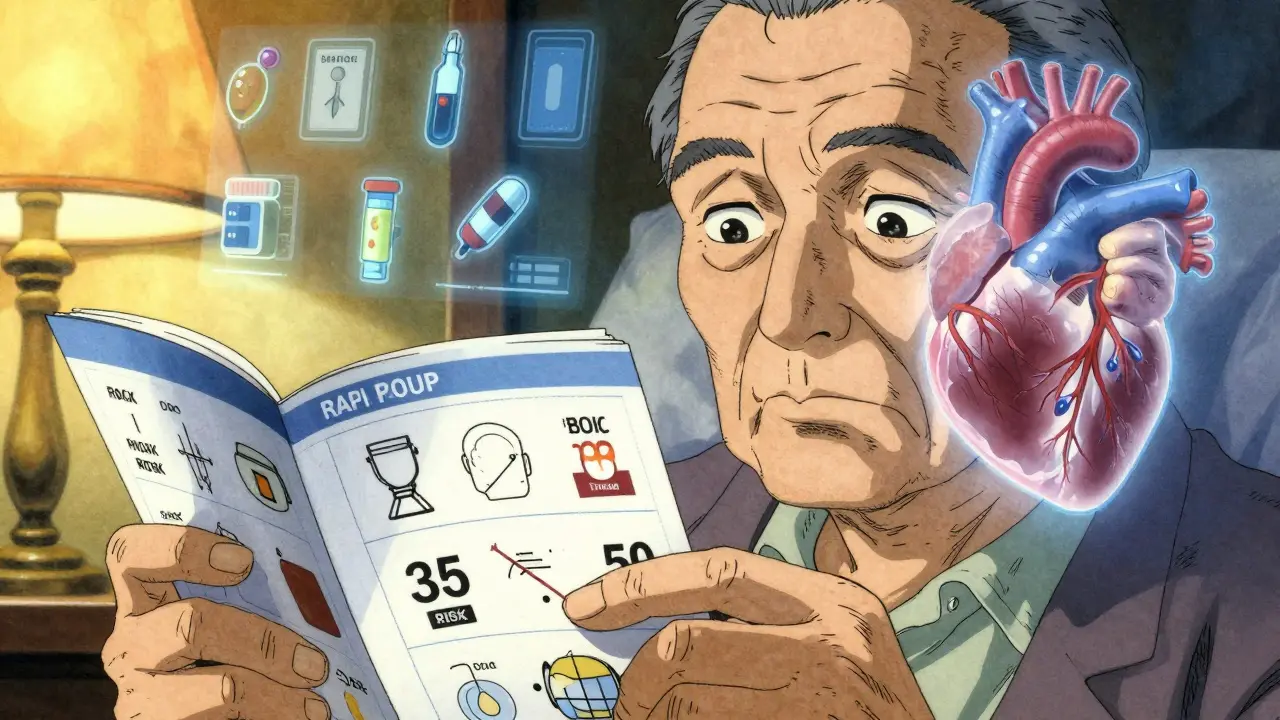
When a doctor says you need a new medication, do you really understand why? Or are you just saying yes because you trust them? Many patients don’t know the real risks or benefits of the pills they’re being asked to take. That’s where patient decision aids come in - tools designed to help you make smarter, safer choices about your meds.
What Are Patient Decision Aids?
Patient decision aids (PDAs) aren’t just brochures or websites. They’re structured tools - digital, paper, or video-based - that give you clear, balanced info about your medication options. They show you what each drug can do, what side effects might happen, and how likely those side effects are. More importantly, they help you think about what matters most to you. Do you care more about avoiding a heart attack? Or are you terrified of muscle pain from statins? PDAs help you sort that out. These tools follow strict standards called IPDAS (International Patient Decision Aids Standards). That means they’re not random info dumps. They’re tested, validated, and built to reduce confusion. Over 150 of them are available today for conditions like diabetes, high blood pressure, depression, and heart disease. Some even include interactive risk calculators that use your age, weight, and lab results to show your personal chances of benefit or harm.How Do They Actually Make Medication Safer?
Medication errors aren’t just about taking the wrong pill. They’re often about taking the right pill for the wrong reason - or not taking it because you didn’t understand why it was prescribed. PDAs fix that. Studies show people who use decision aids know 13% more about their options than those who just get a verbal explanation. That might not sound like much, but in real life, it means fewer people start meds they don’t need. One study found that after using a statin decision aid, 35% of patients changed their mind about taking the drug. Some said no because they realized their actual 10-year heart attack risk was only 7.2%, not the vague "high risk" their doctor mentioned. Another big win? Adherence. People who use PDAs are 17.3% more likely to stick with their meds six months later. That’s huge for conditions like diabetes or high blood pressure, where skipping doses leads to hospital visits and long-term damage. At Mayo Clinic, using decision aids in diabetes care pushed medication adherence from 58% to 75% in just six months. And it’s not just about taking pills. PDAs help people avoid dangerous interactions. One patient on Reddit said the aid showed her that her new cholesterol drug could interact with her existing thyroid med - something her doctor hadn’t flagged. She skipped the new prescription and stayed safe.What Do the Numbers Say?
The evidence isn’t just anecdotal. Over 80 randomized trials have looked at PDAs. Here’s what they found:- Patients using decision aids scored 13.28 points higher on knowledge tests compared to those who didn’t.
- Decisional conflict - that feeling of being stuck or unsure - dropped by 8.7 points on a standard scale.
- Patients were 43% less likely to remain undecided about their treatment.
- Clinicians scored 22 points higher on the OPTION scale, meaning they spent more time listening and less time talking.
Who Benefits the Most?
PDAs work best for preference-sensitive decisions - situations where there’s no single "right" answer. That includes:- Starting statins for mild cholesterol issues
- Choosing between insulin or oral meds for type 2 diabetes
- Deciding whether to take blood thinners for atrial fibrillation
- Selecting antidepressants based on side effect profiles
Why Aren’t They Used Everywhere?
If they’re so good, why aren’t all doctors using them? The biggest barrier? Time. A typical PDA discussion adds 3 to 8 minutes to a visit. In a clinic where appointments are 15 minutes long, that’s a lot. One doctor reported reducing insulin hesitation in her patients from 42% to 18% - but the extra time made her feel rushed. Another issue? Integration. Many PDAs still don’t talk to electronic health records. That means clinicians have to switch screens, print materials, or manually enter notes. Newer tools use FHIR APIs to pull data directly from the EHR and auto-populate risk scores. But only 65% of modern PDAs have this feature - up from just 22% before 2010. Reimbursement is also a problem. Medicare started paying for shared decision-making in 2020, but many private insurers still don’t cover the time spent using PDAs. In fee-for-service systems, doctors get paid for the visit, not for the quality of the decision.How Can You Use One?
You don’t need to wait for your doctor to offer one. You can find validated tools for free:- The Ottawa Hospital Research Institute’s Decision Aids Library has 107 tools, all IPDAS-certified.
- The Agency for Healthcare Research and Quality (AHRQ) offers free printable aids for common conditions like hypertension and osteoporosis.
- Many hospitals now embed PDAs in their patient portals - check your MyChart or similar app.
- Is this tool based on the latest research?
- Does it show both benefits and risks with numbers?
- Does it help me think about what matters to me - not just what the doctor thinks?

The Future Is Personalized
The next wave of decision aids is getting smarter. The NIH is testing a system that pulls your EHR data - lab results, past prescriptions, genetic markers - and builds a custom recommendation. Imagine a tool that says: "Based on your history, you’re 3x more likely to get muscle pain from this statin than average. Here’s an alternative with a 12% lower risk." The FDA has even started recognizing certain decision aids as part of a drug’s official labeling - meaning they’re now considered part of the medical evidence. By 2027, experts predict 75% of high-stakes medication decisions will involve a validated decision aid. It’s not about replacing doctors. It’s about giving you the tools to be their true partner.What’s Holding Back Wider Adoption?
Despite the strong evidence, PDAs still aren’t standard care in most clinics. Why?- Training gaps: Many clinicians haven’t been taught how to use these tools effectively. It’s not enough to hand someone a tablet. You need to guide the conversation.
- Fragmented tools: Too many tools exist without central coordination. Clinicians don’t know which ones are reliable.
- Assumptions about patients: Some providers still think older or less educated patients "won’t understand." But studies show that with simple design, even those with low literacy benefit.
- System inertia: Changing workflows takes money and time - things many clinics don’t have.
Final Thought: You Don’t Have to Guess
Medications save lives - but they can also hurt you if you don’t understand them. You shouldn’t have to rely on a 30-second explanation in a busy exam room to decide whether to take a pill for the rest of your life. Patient decision aids bridge that gap. They turn confusion into clarity. They turn passive acceptance into active choice. And in the end, that’s what medication safety is really about - not just avoiding errors, but making decisions you can live with.Are patient decision aids only for older adults?
No. They work for anyone facing a medication choice with multiple options, regardless of age. Younger patients with depression, anxiety, or ADHD often benefit just as much. The key is matching the tool’s format to the person’s needs - audio for those who prefer listening, visuals for those who learn by seeing, and simple language for those with low health literacy.
Can I use a decision aid without my doctor’s approval?
Yes. Many validated tools are publicly available online. You can review them before your appointment and bring your questions to your provider. In fact, doing so often leads to better conversations. Your doctor may not offer a decision aid, but that doesn’t mean you can’t ask for one or bring your own.
Do decision aids replace the doctor’s advice?
Not at all. They enhance it. A decision aid gives you facts and helps you clarify your values. Your doctor still provides clinical expertise, assesses your health status, and helps interpret the results. The best outcomes happen when both tools and expertise work together.
Are digital decision aids better than paper ones?
Digital tools offer advantages like interactivity, personalized risk scores, and EHR integration. But paper aids are just as effective for knowledge and decisional conflict reduction - and they’re essential for patients without tech access. The best choice depends on the patient’s comfort, literacy, and resources. Many clinics now offer both.
How do I know if a decision aid is trustworthy?
Look for IPDAS certification - it means the tool has been reviewed for balance, accuracy, and clarity. Reputable sources include the Ottawa Hospital Research Institute, AHRQ, and major academic medical centers. Avoid tools that only promote one drug, don’t list side effects, or use vague terms like "high risk" without numbers.
Do insurance companies cover the cost of using decision aids?
Medicare now reimburses for shared decision-making visits that include decision aids in certain cases. Some private insurers follow suit, especially for chronic conditions. But many still don’t. The tool itself is usually free - the challenge is getting paid for the time it takes to use it. That’s changing, but slowly.
Can decision aids reduce hospitalizations from medication errors?
Indirectly, yes. While no single study proves PDAs cut hospital stays directly, they reduce the two biggest drivers: inappropriate prescribing and non-adherence. One large study showed a 28% drop in unnecessary statin prescriptions after implementing a decision aid. Fewer wrong starts mean fewer side effects, fewer ER visits, and fewer admissions.

Alisa Silvia Bila
I used a statin decision aid last year and it totally changed my mind. I thought I was high risk, but the numbers showed I wasn't. I skipped the pill and my doctor was impressed I did my homework.
Marsha Jentzsch
Ugh, I hate when doctors push pills like they’re candy!! And now they want us to use these ‘tools’?? It’s all just corporate propaganda disguised as ‘patient empowerment’!! They just want to cover their butts!!
Henry Marcus
Let me guess - these ‘decision aids’ are secretly funded by Big Pharma to make you think you’re in control while they quietly steer you toward the most profitable drug. I’ve seen the patterns. The ‘risk calculators’? Loaded. The ‘balanced info’? Censored. They don’t want you to know about the 37 studies buried in the appendix that prove statins cause dementia. But hey, go ahead and click ‘I agree’ - I’m sure your EHR will thank you.
William Liu
This is exactly the kind of shift medicine needs. Too many people feel powerless in their own care. These tools don’t replace doctors - they give us a voice. And that’s powerful.
Frank Drewery
I work in a clinic and we started using one for diabetes last year. The number of patients who came back saying ‘I didn’t know I had options’ dropped by half. People feel less scared. That’s worth something.
Adrienne Dagg
Finally!! Someone says it! 🙌 Stop treating patients like dumb kids who just need to swallow the pill and shut up. I used a PDA for my antidepressant and it helped me pick one that didn’t make me feel like a zombie. 🥳
Kinnaird Lynsey
Interesting. I’ve seen these used in practice - mostly by younger, tech-savvy patients. But I wonder how many older folks just get handed a tablet and told to figure it out. The tool’s not the problem. The rollout is.
shivam seo
USA again with its overcomplicated healthcare theater. In Australia, we just give the script and move on. If you can’t read, you’re not fit to make decisions. Simple. No apps, no ‘risk calculators’ - just pills and consequences.
benchidelle rivera
These tools are not optional. They’re ethical. If a provider refuses to use validated, evidence-based decision aids, they are failing in their duty to inform. This isn’t ‘nice to have’ - it’s standard of care. And if your clinic doesn’t offer it, demand it. Your life is not a guess.
Andrew Kelly
Let’s be real - if these tools were truly effective, why are they only used in academic centers? Why aren’t they mandatory? Because they’re a distraction. The real problem is doctors are overworked and underpaid. These aids are a Band-Aid on a broken system. And don’t get me started on how they’re used to shift blame onto patients when things go wrong.
Isabel Rábago
People think they want control, but they don’t. They want someone to tell them what to do. These tools just make them feel guilty for not ‘choosing wisely.’ And now they blame the doctor when they still feel awful. It’s a trap.
Anna Sedervay
While the conceptual framework of patient decision aids is ostensibly laudable, one must interrogate the epistemological underpinnings of the IPDAS criteria - which, as I’ve observed in peer-reviewed critiques, exhibit significant selection bias toward Western, literate, and digitally literate populations. Furthermore, the term ‘risk calculator’ is a semantic misnomer; these are probabilistic heuristics masquerading as scientific objectivity. One must question the commodification of autonomy as a marketable healthcare product.
Dev Sawner
These tools are useless in developing nations. In India, most patients cannot afford the medications, let alone access digital platforms. This is Western privilege dressed as innovation. The real issue is access to medicine - not decision-making frameworks.
Moses Odumbe
Bro, I used one for my blood pressure meds and it literally told me I didn’t need to take it every day. My doctor was mad but I saved $200/month. 🤑 Also, the app had memes. That helped.
Meenakshi Jaiswal
As a nurse who’s seen patients struggle with complex med regimens, I can say without hesitation: decision aids reduce anxiety and improve outcomes. But they need to be integrated early - not just handed out at the end of a rushed visit. Train staff. Offer them in multiple languages. Make them part of the intake process. Small changes, huge impact.