
QT Prolongation Risk Calculator
Personal Risk Assessment
Risk Assessment Results
Important: This is an estimate based on general risk factors. For accurate assessment, consult your healthcare provider and request an ECG.
Recommended Actions
Key Risk Factors
Correcting low potassium cuts risk by 62%.
Some combinations increase risk 5-fold.
Over 1 in 3 elderly patients take QT-prolonging drugs.
Women have higher susceptibility than men.
When a medication changes your heart’s rhythm in a way you can’t see, it’s not just a lab result-it’s a silent threat. QT prolongation is one of those hidden dangers. It doesn’t cause symptoms on its own, but it can trigger a deadly heart rhythm called Torsades de Pointes, which often leads to sudden cardiac death without warning. This isn’t rare. Over 100 commonly prescribed drugs-antibiotics, antidepressants, antifungals, even some anti-nausea meds-can cause it. And for some people, the risk isn’t theoretical. It’s life-or-death.
What Exactly Is QT Prolongation?
The QT interval on an ECG measures how long it takes your heart’s lower chambers (ventricles) to recharge between beats. When that interval stretches too long, the heart’s electrical system becomes unstable. That’s QT prolongation. It’s not a disease. It’s a warning sign-a red flag in your heart’s electrical activity. Doctors measure it as QTc-the corrected QT interval-because heart rate affects the reading. The standard cutoffs? More than 450 milliseconds in men, or more than 470 in women. Once it hits 500 milliseconds or increases by more than 60 milliseconds from your baseline, the risk of sudden death jumps sharply. The real danger isn’t just the length-it’s how unevenly the heart muscle repolarizes. Some areas recover faster than others. That imbalance is what sparks Torsades de Pointes.Which Medications Are the Biggest Culprits?
Not all QT-prolonging drugs are created equal. Some are high-risk by design, others are accidental offenders.- Class III antiarrhythmics like dofetilide and sotalol are built to prolong repolarization to treat arrhythmias-but they carry a 3.3% risk of causing Torsades on standard doses.
- Antibiotics like moxifloxacin can push QTc up by 6-15 milliseconds. Ciprofloxacin? Barely any effect. Erythromycin, especially when taken with drugs that block its metabolism (like certain antifungals or grapefruit juice), can double your risk of sudden death.
- Antidepressants vary wildly. Citalopram at 40 mg daily increases QTc by about 8.5 ms. Escitalopram at the same dose? Only 4.2 ms. That’s why switching isn’t just about mood-it’s about safety.
- Antipsychotics like haloperidol and ziprasidone are notorious. Even low doses can be risky in older adults or those with heart disease.
Who’s Most at Risk?
It’s not just about the drug. It’s about you.- Women are more susceptible. Hormonal differences affect how heart cells handle potassium, making repolarization slower on average.
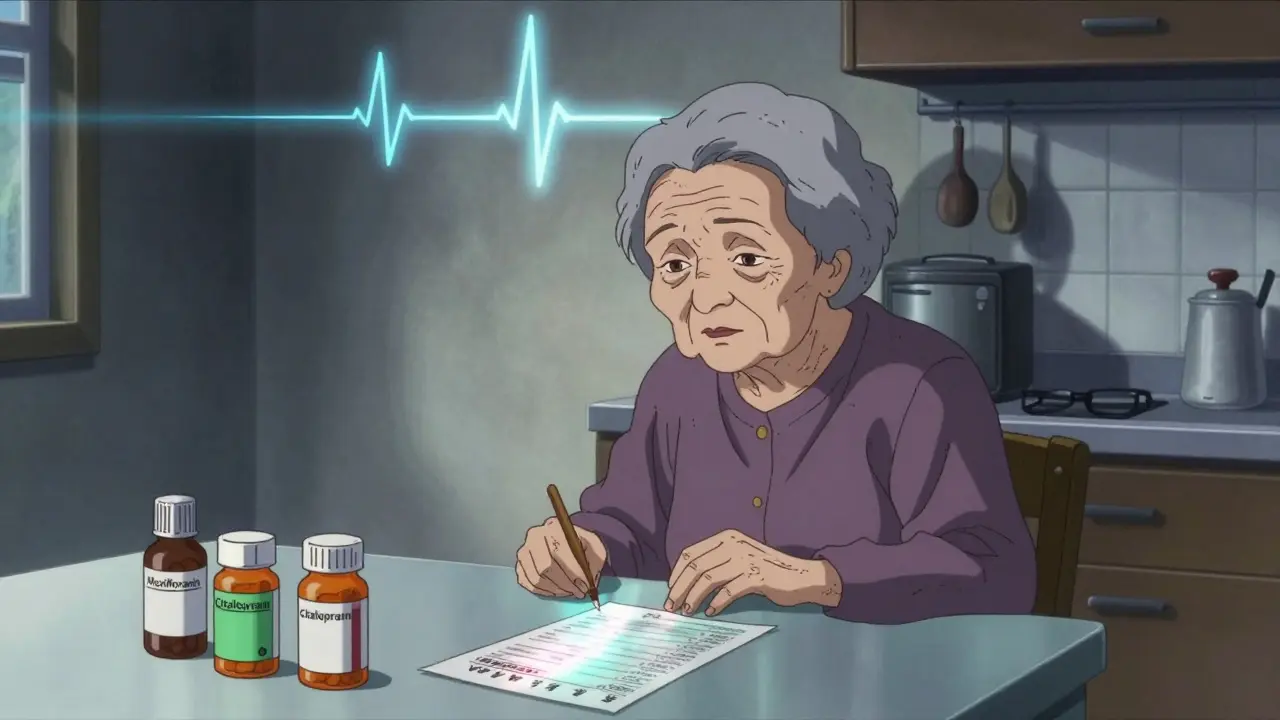
- Older adults take more meds. The average person over 65 is on 7.8 prescriptions. One in three of them is on a QT-prolonging drug.
- People with heart disease face 10 to 100 times higher risk than those with healthy hearts. Scar tissue from past heart attacks creates electrical chaos that drugs can ignite.
- Low potassium or magnesium is a silent amplifier. If your levels dip below 4.0 mEq/L, your QT interval lengthens even with safe meds. Correcting hypokalemia cuts risk by 62%.
- Drug interactions are the biggest hidden trigger. Taking erythromycin with a CYP3A4 inhibitor (like clarithromycin, ketoconazole, or even some antidepressants) can spike your risk fivefold. Many doctors don’t check for this.
Why Do So Many People Get Hit Without Warning?
The biggest myth? That QT prolongation always leads to death. It doesn’t. Most people with a prolonged QTc never have a problem. But for the unlucky few, the trigger is invisible. The POST SCD study found that 78% of people who died suddenly while on a QT-prolonging drug had no arrhythmia found at autopsy. That means something else-like a heart attack, stroke, or electrolyte crash-was the real cause. The drug just made their heart more vulnerable. This is why experts like Dr. Dan M. Roden say the focus on QTc alone is flawed. It’s a marker, not a killer. The real danger is when it combines with other stressors: low potassium, slow heart rate, structural heart disease, or a drug interaction you didn’t see coming.What Should You Do If You’re on One of These Drugs?
You don’t need to stop your meds. But you need to be smart.- Ask for a baseline ECG before starting a new drug known to prolong QT. If you’re already on one and haven’t had one in the last year, request it.
- Check your electrolytes. A simple blood test for potassium and magnesium can prevent a crisis. Aim for potassium above 4.0 mEq/L.
- Review every medication-including over-the-counter and herbal ones. Some antihistamines, laxatives, and even CBD products can interfere.
- Watch for symptoms. Dizziness, palpitations, fainting spells? Don’t brush them off. These are your body’s alarms.
- Use reliable tools. Sites like AZCERT.org list all QT-risk medications and their levels. Pharmacists can help you cross-check your list.
What About AI and New Testing?
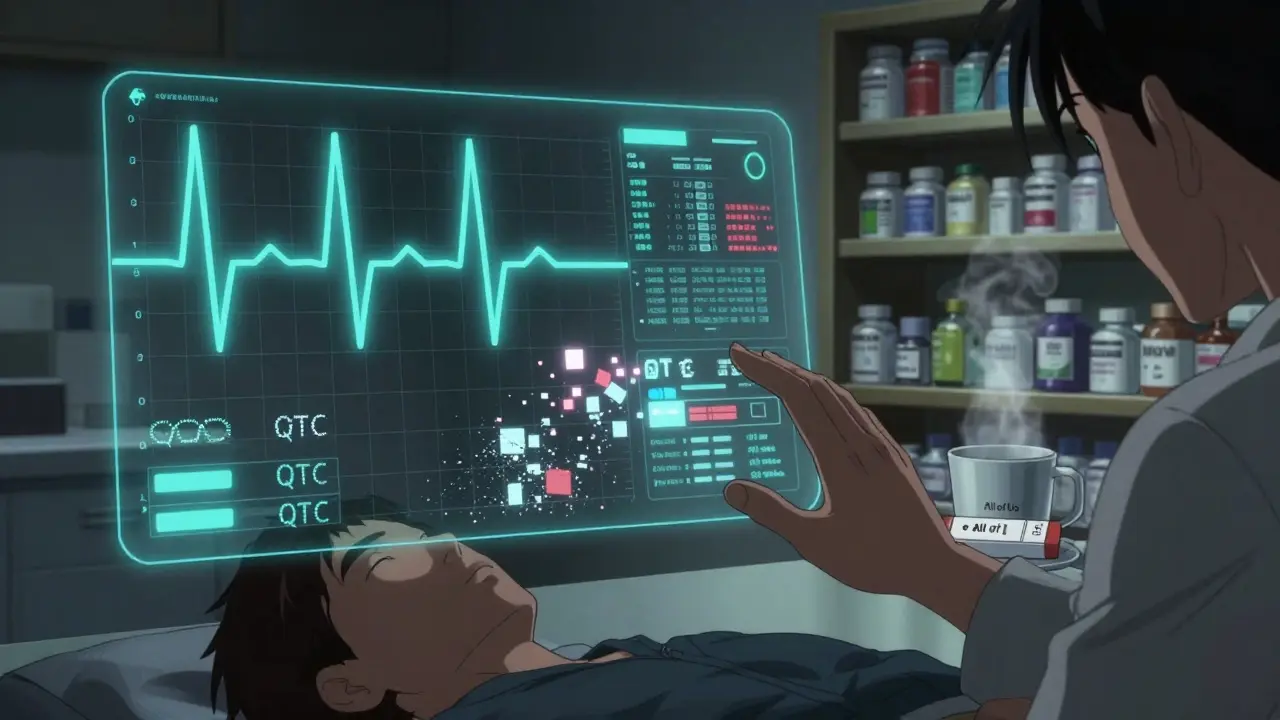
The old way-measuring QTc-is outdated. It’s inaccurate. Automated ECG machines can be off by 40 milliseconds. That’s enough to mislabel someone as high-risk when they’re not-or miss someone who is. New tools are changing the game. The FDA approved QTguard by Verily Life Sciences in 2023. It uses AI to analyze not just the QT interval, but the shape of the T-wave. That’s more predictive. It cuts false alarms by over half. And starting in December 2023, new drugs must show not just QT prolongation, but T-wave morphology changes. That’s a big step forward. It means future medications will be safer.The Bottom Line
QT prolongation isn’t something to panic about. But it’s not something to ignore either. Millions of people take these meds safely every day. The problem comes when risk factors stack up-like old age, low potassium, multiple drugs, and heart disease. If you’re on a medication that can prolong QT, talk to your doctor. Ask: "Is my QTc checked? Are my electrolytes normal? Am I on anything that could interact?" If you’re over 65, have heart disease, or take five or more meds, this conversation isn’t optional. The goal isn’t to avoid all risky drugs. It’s to avoid the perfect storm. With the right checks, most people can stay safe. And that’s the real win.Can a normal ECG rule out risk from QT-prolonging drugs?
No. A normal ECG doesn’t guarantee safety. QT prolongation can develop after starting a drug, especially if electrolytes drop or another medication is added. Even people with normal baseline QTc can develop dangerous prolongation weeks later. Regular monitoring is key if you’re on a high-risk drug.
Is QT prolongation reversible?
Yes, in most cases. Stopping the offending drug, correcting low potassium or magnesium, and treating underlying conditions like heart failure can reverse the prolongation within days to weeks. But if Torsades de Pointes occurs, it requires emergency treatment-magnesium sulfate, pacing, or defibrillation.
Are natural supplements safe if I’m on a QT-prolonging drug?
Not always. Some supplements like St. John’s Wort, licorice root, and high-dose green tea extract can interfere with drug metabolism or lower potassium. Even magnesium supplements can be risky if you have kidney disease. Always check with your doctor before adding anything to your regimen.
Why do some people get Torsades with a QTc of 480, but others don’t with 520?
Because QTc is just one piece. T-wave shape, heart rate, electrolyte levels, and genetics matter more. Someone with a QTc of 520 but normal potassium and no heart disease might be safer than someone with a QTc of 480, low potassium, and a prior heart attack. The context changes everything.
Should I avoid all QT-prolonging drugs if I have a family history of sudden death?
Not necessarily. But you should get genetic testing and a detailed cardiac evaluation first. Some inherited arrhythmia syndromes like Long QT Syndrome type 1 or 2 increase risk dramatically. If you have one, certain drugs must be avoided completely. If you don’t, you may still take them safely with monitoring.
Can stress or exercise trigger sudden death in someone with QT prolongation?
It depends. In inherited Long QT Syndrome, intense exercise can trigger events. But in drug-induced cases, the risk is usually higher at rest or during bradycardia-not during activity. Still, sudden emotional stress or shock can be a trigger in vulnerable individuals. Avoid extreme physical or emotional strain if you’re on high-risk meds.

Kuldipsinh Rathod
Man, I never realized how many meds can mess with your heart like this. My grandma’s on like five prescriptions and one of ‘em’s on this list-she’s 78, has a bit of heart trouble, and her potassium’s always low. I’m gonna get her bloodwork done this week. Better safe than sorry.
Lori Anne Franklin
so i just found out my zoloft is on the list?? like… wait. what. i thought antidepressants were fine?? 😅
carissa projo
Hey Lori-same here. I switched from citalopram to escitalopram last year after my cardiologist flagged my QTc. It wasn’t a big deal, but it made me realize how little most docs talk about this stuff. You’re not alone. And honestly? This post saved me from a potential disaster. Keep asking questions. Your heart will thank you.
Alex Ragen
It is, of course, profoundly ironic-nay, tragically poetic-that our pharmaceutical industry, in its infinite wisdom, has weaponized the very mechanisms designed to heal… by inducing, with clinical precision, the very arrhythmias it purports to cure. The QT interval, that delicate temporal ballet of repolarization, becomes a Rorschach blot for our collective hubris: we measure milliseconds, but we fail to measure mortality. The FDA’s 142 warnings? Merely the tip of a submerged iceberg of pharmacological hubris-each pill, a silent gamble with the rhythm of life itself.
Jeanette Jeffrey
Wow. So you’re telling me people are still alive after taking antibiotics with QT risks? What a miracle. Honestly, if you’re over 50 and on more than 3 meds, you’re just borrowing time. Your ECG’s a lie, your potassium’s trash, and your doctor’s too busy scrolling TikTok to care. You’re one grapefruit juice away from a cardiac coffin.
david jackson
Okay, I’ve been reading this post for 20 minutes and I’m still not sure if I’m supposed to panic or just start doing my own research. But here’s the thing-I’ve been on amiodarone for atrial fibrillation since 2018. My QTc is 498. I’m 62. I take potassium supplements. I avoid grapefruit. I get ECGs every six months. I’ve had two near-fainting spells in the last year. I didn’t connect them until now. And now I’m wondering… how many people like me are just waiting for the other shoe to drop? Because this isn’t theoretical. It’s in my EKG. In my bloodwork. In my sleepless nights. And nobody warned me. Not my PCP. Not my cardiologist. Not the pharmacist. The system’s broken. We’re not being monitored-we’re being scanned for liability, not safety. I’m not mad. I’m just… terrified. And I think a lot of us are.
Jody Kennedy
YOU ARE NOT ALONE. Seriously. I was terrified after reading this too-until I went to my pharmacist and asked for a med review. She flagged three interactions I didn’t even know were risky. We got my potassium up, swapped one med, and now I feel like I’ve been given a second wind. It’s not about fear-it’s about power. You’ve got the info now. Use it. Talk to your team. You’ve got this.
wendy parrales fong
My dad passed from sudden cardiac death at 64. They never found a cause. He was on antibiotics for a sinus infection. He had low potassium. He took a beta-blocker. He was on three other meds. I didn’t know any of this mattered. Now I check every new prescription. I make sure his old meds are reviewed. I’m not trying to scare anyone-I just want people to know: your body’s whispering. Listen. Before it’s too late.