
Going to the pharmacy every month for your blood pressure, diabetes, or cholesterol meds is exhausting. You’re not just wasting time-you’re risking your health. Missing a refill, forgetting to pick it up, or running out because you were too busy? That’s how people end up in the hospital. But there’s a simple fix: ask for a 90-day supply of your maintenance medications. It’s not magic. It’s a program built into most insurance plans, and you’re probably already paying for it.
Why 90-Day Supplies Work
Most people get 30-day prescriptions. That means four trips to the pharmacy every year. With a 90-day supply, you’re down to one. That’s not just convenient-it’s proven to save lives. A 2023 study in JAMA Network Open found people who switched to 90-day supplies took their meds 27% more often. They also saved about $2.35 per prescription each month. For someone on three meds? That’s over $80 a year in your pocket.
These programs target chronic conditions: high blood pressure, type 2 diabetes, high cholesterol, depression, asthma, and thyroid issues. If you take the same pill every day, it’s likely eligible. Antibiotics, painkillers, or short-term meds? Not eligible. This isn’t about getting more drugs-it’s about getting the right ones, in the right amount, with less hassle.
How to Get Started
You can’t just walk in and ask for three months’ worth. You need to follow three steps.
- Check if your plan offers it. Log into your insurance portal or call the number on your card. Look for terms like “90-day supply,” “mail-order pharmacy,” or “extended-day supply.” If you’re on Medicare Part D, it’s required by law. If you’re on a Medicare Advantage plan, you might even get 100-day supplies.
- Confirm your meds qualify. Not every drug is allowed. Specialty drugs (like those for rheumatoid arthritis or multiple sclerosis) often require three 30-day fills before you can switch. Some states-California, Texas, Minnesota, New Hampshire, and Washington-have restrictions. Check your plan’s website or ask your pharmacist.
- Ask your doctor for a 90-day prescription. This is the step most people skip. Your doctor might automatically write a 30-day script because that’s what they’re used to. Say: “I’d like to switch to a 90-day supply to reduce trips to the pharmacy. Can you write a new prescription for that?”
Most doctors are happy to help. They know adherence is a problem. Some even have electronic systems that let you request 90-day refills directly through their patient portal.
How You’ll Get Your Meds
There are two main ways to receive your 90-day supply: mail-order or select retail pharmacies.
Mail-Order Pharmacy
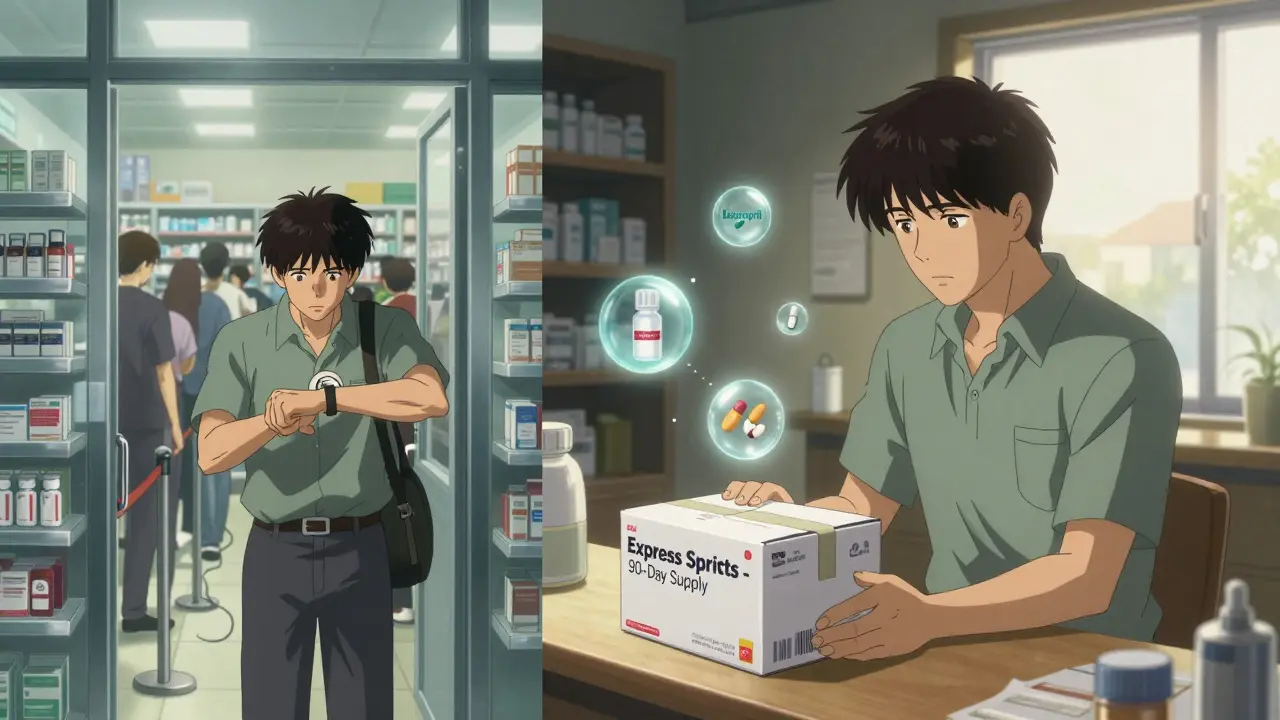
This is the most common method. Your insurance partner (like Express Scripts, CVS Caremark, or Cigna) ships your meds directly to your home. Delivery usually takes 7-10 business days. You’ll get refill reminders by email or text. Some plans even include free delivery, safety checks for drug interactions, and supplies like syringes or glucose monitors.
Pros: No lines, no driving, automatic refills. Cons: You need to plan ahead-don’t wait until you’re out.
Select Retail Pharmacies
Some plans, like Cigna 90 NowSM, let you get 90-day fills at specific pharmacies in their network. Walmart is a big one-they offer generic meds for $10 for 90 days. Other chains like CVS or Walgreens may offer it too, but only if you’re in their network. Check your plan’s pharmacy list before you go.
Pros: Get meds same day. Cons: Not all locations offer it. You might have to drive farther.
What to Watch Out For
It’s not always smooth sailing. Here are the most common roadblocks-and how to fix them.
- “My doctor won’t write a 90-day script.” Bring printed info from your insurer. Say: “My plan covers 90-day supplies. Can you help me switch?” Most doctors will say yes once they know it’s covered.
- “I’m on a specialty drug.” You might need to fill three 30-day prescriptions first. Call your pharmacy or PBM. They’ll tell you when you’re eligible.
- “I live in a restricted state.” If you’re in California, Texas, or one of the other excluded states, mail-order might not be available. Ask if retail network options exist.
- “I’m on Medicaid or Medicare, but I can’t get it.” Some managed Medicaid plans don’t offer it. Medicare Part D does. If you’re denied, ask for an exception-sometimes it’s just a paperwork issue.
Costs and Savings
Don’t assume it’s more expensive. Often, it’s cheaper.
Here’s how pricing usually breaks down:
| Medication Type | 30-Day Cost | 90-Day Cost | Savings |
|---|---|---|---|
| Generic (e.g., Lisinopril) | $4-$10 | $10-$15 | $5-$15/month |
| Preferred Brand (e.g., Metformin ER) | $20-$40 | $20-$40 | Up to 30% less per refill |
| Non-Preferred Brand | $50-$80 | $40-$60 | $10-$20/month saved |
Walmart’s $10 for 90-day generics is hard to beat. Express Scripts and CVS Caremark often cap brand-name costs at $20-$40 for 90 days. That’s less than what you’d pay for three 30-day fills at a regular pharmacy.

What Happens When You Run Out?
Mail-order pharmacies usually send your next refill before you run out. But if you’re using a retail pharmacy, you’ll need to request a refill. Set a reminder on your phone for 10 days before your meds run out. Don’t wait until day 89. Delays happen.
If you’re on a schedule-like taking meds at 8 a.m. every day-keep a backup 7-day supply on hand. It’s not cheating. It’s smart.
What’s Next?
This isn’t a one-time fix. Once you’ve got your 90-day supply, make it part of your routine. Use your insurer’s app to track refills. Set up automatic notifications. If you’re on multiple meds, ask if you can get them all through the same mail-order service. Consolidating reduces clutter and confusion.
Some insurers are starting to use algorithms to identify patients who’d benefit most from extended supplies. If you’ve been consistent with your meds, you might get a letter or email offering to switch you automatically. Say yes.
People with chronic conditions live longer, feel better, and spend less when they stick to their meds. A 90-day supply isn’t a perk-it’s a tool. And it’s yours to use.
Can I get a 90-day supply for any medication?
No. Only maintenance medications for chronic conditions qualify-like those for high blood pressure, diabetes, high cholesterol, depression, or asthma. Antibiotics, painkillers, or short-term drugs don’t count. Check your plan’s list of eligible medications or ask your pharmacist.
Do I need a new prescription for a 90-day supply?
Yes. Your doctor must write a new prescription specifically for 90 days. Even if you have refills left on your 30-day script, you can’t just ask the pharmacy to stretch it. You need a new order with the correct quantity and directions.
Is mail-order safe?
Yes. Mail-order pharmacies are licensed, regulated, and often more careful than retail ones. They check for drug interactions, verify dosages, and use temperature-controlled packaging. Many offer 24/7 pharmacist support. Express Scripts and CVS Caremark even include free safety checks with every order.
What if I move or change insurance?
If you switch plans, check if your new insurer offers 90-day supplies. Some don’t, or they use different pharmacies. If you’re moving to a restricted state, you may need to switch to a retail network pharmacy. Always update your address and insurance info with your pharmacy provider to avoid delays.
Can I get 90-day supplies if I’m on Medicare?
Yes. Medicare Part D plans are required to offer 90-day supplies. If you’re on a Medicare Advantage plan (Part C), you might even get 100-day supplies. Just make sure you use a pharmacy in your plan’s network. Mail-order is usually the easiest option.
How long does it take to get my first 90-day supply?
If you use mail-order, expect 7-10 business days after your doctor sends the prescription. Retail pharmacies can fill it the same day if they’re in your plan’s network. Plan ahead-don’t wait until your current supply runs out.
Final Tip: Don’t Wait for a Crisis
You don’t need to run out of meds to make this change. If you’re tired of monthly pharmacy runs, if you’ve missed a refill before, or if you’re paying more than you should-ask now. It takes one conversation with your doctor and one call to your insurer. The rest? It just happens. Fewer trips. Lower costs. Better health. That’s the real win.

Jake Kelly
Been doing the 90-day thing for my blood pressure med for two years now. No more rushing to the pharmacy during lunch breaks or forgetting on weekends. Mail-order shipped right to my door, and I save like $12 a month. Simple. Effective. Why wouldn’t you?
Ashlee Montgomery
It’s not just about convenience-it’s about consistency. Missing doses isn’t a minor hiccup, it’s a slow unraveling of your health. The data’s clear: fewer trips, better adherence. And yet, so many people don’t even know this option exists. Maybe the system isn’t broken, it’s just invisible to those who need it most.
neeraj maor
90-day supplies? Sounds like Big Pharma’s way of locking you in. What if you need to switch meds? What if the mail-order pharmacy screws up your dosage? They track everything, you know. Your pill habits. Your blood pressure trends. Your heart rate from those fitness trackers you linked. This isn’t convenience-it’s surveillance with a discount.
Ritwik Bose
Thank you for sharing this comprehensive guide. I have been advocating for extended-supply prescriptions in my community, especially among elderly relatives who struggle with mobility. The cost savings and reduction in pharmacy visits are truly transformative. I have shared this with my family and will encourage others to explore this option with their providers. Much appreciation for the clarity and practical steps.
Paul Bear
Let’s be precise: this isn’t a ‘program’-it’s a benefit encoded in your PBM contract under the ‘extended-day supply’ clause. And no, not all chronic meds qualify. You need to check the formulary tier, prior authorization status, and whether your drug is classified as ‘maintenance’ per the FDA’s 2022 guidance. Also, if you’re on a high-deductible plan, the 90-day bulk might push you into a higher cost-sharing tier. Don’t assume savings-run the math.
lisa Bajram
OMG YES. I was on 30-day scripts for my antidepressants and kept forgetting-until I switched to mail-order. Now I get them every three months like clockwork. Plus, they sent me free pill organizers and a little note that said ‘You’ve got this.’ I cried. Not because I’m emotional-I’m just tired of being a burden to myself. This isn’t just healthcare-it’s kindness with a shipping label. 💪🩹
Jaqueline santos bau
Wait-so you’re telling me I’ve been paying $40 a month for my diabetes meds when I could’ve been paying $15? And my doctor never told me? What else have they been hiding? I feel like I’ve been played. I’m going to call my insurance right now. And my doctor. And maybe a lawyer. This is criminal.
Kunal Majumder
Bro, I’m from India and we don’t have this system, but I get what you mean. Here, people buy meds in small packs because they can’t afford big ones. But if you can get 90 days cheap? Do it. No stress. Less running around. Life’s too short for pharmacy queues.
Aurora Memo
I’ve helped several older neighbors set up their 90-day mail-orders. One lady had been skipping doses because she couldn’t drive anymore. Now she gets her meds delivered, and we do a weekly check-in call. It’s not just about the pills-it’s about connection. This system doesn’t just save money. It saves dignity.
chandra tan
My dad’s on three meds and he used to spend 3 hours a month just going to the pharmacy. Now he gets everything delivered. He says he feels like he got back 36 hours a year. That’s like a whole weekend. I told him he should write a thank-you letter to his insurance. He laughed and said, ‘I’ll send it to the CEO. In Hindi.’