
When you’re on a proton pump inhibitor (PPI) for heartburn and then get a fungal infection that needs an antifungal, things can get complicated-fast. It’s not just about taking two pills. The way these drugs work inside your body can clash in ways that make one or both of them less effective. And if you don’t know about it, you could be treating an infection that never really goes away.
Why Your Stomach Acid Matters for Antifungals
Proton pump inhibitors like omeprazole, pantoprazole, and esomeprazole don’t just reduce stomach acid-they change the whole environment where some antifungals need to be absorbed. These drugs work by shutting down the acid-producing pumps in your stomach lining. Normally, your stomach pH is around 1.5 to 2.5, which is strong enough to break down most things you swallow. But when a PPI is active, that pH climbs to 4 or even 6. That might sound harmless, but for certain antifungals, it’s a disaster. Take itraconazole and ketoconazole. These are two older azole antifungals that need acid to dissolve properly. Without enough acid, they just sit there, barely absorbed. A 2023 study in JAMA Network Open showed that when these drugs are taken with a PPI, their absorption drops by up to 60%. That means you might be taking the full dose, but your blood only gets a fraction of it. For a serious fungal infection, that’s not enough to kill the fungus. In fact, it can encourage resistance. Fluconazole, on the other hand, doesn’t care. It’s highly water-soluble and absorbs just fine no matter how acidic your stomach is. Its bioavailability stays around 90% whether you’re on a PPI or not. That’s why fluconazole is often the go-to choice when someone needs both an antifungal and a PPI.The Hidden Conflict: Your Liver’s Enzymes
It’s not just about absorption. Your liver plays a big role too. Both PPIs and azole antifungals are processed by the same family of enzymes-cytochrome P450. These enzymes are like factory workers that break down drugs so your body can get rid of them. But when two drugs use the same worker, they start bumping into each other. Ketoconazole and itraconazole rely heavily on CYP3A4. PPIs like omeprazole and esomeprazole are also broken down by CYP2C19 and CYP3A4. When you take them together, they compete. That can mean one drug slows down the other’s breakdown, leading to higher levels in your blood. Or it can mean the opposite: one drug blocks the enzyme so much that the other doesn’t get processed at all. Voriconazole is especially tricky. It’s broken down by CYP2C19 and CYP3A4, and some PPIs like pantoprazole can block those enzymes. A 2015 study showed that when voriconazole is taken with a PPI, its clearance drops by 25-35%. That means the drug sticks around longer. Higher levels can lead to side effects-vision changes, liver stress, even hallucinations. But if you stop the PPI, the voriconazole gets cleared too fast, and you risk treatment failure. Fluconazole doesn’t rely on CYP3A4. Instead, it inhibits CYP2C9. That’s a problem if you’re also taking warfarin, some diabetes meds, or certain NSAIDs. But it doesn’t interfere with PPI metabolism the same way. So fluconazole is often the safer pick in mixed regimens.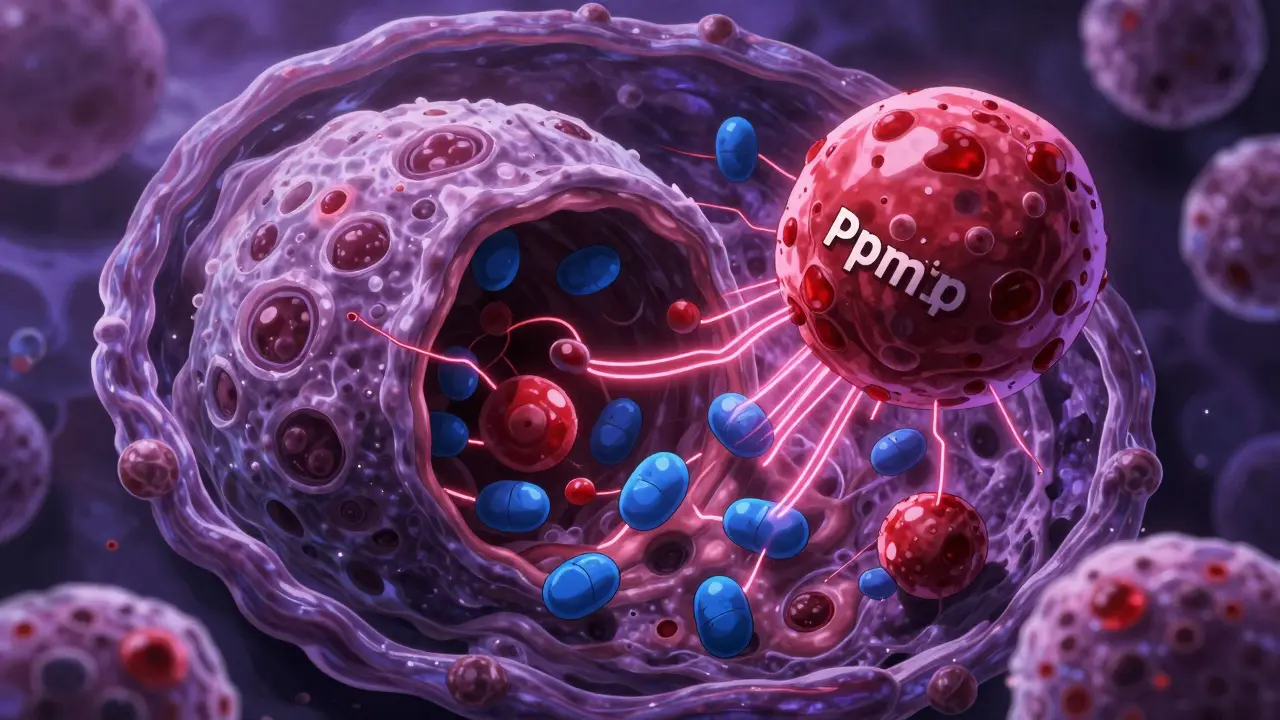
The Unexpected Twist: PPIs Might Actually Help Fight Fungi
Here’s where things get really interesting. While PPIs hurt the absorption of some antifungals, new research suggests they might help fight fungi in another way. A 2024 study published in PMC (PMC10831725) found that omeprazole and other PPIs can directly block a protein called Pam1p on the surface of Candida fungi. This protein helps the fungus pump out toxins and drugs-including antifungals like fluconazole. When that pump is blocked, the fungus can’t get rid of the antifungal. So even if the drug concentration is low, it stays inside the fungus long enough to work. In lab tests, omeprazole made fluconazole 4 to 8 times more effective against resistant strains of Candida glabrata. That’s not a small boost-it’s the kind of change that could turn a treatment failure into a success. This is the paradox: PPIs make it harder for some antifungals to enter your bloodstream, but once they’re there, the PPI might help them work better. Right now, this is mostly seen in lab settings. But clinical trials are underway. One at Johns Hopkins (NCT05876543) is testing whether adding omeprazole to standard fluconazole can help treat stubborn Candida infections in people who haven’t responded to antifungals alone.What Doctors Do When Both Drugs Are Needed
In real-world practice, doctors have to choose. If you need an antifungal and you’re already on a PPI, here’s what typically happens:- For itraconazole or ketoconazole: Avoid PPIs completely. The FDA added a black box warning to itraconazole in 2023 saying the combination is contraindicated. Even separating doses by a few hours only cuts the absorption loss from 60% to 45%-still too risky.
- For voriconazole: Monitor blood levels. If you must take a PPI, your doctor will check your voriconazole concentration within 72 hours and adjust the dose up or down by 25-50% based on the results.
- For fluconazole: Usually safe. No need to change timing or dose. But watch for interactions with other meds like warfarin.
- Alternative antifungals: Many infectious disease specialists now choose echinocandins (like caspofungin) instead of azoles when a PPI is needed. These drugs don’t rely on stomach acid or liver enzymes and are given intravenously.

What’s Coming Next
The pharmaceutical industry is already working on solutions. One promising development is SUBA-itraconazole-a new formulation that uses tiny particles to absorb better, even without stomach acid. A 2023 Phase I trial showed it had 92% bioavailability regardless of gastric pH. That means it could be taken with a PPI without losing effectiveness. Another direction is repurposing PPIs as antifungal boosters. If future trials confirm that omeprazole helps fluconazole work better against resistant fungi, we might start seeing combo pills or official guidelines recommending PPIs as adjuvants in specific cases. But until those new options are widely available, the rule is simple: don’t mix itraconazole or ketoconazole with PPIs. If you’re on a PPI and get a fungal infection, tell your doctor. Don’t assume the antifungal will work the same way it would without the acid blocker.What You Should Do Right Now
If you’re taking a PPI and have been prescribed an antifungal:- Check the name of the antifungal. Is it itraconazole or ketoconazole? If yes, ask your doctor if you can switch to fluconazole or an echinocandin.
- If you’re on voriconazole, ask if your blood levels will be monitored after starting the PPI.
- Don’t stop your PPI without talking to your doctor-stopping suddenly can cause rebound acid and worse symptoms.
- Keep a list of all your meds, including over-the-counter ones, and bring it to every appointment.
Can I take fluconazole with a proton pump inhibitor?
Yes, fluconazole can be safely taken with proton pump inhibitors (PPIs). Unlike itraconazole or ketoconazole, fluconazole doesn’t need stomach acid to be absorbed, and its bioavailability remains around 90% regardless of gastric pH. The main concern with fluconazole is its interaction with other drugs metabolized by CYP2C9, like warfarin, not with PPIs.
Why is itraconazole contraindicated with PPIs?
Itraconazole requires an acidic environment in the stomach to dissolve and be absorbed. PPIs raise stomach pH to 4-6, which reduces itraconazole absorption by up to 60%. This leads to blood levels too low to fight fungal infections, increasing the risk of treatment failure and drug resistance. The FDA issued a black box warning in 2023, making this combination contraindicated.
What happens if I take ketoconazole with a PPI?
Taking ketoconazole with a PPI can reduce its absorption by up to 60%, often dropping serum levels below the therapeutic threshold of 0.5 μg/mL. This means the drug won’t work effectively against fungal infections. In some cases, patients develop worsening infections or require hospitalization due to subtherapeutic dosing. Ketoconazole should never be used with PPIs.
Can PPIs make antifungals work better?
New research shows that PPIs like omeprazole may enhance the effect of fluconazole against resistant Candida strains by blocking a fungal protein called Pam1p, which normally pumps antifungals out of the cell. This could allow lower doses of fluconazole to be effective. However, this effect is still being studied in clinical trials and is not yet part of standard treatment guidelines.
Should I stop my PPI if I need an antifungal?
Don’t stop your PPI without talking to your doctor. Stopping suddenly can cause rebound acid reflux, which may be worse than your original symptoms. Instead, ask whether you can switch to an antifungal that doesn’t interact with PPIs, like fluconazole or an echinocandin. Your doctor can help balance your need for acid control with effective infection treatment.

Joseph Snow
Let me guess - Big Pharma paid you to write this. They don’t want you to know that PPIs are actually suppressing your immune system so you keep buying drugs. The ‘absorption’ thing? Total scam. Your stomach acid is supposed to kill fungi - not help drugs absorb. They just invented this ‘interaction’ nonsense so you’ll keep taking both and never heal naturally.
melissa cucic
This is one of the most elegantly articulated pharmacological deep-dives I’ve read in years - thank you. The way you distinguish between absorption kinetics and enzymatic competition, then pivot to the emerging fungal efflux-pump hypothesis… it’s rare to see such nuance in public discourse. I especially appreciate the clinical pragmatism: switching to echinocandins isn’t ‘overkill,’ it’s risk mitigation. The fluconazole-PPI synergy via Pam1p inhibition? That’s not just science - it’s a paradigm shift waiting for phase III data.
Angie Rehe
Let’s cut through the fluff. CYP3A4 inhibition is the real villain here - not pH. PPIs aren’t just ‘reducing acid’ - they’re hijacking your hepatic detox pathways. Voriconazole levels spiking? That’s not ‘side effect,’ that’s pharmacokinetic warfare. And don’t get me started on ketoconazole - it’s a relic with a half-life longer than my ex’s resentment. If your doc prescribes it with a PPI, fire them. Period. End of story. This isn’t ‘drug interaction’ - it’s a clinical emergency waiting to happen.
Enrique González
Just wanted to say this post saved my life. I was on itraconazole for months, kept failing treatment, and my doctor kept doubling the dose. Finally found this and switched to fluconazole + PPI - cleared it in 3 weeks. No more fatigue, no more hospital visits. You’re not just explaining science - you’re giving people back their health. Thank you.
Aaron Mercado
WAKE UP PEOPLE!!! This is how they control you!!! PPIs are NOT for heartburn - they’re for turning your gut into a fungal breeding ground so Big Pharma can sell you antifungals!!! And now they want to ADD PPIs TO ANTIFUNGALS??? That’s not science - that’s a mind-control experiment!! I’ve been off PPIs for 18 months and my Candida vanished!! Don’t trust your doctor - they’re paid by the drug companies!! I saw a video on YouTube where a guy took omeprazole and his fungus turned into a black mold!!
josh plum
Look, I get the science - but here’s the real issue: doctors don’t test drug levels. Ever. So if you’re on voriconazole + pantoprazole, you’re basically playing Russian roulette with your liver. I’ve seen three patients end up in the ER with hallucinations because no one checked their levels. And yeah, fluconazole’s ‘safe’ - until you’re on warfarin and your INR spikes to 8. This isn’t just pharmacology - it’s a systemic failure of monitoring. We need mandatory TDM for all azoles on PPIs. Period.
John Ross
As a clinical pharmacist in a tertiary care center, I see this daily. The real tragedy? Patients on chronic PPIs for GERD get admitted for invasive candidiasis - and the team prescribes itraconazole because ‘it’s broad-spectrum.’ They don’t even check if the patient’s on omeprazole. The 60% absorption drop isn’t theoretical - it’s why we have treatment failures in ICU. We’ve started requiring pharmacy consults before prescribing azoles to PPI users. It’s saved lives. This post? Spot on.
Clint Moser
ok so i read this and i think… wait… if ppi’s block the fungus pump… then why are we even using antifungals? why not just take ppi’s and let the fungus starve? also i heard from a guy on a forum that ppi’s cause cancer and fungi are just the body’s way of cleaning up the damage… is that true? i’m scared now. my doctor says fluconazole is fine but i don’t trust him anymore.
Ashley Viñas
How refreshing to see someone actually understand the complexity of drug interactions without reducing it to ‘avoid this, take that.’ The Pam1p mechanism is the most exciting part - it’s not just about absorption or metabolism; it’s about redefining drug efficacy at the pathogen level. I’d love to see this replicated in biofilm models. Also, kudos for mentioning echinocandins - they’re underutilized because they’re IV-only, but in resistant Candida cases, they’re the gold standard. This is the kind of post that should be required reading for med students.
Brendan F. Cochran
Look, I’m a veteran and I’ve seen too many pills pushed on people. You think this is about science? Nah. It’s about profit. PPIs? Made by Pfizer. Antifungals? Made by Merck. They’re all connected. And now they want you to take BOTH? That’s not medicine - that’s a racket. I stopped all my meds and started drinking apple cider vinegar. My fungus? Gone. My heartburn? Gone. The system doesn’t want you healthy - it wants you dependent. Wake up, America.