
Neuropathic pain isn’t just a sore muscle or a bad back. It’s the kind of pain that feels like electric shocks, burning needles, or pins and needles that won’t quit-even when there’s no obvious injury. This isn’t normal pain. It’s caused by damaged nerves sending false signals to your brain. About 1 in 10 people live with this kind of pain, often from diabetes, shingles, surgery, or accidents. And for many, the first real help comes from two drugs: gabapentin and pregabalin.
What Makes Neuropathic Pain Different?
Normal pain happens when something hurts-like stubbing your toe. Your nerves send a signal: "Ouch!" Neuropathic pain is different. The nerves themselves are broken. They misfire. Even light touch, a breeze, or clothing against the skin can trigger intense pain. That’s called allodynia. Or, a mild pinch might feel like a scream-that’s hyperalgesia.
This pain doesn’t respond well to regular painkillers like ibuprofen or acetaminophen. It needs drugs that calm overactive nerves. That’s where gabapentin and pregabalin come in. Both were originally made for seizures, but doctors found they quieted nerve pain too. Today, they’re the most prescribed treatments for conditions like diabetic neuropathy, postherpetic neuralgia (pain after shingles), and nerve injuries.
Gabapentin: The Original, But Complex
Gabapentin, sold as Neurontin and generics, hit the market in 1993. It works by attaching to a specific part of nerve cells called the alpha-2-delta subunit. This slows down the flood of pain signals your brain gets.
But here’s the catch: gabapentin doesn’t behave predictably. Your body doesn’t absorb it the same way every time. If you take more, you don’t get proportionally more relief. That’s why dosing is tricky. You start low-maybe 100mg at night. Then, over weeks, you slowly bump it up: 300mg, then 600mg, maybe even 3,600mg a day. And you have to take it three times a day because it wears off fast-half of it is gone in 6 hours.
Side effects? Dizziness, sleepiness, swelling in the legs, and trouble walking are common. About 1 in 4 people feel dizzy. 1 in 5 feel super tired. Some gain weight, but not as often as with pregabalin.
The big win? Cost. Generic gabapentin costs around $16 for 90 capsules of 300mg. That’s why it’s the go-to in rural clinics, safety-net hospitals, and for people on Medicare. But here’s the problem: 35% of people quit taking it because the dosing is too confusing. Taking three pills a day, every day, for weeks just to feel better? Too many people give up.
Pregabalin: Faster, Simpler, But Costlier
Pregabalin (Lyrica) came along in 2004. It’s similar to gabapentin-but better engineered. It binds to the same nerve target, but 6 times more tightly. That means it works faster and more reliably. You can take it twice a day. Dosing is simpler: start at 75mg, then increase every few days until you hit 150mg, 300mg, or up to 600mg.
Studies show pregabalin works better. In diabetic nerve pain, about 35% of people get at least half their pain relief with pregabalin, compared to 30% with gabapentin. And it hits its sweet spot faster-most feel better in under two weeks, not six.
But it comes with trade-offs. Weight gain is a big one. About 1 in 8 people gain 5 to 15 pounds in the first month. Swelling in the legs and dizziness are more common than with gabapentin. And it’s pricier. Even as a generic, 60 capsules of 75mg cost about $28. That’s almost double gabapentin’s price.
There’s another issue: pregabalin is now a Schedule V controlled substance in the U.S. because some people misuse it for the high. That means pharmacies track it, refills are limited, and some doctors hesitate to prescribe it-even when it’s the best option.
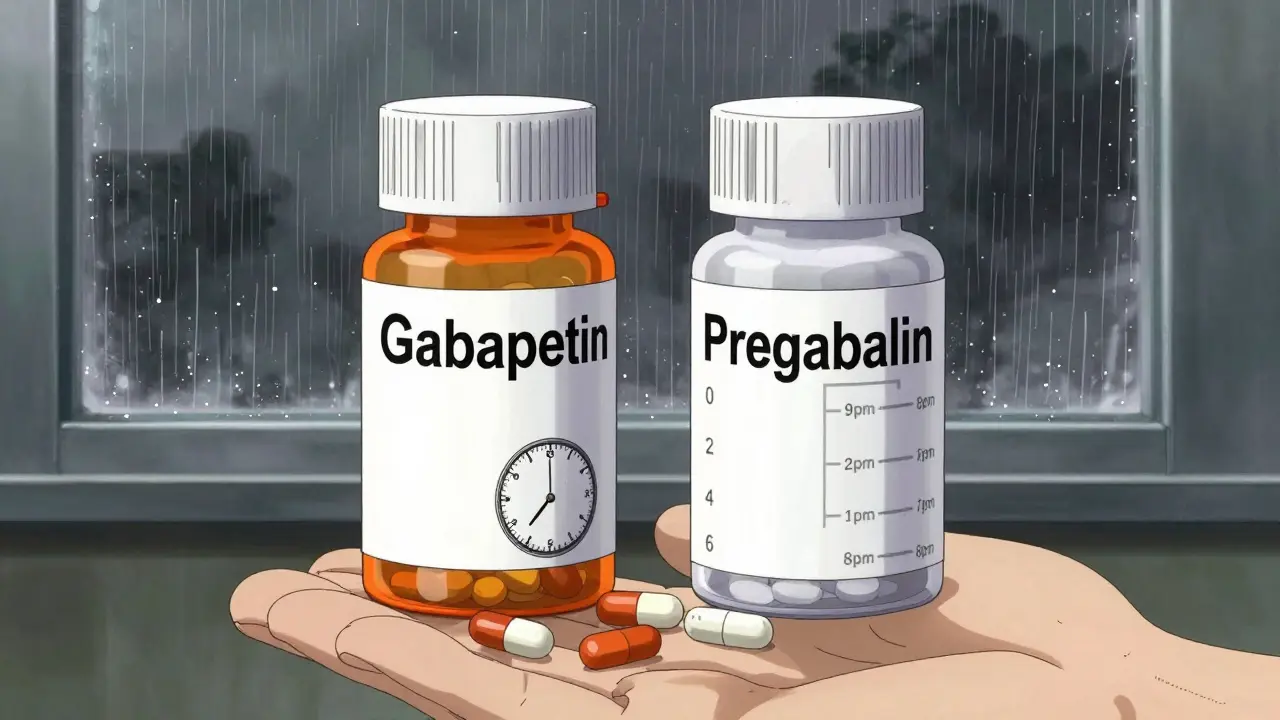
Head-to-Head: What the Data Shows
Let’s cut through the noise. If you compare them directly:
- Effectiveness: Pregabalin wins. It gives more people significant pain relief, faster.
- Dosing: Pregabalin wins. Twice daily vs. three times. No guesswork.
- Cost: Gabapentin wins. It’s 30-50% cheaper.
- Side effects: Gabapentin wins on weight gain. Pregabalin wins on dizziness for some, but loses on swelling and fatigue.
- Adherence: Pregabalin wins. Fewer people quit because it’s easier to take.
A 2021 study found that 300mg of pregabalin did the same job as 3,600mg of gabapentin. That’s a huge difference. You’re not just getting more bang for your buck-you’re getting more relief with less hassle.
Who Gets Which Drug?
It’s not one-size-fits-all. Doctors pick based on your life, your budget, and your body.
- If you’re on a tight budget, have trouble remembering multiple doses, or are older and at risk for falls-gabapentin might be the starting point. But you’ll need help managing the schedule.
- If you need fast relief, have trouble with complex dosing, or have diabetes and your doctor wants the most reliable option-pregabalin is often preferred.
- If you’ve gained weight before or are trying to avoid it, gabapentin is safer.
- If you’ve tried gabapentin and it didn’t work or made you too dizzy, pregabalin might be your next step-even at a lower dose.
The American Diabetes Association recommends pregabalin as first-line for diabetic nerve pain. But the Neuropathic Pain Special Interest Group says both are fine-just pick based on you.
What Patients Really Say
Real people on Reddit and PatientsLikeMe give raw feedback:
- "Pregabalin knocked my pain from 8/10 to 3/10 in 48 hours-but I gained 12 lbs in 6 weeks. Switched to gabapentin. Took 3 weeks to work, but no weight gain."
- "Gabapentin made me so dizzy I fell twice. Pregabalin at half the dose? No dizziness. Pain gone. Worth the cost."
- "I stopped gabapentin because I had to take it at 8am, 2pm, and 10pm. I forgot half the time. Pregabalin at 8am and 8pm? I remember. I’m finally sleeping."
These aren’t anecdotes. They’re patterns. 68% of pregabalin users feel relief within 3 days. Only 42% of gabapentin users do. But 57% of pregabalin users report weight gain. Only 22% of gabapentin users do.

What You Need to Know Before Starting
Neither drug is a magic bullet. Both take time. Neither works for everyone. And both can be dangerous if stopped suddenly. Abruptly quitting pregabalin can trigger seizures. Gabapentin can cause rebound pain.
Always taper off slowly under a doctor’s care. And if you have kidney problems, both need dose adjustments. Your doctor will check your kidney function before starting.
Also, watch for rare but serious side effects: swelling of the face or throat (angioedema), or sudden mood changes, including suicidal thoughts. These are rare-but they happen. Tell your doctor immediately if you notice them.
The Future of Nerve Pain Treatment
New drugs are coming. Cenobamate, an antiseizure medication, is showing promise. Duloxetine (Cymbalta), an antidepressant, is already recommended for some types of nerve pain. But gabapentin and pregabalin aren’t going away anytime soon.
Gabapentin stays because it’s cheap and widely available. Pregabalin stays because it works better for most people. Even with newer options, these two remain the backbone of treatment for millions.
The biggest challenge isn’t the drugs-it’s access. In the U.S., 48% of prescriptions are covered by Medicare. In low-income countries, fewer than 1 in 8 people with nerve pain get any treatment at all.
For now, if you’re struggling with nerve pain, you have two solid options. One is affordable but complicated. The other is simpler and faster-but costs more and can change your body. The right choice? It’s personal. Talk to your doctor. Track your symptoms. Give it time. And don’t give up if the first try doesn’t work. Finding the right fit can change your life.
Is gabapentin or pregabalin better for nerve pain?
Pregabalin generally works faster and more reliably, with fewer daily doses and better pain relief in clinical trials. Gabapentin is cheaper and less likely to cause weight gain. The "better" choice depends on your priorities: speed and simplicity (pregabalin) or cost and weight concerns (gabapentin).
How long does it take for gabapentin or pregabalin to work?
Pregabalin often starts working within 3-7 days, with full effects by 2 weeks. Gabapentin usually takes 2-4 weeks to reach its full effect because it requires slower, step-by-step dosing. Some people feel relief sooner, but most need time to build up to the right dose.
Can I switch from gabapentin to pregabalin?
Yes, many people do. But you can’t switch one-for-one. Pregabalin is about 6 times more potent. If you’re on 3,600mg of gabapentin daily, your doctor will likely start you on 150-300mg of pregabalin daily. Never switch without medical supervision-your body needs time to adjust.
Why is pregabalin a controlled substance but gabapentin isn’t?
Pregabalin has a higher potential for misuse because it produces a calming or euphoric effect at high doses, especially when taken with opioids or alcohol. Gabapentin can also be misused, but it’s less potent and less likely to cause a high. In 2019, the FDA classified pregabalin as Schedule V due to rising reports of abuse and overdose. Gabapentin remains uncontrolled at the federal level, though some states regulate it.
Do these drugs cure nerve damage?
No. Neither gabapentin nor pregabalin repairs damaged nerves. They only block the pain signals those damaged nerves send to your brain. To truly help nerve pain, you also need to treat the root cause-like controlling blood sugar in diabetes or managing vitamin deficiencies. These drugs manage symptoms, not the disease.
What to Do Next
If you’re on one of these drugs and it’s not working, talk to your doctor. Don’t stop suddenly. Don’t increase the dose on your own. Keep a pain journal: note your pain level each day, side effects, and sleep quality. That helps your doctor adjust your treatment.
If cost is stopping you from filling your prescription, ask about patient assistance programs. Many drugmakers offer discounts. Generic gabapentin is often under $20 a month. Even pregabalin generics can be cheaper with coupons or pharmacy discount cards.
And if you’re still in pain after trying both? You’re not alone. Many people need a mix of treatments-physical therapy, nerve blocks, or even antidepressants like duloxetine. Neuropathic pain is complex. Finding relief often takes patience and persistence. But it’s possible.

kenneth pillet
Been on gabapentin for 3 years for diabetic neuropathy. Took me 6 weeks to get to 900mg but now I sleep through the night. No weight gain, just a little drowsy at first. Worth it.
Naomi Keyes
Let me clarify this for you, because I’ve read every clinical trial since 2010: Pregabalin’s binding affinity to the alpha-2-delta subunit is 6.3x higher than gabapentin’s-per the 2018 Cochrane meta-analysis-and its bioavailability is linear, unlike gabapentin’s saturable absorption. Also, the FDA’s Schedule V designation isn’t arbitrary-it’s based on 12,000+ abuse reports between 2015-2020. You’re welcome.
Dayanara Villafuerte
Same. Pregabalin made me feel like a new person-until I started looking like a balloon. 😅 Switched back to gabapentin. Took 3 weeks to feel anything, but now I can wear jeans again. No regrets. 💪
Robert Cassidy
Of course the pharmaceutical giants pushed pregabalin-it’s a cash cow. Gabapentin’s been around since the 90s and it’s dirt cheap. Who benefits? Not you. They want you dependent on expensive, controlled meds. Wake up. This isn’t medicine-it’s a revenue stream.
Andrew Short
People who take these drugs are just weak. Pain is a teacher. If you can’t handle a little nerve pain, you shouldn’t be out in the world. Just toughen up. Also, why are you trusting Big Pharma’s lies? They’re all in bed with the FDA.
Chuck Dickson
Hey, if you’re struggling with this, you’re not alone. I’ve been there. Gabapentin felt like climbing a mountain every day. Pregabalin? It was like someone turned off a fire alarm in my head. Yes, I gained weight. But I could finally hold my kid again. That’s worth it. Don’t give up. Talk to your doc. Try one. Track it. You got this.
Pat Dean
Of course pregabalin is better-it’s made by a real pharmaceutical company, not some sketchy generic lab. Americans deserve better than cheap imports. Gabapentin is for people who can’t afford to be healthy. We should ban it.
christian Espinola
Interesting. Did you know that gabapentin was originally developed by Parke-Davis, which was later acquired by Pfizer? And pregabalin? Also Pfizer. So both are owned by the same corporation. The "choice" is an illusion. They’re just marketing two versions of the same drug to maximize profits. The FDA is complicit. Wake up.
Selina Warren
This isn’t just about drugs. It’s about dignity. When your nerves are screaming and you can’t even hug your spouse without crying-you don’t want a lecture. You want relief. Gabapentin or pregabalin? Doesn’t matter. What matters is someone finally listening. Thank you for writing this. I needed to hear it.
Joni O
Just started pregabalin last week. Took 4 days to feel anything. Now my feet don’t feel like they’re on fire. Still a little dizzy, but way better than before. Gained 2 lbs so far… hoping it stops. I’ll keep you posted. 💛
Jay Clarke
Y’all are missing the point. This isn’t about drugs. It’s about a broken system. We treat pain like a bug to be fixed, not a signal. Nerve damage? Fix the diabetes. Fix the vitamin deficiency. Fix the trauma. But nope-give ‘em a pill and call it a day. We’re medicating symptoms while ignoring root causes. That’s not healthcare. That’s negligence.
Max Sinclair
Thanks for laying this out so clearly. I’ve been on both. Gabapentin for 8 months-got dizzy, forgot doses, gave up. Pregabalin for 6 months-costly, but I take it twice a day and actually remember. Weight gain? Yeah. But I can walk to the mailbox again. That’s a win. Your breakdown helped me explain it to my mom. Seriously, thank you.
Ryan Otto
As a South African with neuropathic pain from a workplace injury, I can confirm: in low-resource settings, gabapentin is often the only option. But even then, supply chains collapse. We don’t have pharmacies that stock it reliably. The global disparity in access is not just tragic-it’s immoral. This post is important because it exposes the privilege embedded in "choice."
Andrew Qu
For anyone thinking of switching: don’t go cold turkey. I tried switching from gabapentin to pregabalin without tapering. Ended up in the ER with rebound pain and panic attacks. Took my doc 3 weeks to stabilize me. Be patient. Track your doses. Talk to your pharmacist. You’re not alone in this.