
Vitamin E & Warfarin Risk Calculator
Enter your current daily Vitamin E intake (from supplements and multivitamins) and your latest INR reading to estimate your relative risk level.
Enter values to see your personalized risk assessment.
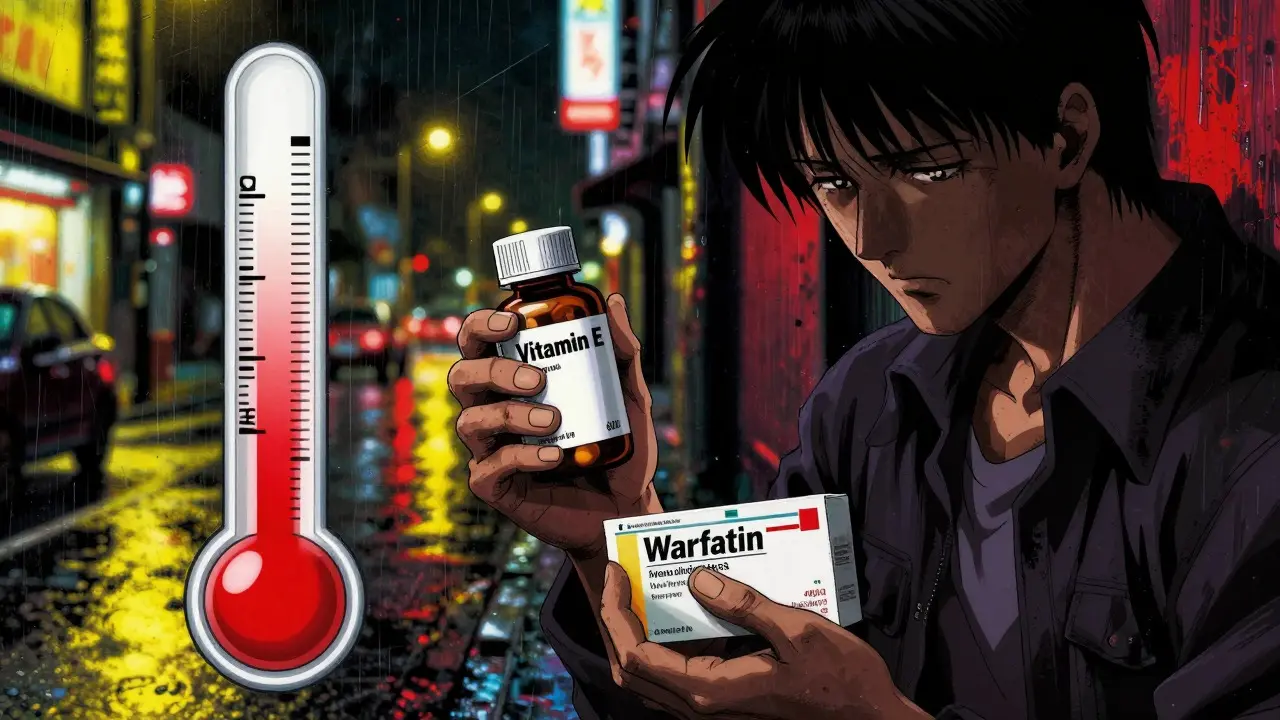
Imagine you are taking Warfarin, a common blood thinner prescribed to prevent dangerous clots. You feel healthy, so you decide to boost your antioxidant intake by adding a high-dose Vitamin E supplement. It seems like a harmless, even smart, health move. But for millions of patients on anticoagulant therapy, this combination can turn into a medical emergency. The interaction between Vitamin E and Warfarin is not just a theoretical concern; it is a complex pharmacological relationship that has confused doctors, researchers, and patients for decades.
The core issue? Vitamin E may enhance the anticoagulant effects of Warfarin, leading to an increased risk of bleeding. While some studies suggest low doses are safe, others warn of severe hemorrhagic events. If you are managing your own health or caring for someone on blood thinners, understanding these nuances is critical. This guide breaks down what the science says, why experts disagree, and how to stay safe without sacrificing your wellness goals.
Why Does Vitamin E Interact with Warfarin?
To understand the risk, we first need to look at how these two substances work in the body. Warfarin (often known by the brand name Coumadin) is a vitamin K antagonist. It works by blocking the production of clotting factors in the liver, which requires vitamin K to function properly. When you take Warfarin, your blood takes longer to clot, preventing strokes and deep vein thrombosis (DVT).
Vitamin E, specifically alpha-tocopherol, is a fat-soluble antioxidant. Many people take it for heart health or skin benefits. However, Vitamin E has antiplatelet activity. In simple terms, it stops platelets from sticking together to form clots. When you combine an agent that slows clotting factor production (Warfarin) with one that inhibits platelet aggregation (Vitamin E), you get a double hit on your body’s ability to stop bleeding.
This synergy is where the danger lies. The interaction isn't always immediate. Research indicates it can be dosage-dependent and time-dependent. A patient might take both supplements for weeks before seeing any change in their International Normalized Ratio (INR), the standard measure of how long it takes blood to clot. Then, suddenly, the INR spikes, indicating the blood is too thin.
The Great Debate: Safe or Dangerous?
If you search online, you will find conflicting advice. This confusion stems from contradictory research findings over the last 30 years. Let's look at the two sides of this scientific argument.
The Case for Safety: A landmark 1996 study published in the American Journal of Cardiology by researchers J.M. Kim and R.H. White from UC Davis found no significant changes in INR among 21 subjects taking chronic Warfarin who were randomized to receive Vitamin E or placebo. Based on this short-term trial, they concluded that Vitamin E could be safely given to patients on Warfarin. This finding gave many clinicians permission to allow moderate supplementation.
The Case for Risk: More recent and larger-scale data tells a different story. A 2013 retrospective observational study published in the Journal of the American Heart Association analyzed 1,011 patients with non-valvular atrial fibrillation (NVAF). This study provided the first strong evidence that higher serum levels of Vitamin E were associated with bleeding events. Specifically, patients with Vitamin E levels ≥4.49 μmol/mmol cholesterol had an increased risk of any bleeding, while those with levels ≥5.56 μmol/mmol faced the highest risk of major bleeding, including cerebral hemorrhages. Crucially, this risk was independent of other known factors like age or hypertension.
So, who is right? The answer likely lies in the methodology. The 1996 study was short-term and small. The 2013 study looked at real-world outcomes over a longer period. It suggests that while short-term use might not spike INR immediately, cumulative exposure to high Vitamin E levels creates a sustained bleeding risk that standard INR checks might miss if not monitored closely.
Dosage Matters: The 400 IU Threshold
Not all Vitamin E is created equal when it comes to risk. The dose makes the poison. Clinical guidelines generally agree on a threshold for caution.
| Daily Dose | Risk Level | Clinical Recommendation |
|---|---|---|
| < 400 IU | Low to Moderate | Monitor INR regularly; generally considered safer but still requires vigilance. |
| 400 - 800 IU | Moderate to High | Caution advised. Increased frequency of INR testing recommended. |
| > 800 IU | High | Avoid if possible. Significant risk of additive anticoagulant effects and bleeding. |
The University of California San Diego Anticoagulation Guidelines categorically list Vitamin E under "Increased Risk of Bleeding due to Antiplatelet Effect." They place it in the same category as other herbal supplements known to interact with blood thinners, such as Ginkgo Biloba, Garlic, and Fish Oil.
A survey of 250 anticoagulation clinics published in the Journal of Thrombosis and Thrombolysis (2017) revealed that 78% of clinics routinely warn patients about Vitamin E. Of those, 63% specifically advise against doses exceeding 400 IU daily. This consensus among practitioners highlights the practical reality: even if some studies show safety, the potential cost of a bleed is too high to ignore.
Hidden Sources of Vitamin E
Many patients think they are avoiding Vitamin E because they aren't taking a pill. But Vitamin E is ubiquitous in multivitamins and fortified foods. If you are on Warfarin, you need to read labels carefully.
- Multivitamins: Most standard adult multivitamins contain 100-300 IU of Vitamin E. Taking one daily plus a separate supplement can quickly push you over the safe threshold.
- Fortified Foods: Some cereals, plant milks, and snack bars are fortified with alpha-tocopherol.
- Natural Sources: While food sources like almonds, sunflower seeds, and spinach contain Vitamin E, they rarely cause interactions unless consumed in massive quantities. The risk primarily comes from concentrated supplements.
The key is consistency. Warfarin requires stable vitamin K intake, but it also requires stable Vitamin E intake. Sudden changes-like starting a new multivitamin regimen-can disrupt your INR stability.
Monitoring and Management Strategies
If you must take Vitamin E while on Warfarin, strict monitoring is non-negotiable. Here is what effective management looks like according to clinical best practices:
- Baseline Measurement: Check your INR before starting any new supplement. Establish a normal baseline.
- Frequent Early Testing: For the first four weeks of concurrent use, test your INR weekly. This catches early signs of potentiation.
- Ongoing Surveillance: If stable, continue biweekly monitoring. Do not revert to monthly checks until you have several months of stable results.
- Symptom Awareness: Watch for signs of bleeding: unusual bruising, nosebleeds, bleeding gums, red or brown urine, or black tarry stools.
The American College of Chest Physicians classified the evidence regarding this interaction as Grade 2C, recommending against high-dose Vitamin E in patients taking Warfarin. This means the recommendation is based on moderate-quality evidence, but the balance of risk favors avoidance.

Genetic Factors and Individual Susceptibility
Why do some patients bleed heavily while others see no change? Genetics play a surprising role. Variations in genes like CYP2C9 and VKORC1 affect how your body metabolizes Warfarin. Patients with certain polymorphisms in these genes are more sensitive to Warfarin and may be disproportionately affected by additional anticoagulants like Vitamin E.
Future research is focusing on personalized medicine approaches. The European Society of Cardiology’s 2023 update to atrial fibrillation guidelines now recommends considering serum Vitamin E levels in patients with unexplained bleeding events. This shift acknowledges that Vitamin E is not just a passive bystander but an active variable in anticoagulation therapy.
Alternatives to Consider
If you want the antioxidant benefits of Vitamin E without the bleeding risk, talk to your doctor about alternatives. Vitamin C and Beta-Carotene offer antioxidant support with minimal impact on coagulation pathways. Additionally, focusing on a diet rich in whole fruits and vegetables provides natural antioxidants without the concentrated doses found in supplements.
In some cases, switching from Warfarin to a Direct Oral Anticoagulant (DOAC) like Apixaban or Rivaroxaban may reduce dietary restrictions. DOACs have fewer drug-drug and drug-food interactions than Warfarin, though they are not entirely free of them. Always consult your cardiologist or hematologist before making any changes.
Can I take a multivitamin with Warfarin?
Yes, but you must check the label for Vitamin E content. Many multivitamins contain 100-300 IU. Ensure your total daily Vitamin E intake from all sources stays below 400 IU, and inform your healthcare provider so they can monitor your INR accordingly.
How long does it take for Vitamin E to affect my INR?
The effect can be delayed. Some studies show no immediate change, but risks can become apparent after 4-6 weeks of consistent use. This is why regular INR monitoring is crucial even if you feel fine.
Is food-based Vitamin E safe with Warfarin?
Generally, yes. Getting Vitamin E from foods like nuts, seeds, and leafy greens is unlikely to cause significant interactions unless consumed in extremely large amounts. The primary risk comes from high-dose supplements.
What are the signs of excessive bleeding?
Watch for easy bruising, prolonged bleeding from cuts, nosebleeds, bleeding gums, red or brown urine, black tarry stools, or unusually heavy menstrual periods. Seek immediate medical attention if you experience these symptoms.
Should I stop taking Vitamin E if I am on Warfarin?
It depends on your individual risk profile. The American College of Chest Physicians recommends against high-dose (>400 IU) Vitamin E. Discuss with your doctor whether the benefits outweigh the risks for your specific case. Do not stop abruptly without consulting your provider, as sudden changes can also affect your health.
