
Every morning, you wash your face, apply moisturizer, maybe even a serum. But if you skip sunscreen, you’re leaving your skin exposed to damage that builds up silently-day after day, year after year. It’s not just about avoiding sunburn. The real danger is invisible. UV radiation doesn’t wait for beach days. It hits your skin even when it’s cloudy, even when you’re sitting by a window. And the numbers don’t lie: 90% of visible skin aging comes from sun exposure, and one in five Americans will develop skin cancer in their lifetime.
What SPF Actually Means (And What It Doesn’t)
SPF stands for Sun Protection Factor. It’s a measure of how well a sunscreen protects your skin from UVB rays-the ones that cause sunburn. But here’s the thing: SPF isn’t linear. SPF 15 blocks about 93% of UVB rays. SPF 30 blocks 97%. SPF 50 blocks 98%. That’s it. Going from SPF 30 to SPF 100 doesn’t double your protection-it adds less than 1% more.
Why does this matter? Because most people apply way too little. Dermatologists recommend a quarter teaspoon for your face alone. But studies show 90% of people use only a quarter to half of that amount. That means if you’re using SPF 30 but applying half the right amount, you’re getting the protection of SPF 7.5 to SPF 15. That’s barely better than nothing.
That’s why experts like the American Academy of Dermatology and the Skin Cancer Foundation now recommend SPF 30+ as the minimum for daily use. Higher SPFs aren’t magic-they’re insurance. They help make up for the fact that most of us don’t apply enough.
UVA vs. UVB: The Hidden vs. The Obvious
Not all UV rays are the same. UVB rays are the burners. They’re shorter wavelengths, mostly absorbed by the top layer of your skin (the epidermis). That’s why they cause redness, peeling, and direct DNA damage that can lead to skin cancer.
But UVA rays? They’re the silent destroyers. Longer wavelengths, deeper penetration. They reach the dermis-the layer where collagen and elastin live. That’s why they’re the main cause of wrinkles, sagging, and dark spots. UVA rays don’t care if it’s winter, cloudy, or you’re indoors. They pass through glass. They’re present all day, every day, no matter the season.
Here’s the scary part: UVA makes up 95% of the UV radiation that reaches Earth. UVB? Only 5-10%. Yet most people still think sunscreen is just about avoiding sunburn. That’s why “broad spectrum” isn’t just a marketing term-it’s the only thing that matters. A sunscreen labeled “broad spectrum” means it protects against both UVA and UVB. The FDA requires it to meet a minimum standard: the UVA protection must be at least one-third of the labeled SPF. For example, an SPF 30 broad-spectrum sunscreen must offer at least SPF 10 UVA protection.
Mineral vs. Chemical: What’s Really in Your Sunscreen
There are two main types of sunscreen: mineral and chemical. They work in completely different ways.
Mineral sunscreens-also called physical sunscreens-use zinc oxide and/or titanium dioxide. These ingredients sit on top of your skin and reflect UV rays like tiny mirrors. They start working immediately. They’re less likely to irritate sensitive skin or trigger breakouts. That’s why so many people with acne or rosacea swear by them.
But there’s a downside: they can leave a white cast, especially on darker skin tones. That’s changed in recent years. Newer formulas use micronized or tinted particles that blend better. Brands like Suntribe and CeraVe have made big strides here.
Chemical sunscreens use ingredients like avobenzone, octinoxate, octocrylene, and oxybenzone. These absorb UV rays like a sponge, converting them into harmless heat. They’re usually thinner, easier to spread, and don’t leave a white cast. But they need about 15 minutes to activate after application. And some people report stinging, redness, or breakouts-especially with oxybenzone, which is also linked to coral reef damage.
Here’s what users say: On Reddit’s r/SkincareAddiction, 78% of 1,245 respondents reported fewer breakouts after switching from chemical to mineral sunscreens. But 63% said the white cast was still a dealbreaker. On Amazon, top-rated sunscreens like La Roche-Posay Anthelios SPF 50 have over 8,700 reviews, with many praising the “no white cast” versions. The trade-off is real: protection vs. wearability.
Daily Use Isn’t Optional-Here’s Why
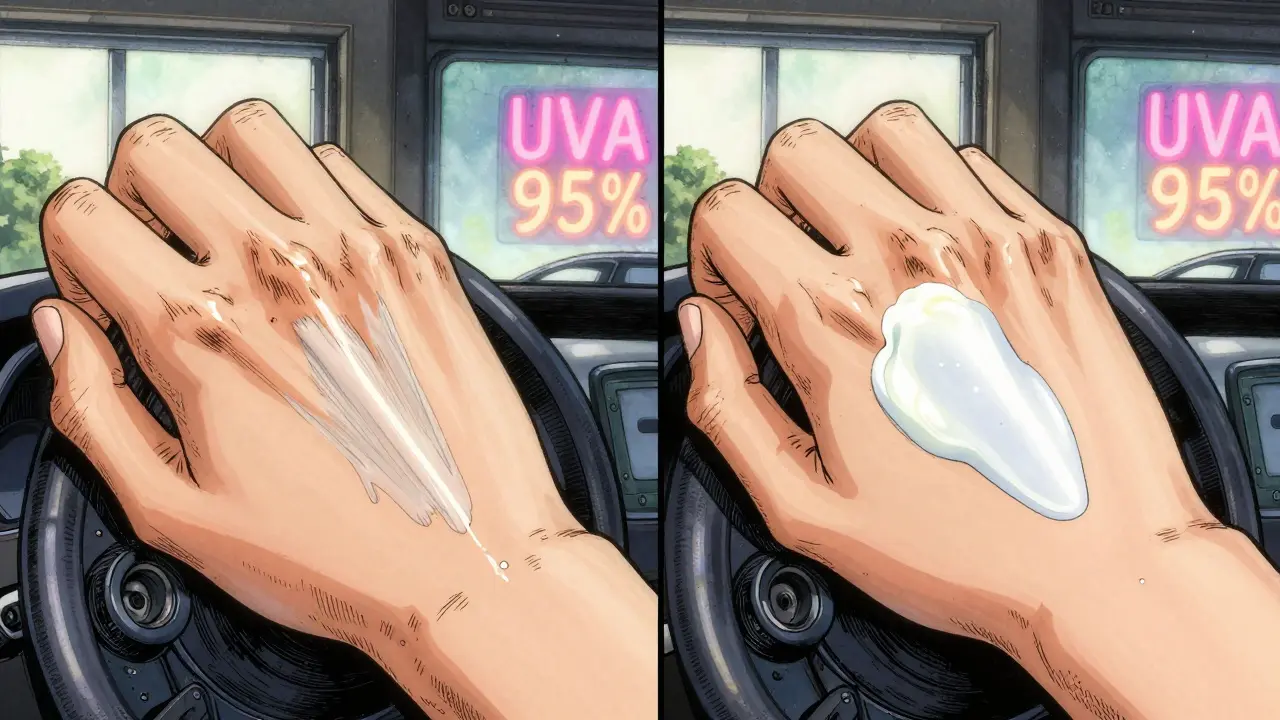
You don’t need to be outside to get damaged. UVA rays penetrate windows. If you sit near a window at work, drive your car, or even stand by the kitchen sink, you’re exposed. Dr. Leslie Baumann, a board-certified dermatologist, says: “UVA rays are equally intense during all daylight hours throughout the year.”
That’s why dermatologists now treat sunscreen like brushing your teeth. It’s not a summer thing. It’s a daily habit. Skipping it for a few days won’t cause immediate damage-but over time, it adds up. Every exposure chips away at your skin’s structure. That’s why the Skin Cancer Foundation updated its recommendations in 2023: daily sunscreen should be SPF 30+, not SPF 15. For outdoor activities, they now recommend SPF 50+.
And it’s not just about cancer. Photoaging-wrinkles, brown spots, uneven texture-is preventable. Studies show people who use sunscreen daily have 24% less skin aging after four years than those who don’t.
How to Apply Sunscreen Right (And Why Most People Get It Wrong)
Applying sunscreen isn’t just slathering it on. It’s science.
- Use 1/4 teaspoon for your face and neck.
- Apply it after moisturizer but before makeup.
- Wait 15 minutes before going outside or putting on foundation.
- Reapply every two hours-or immediately after swimming, sweating, or towel-drying.
Most people miss spots: ears, back of the neck, eyelids, lips. Use a lip balm with SPF 30+. For hard-to-reach areas like the scalp, try a spray or powder sunscreen with zinc oxide.
And don’t fall for “water-resistant” claims. That label means the sunscreen stays effective for 40 or 80 minutes in water-not all day. You still need to reapply.
Another common mistake: mixing sunscreen with moisturizer. That dilutes the SPF. If you want a moisturizer with SPF, make sure it’s labeled SPF 30+ and you’re using the full amount.
What’s Changing in 2025 and Beyond
The FDA is cracking down. By December 2025, any sunscreen sold in the U.S. that doesn’t clearly label “broad spectrum” will be pulled from shelves. That’s a big deal-it means brands can’t hide weak UVA protection behind high SPF numbers anymore.
Also, the FDA is considering capping SPF labels at “SPF 60+.” Why? Because above SPF 50, the added protection is so minimal that it misleads consumers into thinking they’re getting way more safety than they are. It’s not about limiting protection-it’s about preventing false confidence.
And the future? It’s not just UV anymore. Dermatologists are starting to look at blue light from screens and infrared radiation from the sun. Early research suggests these may also contribute to skin aging. Some new sunscreens already include antioxidants like vitamin C and ferulic acid to help neutralize free radicals from all sources.
Reef-safe formulas are also growing fast. Ingredients like oxybenzone and octinoxate are banned in Hawaii and parts of the Caribbean because they harm coral reefs. Many brands now label their products “reef-safe,” meaning they avoid those two chemicals. If you swim in oceans, this matters.

What to Look for on the Label
Here’s your quick checklist when buying sunscreen:
- Broad spectrum - non-negotiable.
- SPF 30 or higher - for daily use. SPF 50+ for extended outdoor time.
- Water resistant (40 or 80 minutes) - if you sweat or swim.
- Mineral (zinc oxide/titanium dioxide) - if you have sensitive or acne-prone skin.
- Non-comedogenic - means it won’t clog pores.
- Tinted - helps blend on deeper skin tones.
- Reef-safe - if you care about oceans.
Don’t be fooled by “natural,” “organic,” or “chemical-free” labels. Those are marketing terms, not regulated standards. Only “broad spectrum” and “SPF” have legal definitions.
Top Picks Based on Real User Experience
Based on thousands of reviews and dermatologist recommendations:
- Best overall: La Roche-Posay Anthelios SPF 50 - lightweight, no white cast, high UVA protection.
- Best for sensitive skin: CeraVe Hydrating Mineral Sunscreen SPF 30 - zinc oxide, fragrance-free, non-irritating.
- Best for dark skin: Black Girl Sunscreen SPF 30 - tinted, moisturizing, no white cast.
- Best for daily wear under makeup: Supergoop! Unseen Sunscreen SPF 40 - invisible, gel-like, works as a primer.
These aren’t endorsements-they’re based on consistent user feedback and clinical testing.
Final Takeaway: Sunscreen Isn’t Optional-It’s Your Skin’s Best Defense
You don’t need the most expensive sunscreen. You don’t need SPF 100. You just need to use a broad-spectrum SPF 30+ every single day, apply enough, and reapply when needed. That’s it.
It’s not about looking perfect. It’s about staying healthy. Every day you skip sunscreen, you’re adding to the damage. Every day you use it, you’re giving your skin a chance to heal, protect, and age well.
Make it part of your routine. Like brushing your teeth. Like drinking water. It’s not a luxury. It’s basic care for your largest organ.
Is SPF 30 enough for daily use?
Yes, SPF 30 is the minimum recommended for daily use by the American Academy of Dermatology and the Skin Cancer Foundation. It blocks 97% of UVB rays when applied correctly. Higher SPFs offer only marginally more protection, but they help make up for most people applying too little.
Do I need sunscreen on cloudy days or indoors?
Yes. Up to 80% of UV rays penetrate clouds, and UVA rays pass through windows. You’re exposed to aging and cancer-causing radiation even when you’re not in direct sunlight. Daily sunscreen is a habit, not a weather-dependent choice.
What’s the difference between mineral and chemical sunscreen?
Mineral sunscreens (zinc oxide, titanium dioxide) sit on top of the skin and reflect UV rays. They work immediately and are gentler for sensitive skin but can leave a white cast. Chemical sunscreens absorb UV rays and convert them to heat. They’re more cosmetically elegant but may irritate some skin types and need 15 minutes to activate.
Why does my sunscreen pill under makeup?
Pilling happens when sunscreen doesn’t absorb properly or is layered with incompatible products. Apply sunscreen as the last step in your skincare routine, wait 15 minutes for it to fully absorb, then apply makeup. Avoid mixing it with thick creams or silicone-based primers right on top.
Are expensive sunscreens better than drugstore ones?
Not necessarily. Many drugstore brands like CeraVe, Neutrogena, and La Roche-Posay offer excellent broad-spectrum protection at lower prices. What matters is the ingredients (zinc oxide, avobenzone), SPF level, and whether it’s labeled broad spectrum. Price doesn’t guarantee better protection.
Can sunscreen cause breakouts?
Yes, especially chemical sunscreens with ingredients like oxybenzone or octinoxate, which can clog pores or irritate acne-prone skin. Mineral sunscreens are often better for acne-prone skin. Look for labels like “non-comedogenic” and “oil-free.” If you break out, switch brands-there are plenty of options that won’t trigger acne.

Samyak Shertok
SPF 30 is enough? Lol. You’re telling me I should trust my face to a chemical sludge that’s literally just a glorified lotion with a number slapped on it? I’ve seen people apply sunscreen like they’re painting a fence with a toothbrush. And then they wonder why they look like a raccoon after two hours in the sun. The real scam? Companies selling SPF 100 as ‘maximum protection’ while knowing full well you’re using a quarter of the amount. It’s not science-it’s marketing theater.
Stephen Tulloch
Bro SPF 30 is for peasants. If you’re not using SPF 70+ with iron oxide and blue light blockers, you’re basically letting your skin get gangbanged by UV rays and your laptop. 🤡 I use La Roche-Posay Anthelios like it’s my job. Tinted. Non-comedogenic. No white cast. And I reapply every 90 minutes like a monk chanting mantras. If your sunscreen pills under makeup, you’re doing skincare wrong. Also, oxybenzone is a coral killer. Don’t be that guy who poops in the ocean and then complains about his wrinkles.
vivek kumar
There is a fundamental misunderstanding in the article regarding the efficacy of SPF values. While it is true that SPF 30 blocks 97% of UVB radiation and SPF 50 blocks 98%, the statistical margin of error in real-world application is often greater than this difference. Furthermore, the claim that ‘higher SPFs help make up for inadequate application’ is misleading; it implies a linear compensation, which does not exist in photobiology. The real issue is behavioral compliance, not SPF number inflation. The FDA’s proposed cap at SPF 60+ is scientifically sound and should be implemented immediately to prevent consumer deception.
Henry Ip
Love this breakdown. Honestly, I used to skip sunscreen until I got a weird spot on my cheek that turned into a biopsy. Now I slap on CeraVe every morning like brushing my teeth. No drama. No white cast. Just clean skin. And yeah, I know people say ‘I’m indoors all day’-but your window? Your car? That’s UVA city. I even have a little spray bottle of sunscreen in my car now. Small habits, big results. You don’t need to be perfect. Just show up.
Isabella Reid
As someone who’s lived in three countries and has dark skin, I’ve tried everything. The ‘white cast’ thing is real. I used to think mineral sunscreen was for white people. Then I found Black Girl Sunscreen and my whole life changed. No more ashy face. No more ‘is that sunscreen or did I forget to wash my face?’ It’s not about being trendy-it’s about being seen. Also, sunscreen doesn’t have to be expensive. I buy Neutrogena on sale and it works fine. Just don’t skip it. Ever.
kanchan tiwari
They’re lying to you. All of it. SPF doesn’t protect you from the real threat-the government’s secret UV lasers hidden in streetlights and cell towers. That’s why your skin ages even when you’re indoors. And the ‘broad spectrum’ label? That’s just what the FDA lets them say after they pay off the chemists. Oxybenzone? It’s not just killing coral-it’s turning your hormones into a rave party. And don’t get me started on tinted sunscreens… they’re tracking your melanin levels. I only use homemade coconut oil and moonwater. It’s the only way.
Bobbi-Marie Nova
Okay but like… why is everyone acting like sunscreen is a chore? It’s literally the only skincare thing that actually works. I used to hate it until I got a tinted one that doubles as a primer. Now I feel like a glowing angel. Also, if your sunscreen pilled? You’re using too much moisturizer. Dab, don’t rub. And yes, I reapply before lunch. I’m not a monster. I’m just… prepared.
Allen Davidson
One of the best summaries I’ve read on this. Seriously. I used to think sunscreen was for beach days. Then I got sun damage at my desk. Now I keep a tube next to my coffee mug. And I tell everyone I know. Not because I’m obsessed-I’m just tired of seeing people with 40-year-old skin at 25. You don’t need to be perfect. Just be consistent. One day at a time. Your future self will thank you.