Why School Medication Safety Starts with You
Every day, thousands of children take medications at school-asthma inhalers, ADHD pills, insulin shots, allergy tablets. It’s not rare. In fact, nearly half of all school-aged kids rely on some kind of medicine during the school day. But here’s the truth: school medications are only as safe as the paperwork, communication, and follow-through from parents. A missed dose. A wrong pill. A forgotten inhaler. These aren’t just mistakes-they can land a child in the ER.
It’s not the school’s job to guess what your child needs. It’s not the nurse’s job to read the label on a bottle your kid handed over. It’s yours. And if you want your child to stay safe, healthy, and on track at school, you need to treat medication administration like a non-negotiable routine-not an afterthought.
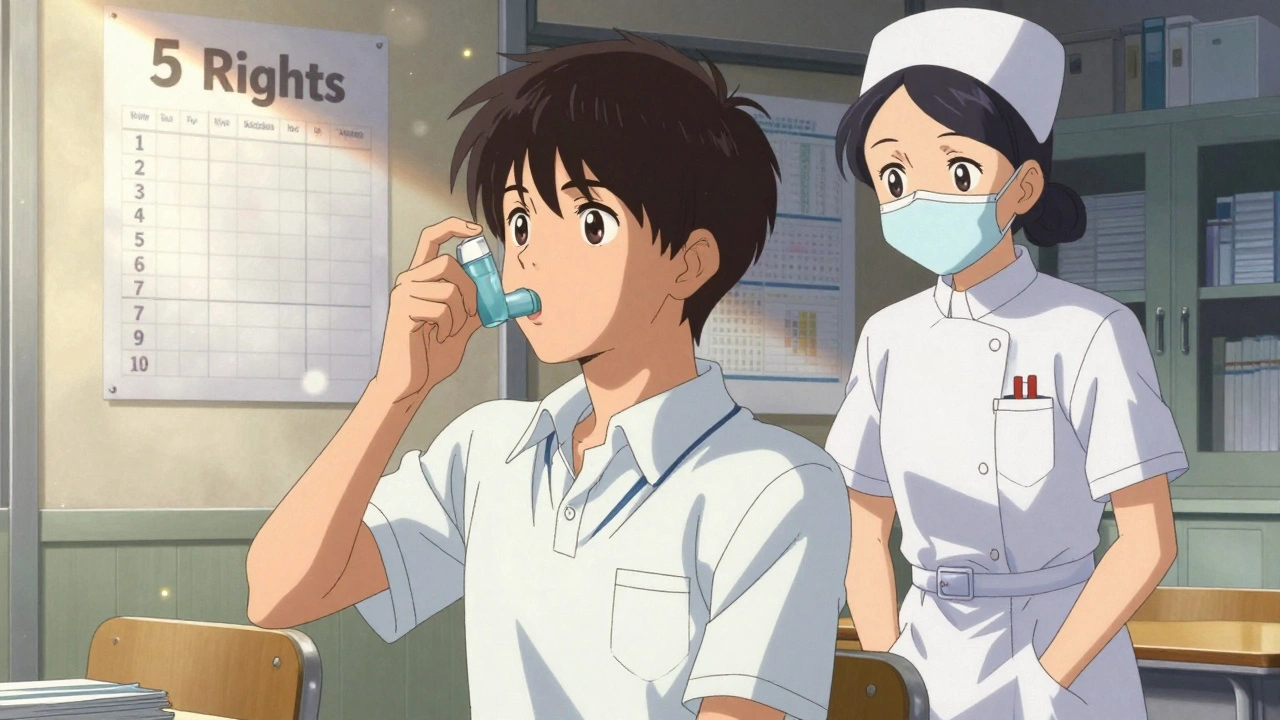
The 5 Rights: Your Checklist for Every Dose
Every school nurse in the country follows the same basic rule: the 5 Rights. If you don’t know them, you’re flying blind. Here’s what you need to make sure matches up every single time:
- Right student - Is the name on the bottle exactly the same as the name on the form? Middle initials? Spelling? It all matters.
- Right medication - Is it the exact drug prescribed? Not a similar one. Not a generic version unless the doctor approved it.
- Right dose - 5 mg, not 10 mg. One puff, not two. One tablet, not half. Dosage errors are the #1 cause of serious school incidents.
- Right route - Is it meant to be swallowed, inhaled, sprayed in the nose, or injected? Giving a nasal spray orally can be dangerous.
- Right time - Is it before lunch? After PE? Within 30 minutes of the scheduled time? Timing affects how well the medicine works.
Don’t assume the school will catch a mismatch. Double-check every form. Every bottle. Every instruction sheet.
What the School Needs From You (And When)
Schools don’t hand out meds on a whim. They need legal, medical, and logistical proof. Here’s what you must do-and when:
- Complete the authorization form - Every district requires a signed form from both you and your child’s doctor. This isn’t optional. No form = no medication.
- Include the doctor’s license number - Some states, like New York, legally require this. If your doctor forgets to write it, go back and ask for a corrected form.
- Deliver the medication yourself - No student is allowed to bring medication to school unless they’re approved for self-administration (and even then, it’s tightly controlled). Bring it in person, to the nurse’s office, during school hours.
- Use the original container - The pharmacy bottle with the label intact. No Ziploc bags. No pill organizers. No loose pills in a box.
- Submit forms early - If you wait until September, your child might miss weeks of treatment. New York City Public Schools recommends submitting forms by June 1 for the next school year.
And here’s the hard part: if your child’s dose changes, the doctor switches the medication, or you notice a side effect-call the school immediately. About 18% of medication errors happen because parents don’t update the school.
Storage Rules: No More Medicine in Backpacks
Medications aren’t snacks. They’re controlled substances-even if they’re over-the-counter. Here’s how schools store them, and why you need to respect it:
- All meds must be locked up-usually in a locked cabinet or drawer in the nurse’s office.
- Refrigerated meds (like insulin or some biologics) must be kept between 36°F and 46°F, in a dedicated fridge-never next to lunch items.
- Epinephrine auto-injectors (EpiPens) are kept in an easily accessible but secure location, often near the nurse’s station or in a classroom with trained staff.
- Even cough syrup or ibuprofen must be stored this way. No exceptions.
Some parents think, “My kid’s fine with keeping their inhaler in their pocket.” But schools have rules for a reason. A child could accidentally take someone else’s medicine. Or a bottle could get lost. Or a younger sibling could find it. Lock it up. Let the professionals handle it.
Self-Administration: When Can Your Child Handle Their Own Meds?
Some kids-especially teens with asthma, diabetes, or epilepsy-are capable of managing their own meds. But it’s not automatic. Schools require proof.
In New York, a student can self-administer only if:
- The doctor signs a special form saying the student is capable,
- You sign a consent form,
- The nurse has observed the student demonstrate correct use (like using an inhaler properly), and
- The school has a written plan for what happens if the student refuses or can’t use it.
California requires a supervised training session before approval. Other states have different rules. Don’t assume your child can carry their own meds. Ask the nurse. Get the paperwork. This isn’t about trust-it’s about safety and legal protection.
What Happens at the End of the Year?
Most parents forget this part until it’s too late.
At the end of the school year, all unused medication must be picked up. Frederick County Schools and New York State both say: no meds stay over summer. Not even one pill. Not even if it’s expensive. Not even if you think you’ll need it next year.
Why? Because:
- Medications expire.
- Labels fade or get damaged.
- There’s no legal way to transfer meds from one school year to the next.
- Storage conditions aren’t guaranteed over summer break.
Get the medicine back by August 31. If you don’t, the school will dispose of it properly. You won’t get a refund. You won’t get a second chance. And if your child needs it in September, you’ll have to get a new prescription and go through the whole process again.

What If Your Child Refuses to Take Their Medicine?
It happens. More often than you think. A kid might feel fine, think the pill is gross, or be embarrassed to take it in front of friends. Schools are trained to handle this.
Here’s what you should know:
- Staff will never force a child to take medicine.
- If your child refuses, the nurse will contact you immediately.
- You may need to come in to talk to your child, or work with the school counselor to find a solution.
Research shows that kids who understand why they need their medicine miss 32% fewer doses. Talk to your child. Use simple language. Let them ask questions. Involve them. When they feel like part of the plan, they’re more likely to follow it.
What’s Changing in School Medication Safety
Things are getting better-and faster.
Eighty-nine percent of public schools now use electronic medication records (eMARs), which cut documentation errors by over half. Some districts are testing apps that text you the moment your child takes their pill. Others are testing fingerprint scanners to make sure the right kid gets the right med.
But the biggest shift? The focus on student assent. Schools aren’t just asking for your permission anymore. They’re asking your child for their agreement. Developmentally appropriate. Age-appropriate. That means a 7-year-old might say “yes” with a sticker chart. A 14-year-old might sign a form. It’s not about control-it’s about dignity and responsibility.
Final Reminder: You’re the Key
It’s easy to think, “The school has a nurse. They’ve got this.” But the data says otherwise. The biggest causes of medication errors in schools? Incomplete paperwork (42%), poor communication between doctor and school (68%), and staff not being trained properly (29%).
You’re the only person who knows your child’s full medical history. You’re the only one who can make sure the doctor’s instructions are clear. You’re the only one who can deliver the right medicine in the right container at the right time.
Don’t wait for a crisis. Don’t assume someone else will fix it. Do the work. Fill the forms. Call the school. Talk to your child. Pick up the meds at the end of the year.
Your child’s safety doesn’t depend on luck. It depends on you.
Can my child bring their own medication to school?
No. All medications must be delivered to the school by a parent or guardian in the original, labeled container. Students are not allowed to carry medications unless they’ve been approved for self-administration through a formal process that includes doctor and parent consent, and a demonstration of competency with the school nurse.
Do I need a new form every year?
Yes. In 32 states, including New York and California, medication authorization forms must be renewed annually. Even if the medication and dosage haven’t changed, the school needs a current, signed form from both you and your child’s doctor. Outdated forms are not legally valid.
What if my child’s medication schedule changes during the school year?
Notify the school nurse immediately. Even small changes-like a new dose, a different time, or a new side effect-must be documented with a new signed form from the prescribing doctor. Failing to update the school is one of the top reasons for medication errors.
Can the school give my child over-the-counter medicine like ibuprofen?
Yes-but only with a signed parent and doctor authorization form. Even simple pain relievers like ibuprofen or acetaminophen require written permission. Schools cannot give OTC meds based on a note from a parent alone. The form must include dosage, frequency, and reason for use.
What happens to leftover medication at the end of the year?
You must pick it up by August 31. Schools are not allowed to store medications over the summer. Unused or expired meds will be disposed of safely by the school. If you don’t retrieve them, you’ll need a new prescription and form for the next school year.

Tommy Watson
lol why are we treating kids like lab rats? My kid takes his inhaler in class and no one cares. Schools are overcomplicating everything. Just let them have it. 🤷♂️
Sheldon Bird
This is actually super helpful. I didn't realize how much paperwork was involved. Took me 3 weeks to get my son's ADHD meds approved last year. Don't wait till August like I did 😅
Karen Mccullouch
This is why America is crumbling. Parents think they can just hand over a Ziploc bag with pills and expect the school to magically make it work. If you can't follow basic rules, maybe your kid shouldn't be in public school. 😤
Willie Onst
I love how this post treats parents like partners instead of problems. My daughter’s insulin pump used to be a nightmare until we sat down with the nurse and made a plan together. She even got to pick the sticker for her med log. 🤝✨
Ronan Lansbury
Interesting. In Ireland, we just give meds in the office and call it a day. No forms, no fingerprints, no apps. Just trust. Maybe the U.S. is over-engineering safety to the point of absurdity? Or is this just bureaucratic theater?
Shelby Ume
I'm a school nurse of 18 years. This list is spot-on. I've seen kids hospitalized because parents thought 'it's just ibuprofen' and dropped it in a backpack. The system isn't broken - it's ignored. Please, for the love of all that's holy, read the damn forms.
Jade Hovet
OMG YES!! My son’s EpiPen was in his lunchbox last year. I didn’t even realize!! Nurse called me screaming. Now I have a checklist on my fridge 🍎💉 #ParentingWin
nina nakamura
You're all missing the point. The real issue is that schools are turning into pharmaceutical distribution centers. This isn't safety - it's institutional overreach. Where does it end? Will they start administering antidepressants next? No parental consent? No.
Rawlson King
This is why I homeschool. Why should I trust a school to handle my child’s life-saving meds? Nurses are underpaid, overworked, and trained by bureaucrats. I’d rather be the one holding the pill.
Constantine Vigderman
I just submitted my daughter’s form for her asthma meds - took me 4 tries because the doctor’s license number was smudged 😅 But wow, the eMAR system they’re using now? It texts me when she takes it. Like a fitness tracker but for medicine. Future is here 🚀
Cole Newman
You people are so dramatic. My kid takes his Adderall at lunch. No forms. No nurse. He just knows. If you can't raise a responsible kid, that's your problem, not the school's.
Casey Mellish
As an Aussie who’s watched this unfold in the U.S., I’m genuinely impressed. The level of detail here - right student, right route, right time - it’s meticulous. We don’t have half this structure. Maybe we should borrow it. Solid work.
Emily Haworth
They're tracking every pill with fingerprint scanners now? Next they'll be implanting microchips. This isn't safety - it's surveillance capitalism disguised as child protection. They're not protecting your kid. They're collecting data. Wake up.