When you think of infections, you probably think of colds, flu, or maybe stomach bugs. But there’s a quieter, more persistent kind of infection hiding in plain sight-parasites. Two of the most common ones in homes, schools, and even fancy cities like Sydney? Giardia and pinworms. They don’t make headlines, but they make life miserable. And here’s the kicker: they’re totally treatable-if you know what to look for and what to do.
What Giardia Actually Does to Your Gut
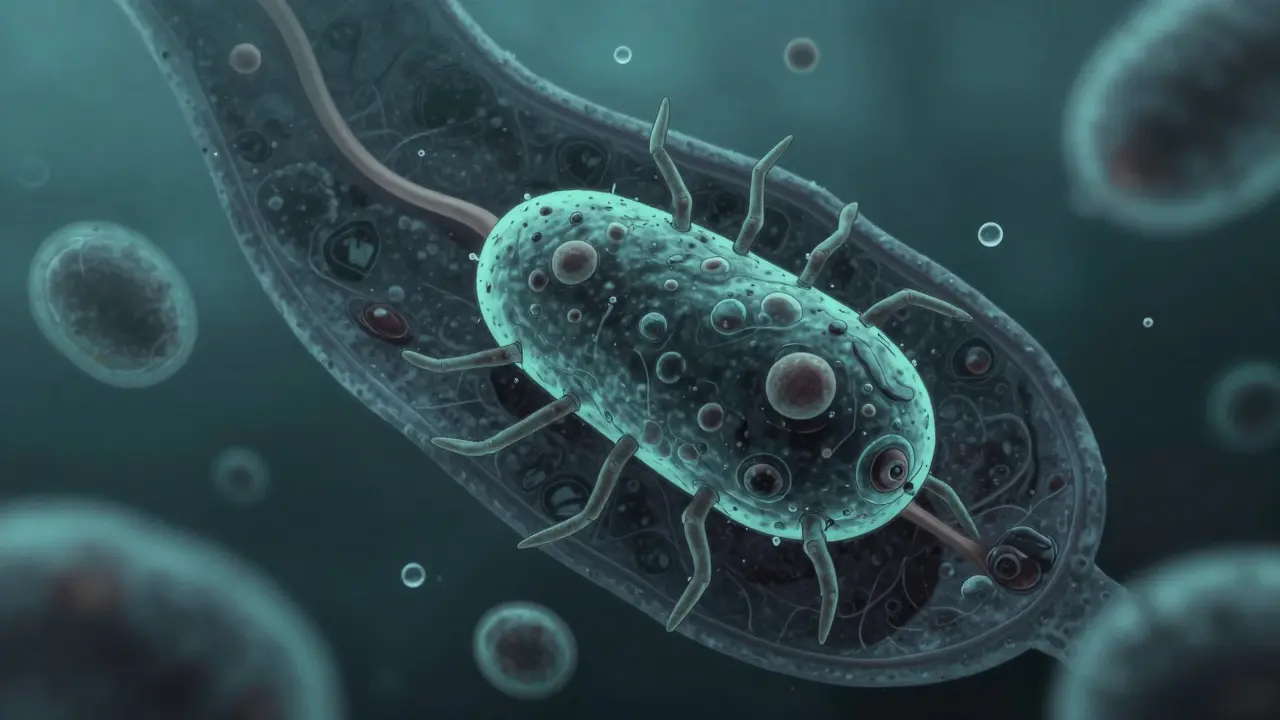
Giardia isn’t just a bug. It’s a microscopic, pear-shaped parasite that clings to the lining of your small intestine. It doesn’t just cause diarrhea-it messes with how your body absorbs food. Think of it like a tiny thief stealing nutrients right out of your gut. One cyst can start the whole problem, and you only need 10 to 25 of them to get infected.
Most people catch it from water. Not just muddy pond water-think hiking streams, backyard wells, or even city tap water that hasn’t been filtered right. The cysts survive for months in cold water, and chlorine? It barely touches them. That’s why boiling water for one minute is the gold standard if you’re unsure. Filters with pores smaller than 1 micron also work.
Symptoms show up 1 to 14 days later, usually around day 7. You’ll get watery, greasy poop that smells awful. Then come the cramps, bloating, gas that won’t quit, and a deep, dragging fatigue. Some people lose weight without even trying. A few even develop long-term issues like lactose intolerance or ongoing gut inflammation. And here’s the sneaky part: up to 30% of infected people show no symptoms at all. That’s how it spreads-someone feels fine, but they’re still shedding cysts in their poop.
Pinworms: The Nighttime Nuisance
Pinworms are tiny, white, thread-like worms-about as long as a staple. They live in your colon and, here’s the creepy part: at night, the female crawls out of your anus to lay eggs on your skin. That’s when the itching starts. Not just a little itch. A deep, burning itch that keeps you awake. Kids are the most common victims, but adults in daycare centers, nursing homes, or households with kids get it too.
It’s not about hygiene. Even clean homes get pinworms. Eggs get on bedding, toys, doorknobs, even in the air. You touch something, your hand goes to your mouth, and boom-you’ve swallowed eggs. They hatch inside you, grow into adults in 2 to 6 weeks, and the cycle repeats. That’s why treating just one person rarely works. Everyone in the house needs treatment at the same time.
Doctors often use the “scotch tape test” to confirm it. You press clear tape against the skin around the anus first thing in the morning, then stick it to a slide. Under the microscope, you’ll see eggs. One test catches about half the cases. Three tests? You’re at 90% accuracy.
How to Treat Giardia-And Why Some People Still Feel Sick
There are three main drugs used to kill Giardia: metronidazole, tinidazole, and nitazoxanide. Metronidazole (5 to 7 days, three times a day) is the old standard. But it comes with a price: a strong metallic taste (78% of people report it), nausea, and sometimes dizziness. Tinidazole is a single 2g dose-easier, and often better tolerated. Nitazoxanide is a 3-day course, safe for kids as young as 1 year, and doesn’t leave that awful taste behind.
Success rates? Around 80 to 95%. But here’s where things get messy. Some people get better, then symptoms come back. Why? Two reasons: reinfection or drug resistance. In Southeast Asia, 15% of cases don’t respond to metronidazole. In North America, it’s closer to 5%. That’s why doctors now recommend stool antigen tests-not just looking under a microscope-to confirm the infection before and after treatment.
And if you’re immunocompromised? Treatment takes longer. Your body can’t fight off the parasite the way a healthy one can. In those cases, doctors might use longer courses or switch drugs. The CDC recommends avoiding daycare or food handling for two weeks after symptoms stop-because even if you feel fine, you might still be contagious.

How to Treat Pinworms-And Why You Need to Treat Everyone
For pinworms, three drugs are standard: mebendazole, albendazole, and pyrantel pamoate. All are single-dose pills. Mebendazole (100 mg) is common, but it’s only approved for kids over 2. Albendazole (400 mg) works for all ages and is now recommended as the first choice by the CDC’s January 2024 update. Pyrantel pamoate (11 mg per kg of body weight) is also effective and available over the counter.
But here’s the deal: one dose isn’t enough. Eggs can still be alive two weeks later. That’s why you need a second dose two weeks after the first. Some experts now suggest a third dose for stubborn cases-especially in households with kids or in long-term care.
And you can’t stop at pills. You have to clean everything. Wash all bedding, pajamas, towels in hot water. Vacuum carpets and wipe down surfaces. Cut fingernails short. Don’t let kids scratch and then touch food. Change underwear daily. One family in Melbourne told a health forum they went through 12 loads of laundry, cleaned every toy, and still had one child reinfected-because they missed the stuffed animal under the bed. It took a second round of treatment and a third dose to finally stop it.
Prevention: Simple Steps That Make a Huge Difference
Here’s the truth: you don’t need fancy gadgets or expensive treatments. Just three habits stop 90% of cases.
- Wash your hands with soap after using the toilet, before eating, and after changing diapers. Studies show this cuts transmission by 30 to 50%.
- Boil or filter your water if you’re in an area with questionable supply, or if you’re hiking. Cold water doesn’t kill Giardia-heat does.
- Treat everyone at once if one person has pinworms. Don’t wait. Don’t assume others are fine. In 75% of households, others are already infected-even if they show no symptoms.
For Giardia, avoid swallowing water in pools, lakes, or water parks. Use bottled water for brushing teeth if you’re traveling. For pinworms, keep kids from sharing towels or beds until treatment is done.

What’s New in 2026? What’s Changing
Science is catching up. The WHO now pushes point-of-use water filters in high-risk areas-like in Bangladesh, where cases dropped 42% after distribution. The CDC updated its pinworm guidelines in January 2024 to recommend triple-dose albendazole for resistant cases. And guess what? A new Giardia vaccine called GID1 is in early trials. In 2023, it triggered immune responses in 70% of volunteers. It’s not ready yet, but it’s a start.
Climate change is also shifting the game. Warmer temperatures mean more flooding, more runoff, more contaminated water. Experts predict Giardia will spread into temperate zones like Sydney and Melbourne by 2040. That’s not science fiction-it’s based on water contamination models.
And drug resistance? It’s real. Metronidazole isn’t as reliable as it used to be. That’s why doctors are switching to nitazoxanide or tinidazole more often. If you’ve been treated and still feel awful, ask for a stool test-not just a guess.
Frequently Asked Questions
Can you get Giardia from swimming pools?
Yes. Giardia cysts survive chlorine in pools. If someone with giardiasis swims, they can spread it. That’s why public pools require strict hygiene rules-no swimming if you’re sick, and kids in diapers should be in waterproof swimwear. Still, outbreaks happen. Filtering pool water or using UV treatment helps reduce risk.
Are pinworms dangerous?
Not usually. They don’t burrow into organs or cause serious damage. But the itching can lead to skin infections from scratching, and in rare cases, female worms can migrate into the vagina or urinary tract, causing irritation or infection. The real danger is how easily they spread-especially in schools and homes with young kids.
Can pets give me Giardia or pinworms?
Giardia from dogs or cats is a different strain than what infects humans. It’s very rare to catch human giardiasis from pets. Pinworms? No. They only infect humans. So if your dog has worms, it’s not the same kind. But always wash your hands after handling pet poop-just in case.
Why do some people get reinfected even after treatment?
Two reasons: either they didn’t treat everyone in the household, or they didn’t clean contaminated surfaces. Pinworm eggs live for weeks on bedding, toys, or even in dust. Giardia cysts can linger in water sources or on unwashed hands. Reinfection isn’t failure-it’s incomplete action. Treating the person but not the environment is like turning off the faucet but leaving the sink full.
Is it safe to treat kids for pinworms?
Yes. Mebendazole and albendazole are approved for children over 2. Pyrantel pamoate is safe for infants over 1 year. Always check weight-based dosing. For babies under 1, talk to a doctor. Never give adult doses to kids. Most cases in young children resolve completely with proper treatment and hygiene.

jared baker
Giardia is way more common than people think. I work in public health and we see it all the time in daycare outbreaks. Boiling water for a minute is the cheapest and most reliable fix. Filters work too, but only if they're rated for 1 micron or smaller. Most cheap filters don't cut it. And yes, chlorine does nothing. I've seen pools shut down over this.
Ryan Voeltner
I appreciate the clarity here. In my work across Southeast Asia, I've seen how water infrastructure gaps make Giardia a silent epidemic. The real issue isn't treatment-it's access. A single dose of tinidazole can change a family's life, but if the nearest clinic is 50km away, it doesn't matter. Infrastructure first, medicine second.
Manish Singh
In India, we call pinworms 'ratti'-little rats that crawl at night. My grandmother used neem oil on the anal area and it worked wonders. Not scientific, but effective. The real problem is the shame around talking about it. Kids get scolded for itching, not helped. We need open conversations, not stigma.
Linda Olsson
Of course the CDC updated guidelines in 2024. They always do when pharmaceutical companies fund the research. Albendazole? That's a Big Pharma favorite. The real cure is cleanliness. And yet they push pills. They don't want you to know that sunlight kills eggs instantly. Or that airing out bedding for 48 hours works better than any drug.
Michelle Jackson
I read this whole thing and honestly? I'm not surprised. The system is designed to keep us sick. Why? Because if you're healthy, you don't need meds, doctors, tests, or follow-ups. They profit from chronic illness. That's why they say 'treat everyone'-because if you only treat one person, you'll be back next month. It's a cycle. I'm not mad, I'm just awake.
Emily Hager
I'm sorry, but this article reads like a pharmaceutical brochure. 'Nitazoxanide is safe for kids as young as 1'? Really? Have you read the side effects? Nausea, vomiting, abdominal pain. And yet they call it 'better tolerated'? That's a joke. I've seen children hospitalized after taking it. Why not try herbal alternatives? Wormwood? Black walnut? Garlic enemas? No? Because they don't patent those.
Andrew Muchmore
I've treated 3 families for pinworms in the last year. One thing I always tell them: don't just treat the kid. Treat the dog. Treat the grandma. Treat the babysitter. Treat the stuffed bear. One family missed the blanket under the couch. Three weeks later, same symptoms. Clean everything. Even the TV remote. Even the toothbrush holder. It's not paranoia. It's science.
Alexander Pitt
Giardia cysts survive freezing. So ice cubes? Risky. If you're in a place with questionable water, use bottled water for ice. I've seen outbreaks from hotel ice machines. Also, don't assume your tap water is safe just because it's clear. The cysts are invisible. Boil or filter. No exceptions.
Nilesh Khedekar
I'm not saying this is fake but I heard from a guy on a forum that the government puts something in the water to keep us docile. I think it's lithium. Or maybe fluoride. Either way, if you boil water, you're removing the truth. I don't trust anything the CDC says anymore. My cousin got sick after taking metronidazole. She said it felt like her soul was being pulled out. Coincidence? I think not.
Lauren Volpi
So let me get this straight. We're supposed to believe that a parasite that lives in poop can be cured by a pill? And the solution is to wash hands? That's it? No wonder everyone's sick. We live in a world where people think hand sanitizer is a cure-all. You can't sanitize a society that ignores the root cause. The real parasite is capitalism.
Robin Hall
The assertion that Giardia is treatable is misleading. In immunocompromised individuals, recurrence rates exceed 40%. The CDC's recommendation to avoid food handling for two weeks is inadequate. Studies from 2022 indicate that asymptomatic carriers shed viable cysts for up to 63 days. Therefore, the notion of 'complete recovery' is a fallacy perpetuated by insufficient surveillance systems and underfunded public health departments.
Suchi G.
I had Giardia last year. I didn't even know I had it until my doctor said my stool looked like it had oil floating on top. I lost 15 pounds in three weeks. I thought I was just stressed. Then I found out my coworker had it too. We both used the same water cooler. I never told anyone because I was embarrassed. But now I tell everyone I know. Don't wait until you're wasting away. Get tested. Even if you feel fine. Especially if you feel fine.
becca roberts
Oh wow, so the solution to parasites is... handwashing? And boiling water? Groundbreaking. Next you'll tell me vaccines prevent disease. I'm so impressed by how much we've advanced since the 1800s. Honestly, if this article was written in 1920, I'd be impressed. In 2026? It's like watching someone use a flip phone and call it innovation.
Melissa Starks
I used to think pinworms were just a kid thing until my 8-year-old started scratching at 3am and I realized I was doing it too. We treated her, cleaned everything, did the tape test, did the second dose... and still, the itching came back. I didn't tell anyone because I felt gross. Then I found out my mom had it too. And my sister. And my partner. We all had it. No one knew. No one talked about it. It took three rounds of albendazole and 17 loads of laundry to finally win. Don't be ashamed. Talk. Clean. Treat. Together.
Andrew Muchmore
Just a quick note: if you're treating pinworms and still see symptoms after the second dose, don't assume resistance. Check for eggs under the nails. Kids dig. Adults don't realize they're scratching while sleeping. Cut nails short. Wash hands before touching face. Simple. Effective. Underrated.