
Missing a dose of insulin or warfarin while stuck in a layover isn't just an inconvenience; it can be dangerous. For travelers managing chronic conditions, the act of crossing time zones adds a layer of complexity that standard travel advice often ignores. You aren't just fighting jet lag; you are managing a strict pharmacological timeline while your body's internal clock is scrambling.
If you rely on time-sensitive medications that require precise dosing intervals, this guide will help you navigate the logistical and physiological challenges of air travel. We will break down how to adjust your schedule based on the direction of your flight, what the Transportation Security Administration (TSA) actually allows in your carry-on, and which tools can automate the math so you don't have to calculate half-lives at 30,000 feet.
Understanding Time-Sensitive Medications
Not all pills behave the same way in your system. To plan effectively, you first need to know where your specific medication falls on the sensitivity spectrum. The Centers for Disease Control and Prevention (CDC) notes that approximately 38% of travelers with chronic conditions struggle with timing adjustments, a number that jumps to 62% when crossing five or more time zones.
Time-sensitive medications are defined by their pharmacokinetics-specifically, how long they stay active in your blood (half-life) and how narrow the window is between a therapeutic dose and a toxic one.
- Narrow Therapeutic Index Drugs: These include anticoagulants like warfarin and anti-epileptic drugs. For these, even a few hours' deviation can lead to serious complications, such as seizures or bleeding risks. The American Society of Health-System Pharmacists (ASHP) emphasizes that these require exact timing maintenance.
- Biologics and Insulin: Medications like insulin therapies depend heavily on meal timing and activity levels. A study in the Diabetes Care journal found that 52% of insulin-dependent travelers experienced hypoglycemic episodes during flights due to schedule disruptions.
- Short Half-Life Drugs: Any medication with a half-life of less than 8 hours usually requires twice-daily dosing. These are harder to manage across time zones because they clear your system quickly.
The good news? About 78% of time-sensitive medications can safely accommodate a 1-to-2-hour variation, according to the American Pharmacists Association (APhA). But for the remaining 22%, primarily transplant immunosuppressants and certain anti-epileptics, precision is non-negotiable.
Eastbound vs. Westbound: The Adjustment Strategy
The direction you fly changes how you should adjust your schedule. Dr. Sarah Thompson, Director of Travel Medicine at Johns Hopkins University, recommends maintaining your home time zone schedule for the first 48 to 72 hours if you are taking medications with short half-lives and crossing three or more time zones. However, for longer half-life medications, immediate adjustment to local time is often safer.
A practical protocol developed by pharmacists at the University of Michigan Health System suggests adjusting in 1-hour increments daily. This reduces timing errors by 76% compared to trying to jump straight to the new time zone.
| Direction | Challenge | Recommended Strategy | Risk Factor |
|---|---|---|---|
| Westbound (e.g., NY to LA) | Your day gets longer. You may need to wait longer for the next dose. | Delay doses gradually. If crossing 3+ zones, consider splitting the gap into smaller delays over two days. | Low risk of double-dosing. High risk of missed doses if you forget. |
| Eastbound (e.g., LA to NY) | Your day gets shorter. You may feel pressure to take a dose too early. | Advance doses gradually. Take your morning dose slightly earlier each day before departure. | High risk of double-dosing or taking doses too close together. |
| Crossing International Date Line | You might gain or lose a full day. | Consult your doctor specifically for this scenario. You may skip a day or take two days' worth carefully spaced out. | Very high risk. Requires personalized medical advice. |
Remember, WebMD advises that while it is usually safe to take medicine 1-2 hours early or late, you should never double up doses. This general rule does not apply to medications with narrow therapeutic windows, so always check with your pharmacist.
TSA Rules and Packing Essentials
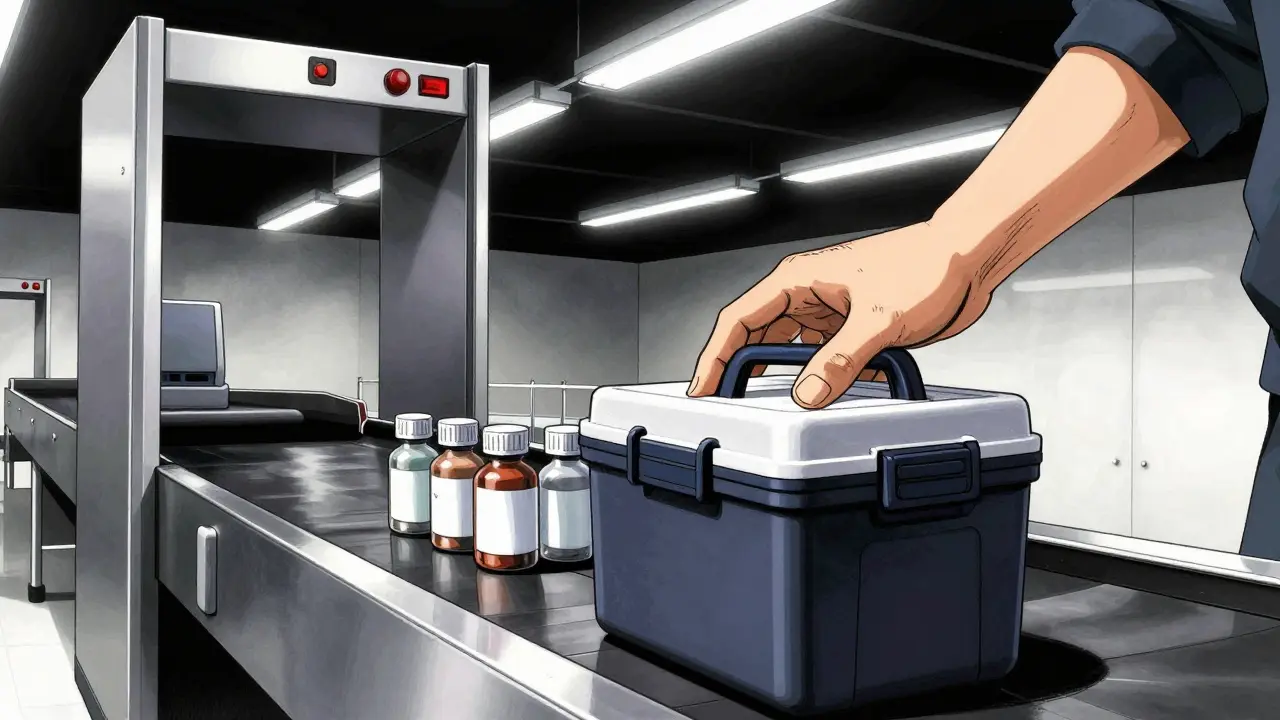
Security checkpoints can be stressful, but the rules for medication are relatively straightforward if you prepare correctly. The Transportation Security Administration (TSA) permits travelers to carry all necessary medications in original containers through security checkpoints.
Here is what you need to know about packing:
- Solid Medications: There are no quantity restrictions for pills, capsules, or powders. Keep them in their original labeled bottles to avoid questions.
- Liquid Medications: Liquids, gels, and aerosols exceeding the standard 3.4-ounce limit are allowed in reasonable quantities for your journey. You must declare them to TSA officers at the start of the screening process. They may need to be screened separately.
- Ice Packs: Gel ice packs are permitted through security when used for medically necessary items, even if partially melted. This is crucial for temperature-sensitive drugs.
The CDC recommends carrying a comprehensive medication list that includes drug names (brand and generic), dosages, frequency, your prescribing doctor's name, and pharmacy contact information. Emergency departments report that having this complete information helps them manage medication-related issues much more effectively.
Temperature Control and Storage
About 35% of time-sensitive medications require temperature-controlled storage. Insulin is the most common culprit, accounting for 58% of specialty medication travel cases. Most of these drugs need to stay between 35°F and 46°F (2°C to 8°C).
Airplane cabins are pressurized and temperature-controlled, but cargo holds are not. Never check bags containing medication. Instead, use a portable medication cooler. Devices like the Travelport 3.0 use phase-change technology to maintain optimal temperatures for up to 48 hours without power. This ensures your biologics or insulin remain effective from the moment you leave your house until you reach your destination.
If you are traveling to countries with strict regulations, be aware that some nations require special permits for standard US medications. For example, pseudoephedrine is prohibited in 12 countries, and zolpidem requires advance permission in 24 others. Check the entry requirements of your destination country well in advance.
Tools and Technology for Precision
Relying on memory or manual calculations is risky. Technology can bridge the gap between your home schedule and your destination time zone.
Dedicated apps like Medisafe automatically adjust schedules based on your flight itinerary. As of August 2024, Medisafe has been downloaded over 1.2 million times, largely because it handles the complex math of time zone conversions for you. It sends reminders based on your current location, ensuring you don't miss a dose or take one too early.
For those who prefer analog solutions, the MedTime Zone Watch allows you to track multiple time zones simultaneously. While it doesn't automate reminders, it provides a visual reference for when your "home" dose is due relative to your "local" time.
Create a detailed medication timeline at least 72 hours before travel. Calculate exact administration times based on your departure and arrival time zones. If you are crossing multiple zones, map out every single dose for the first three days of your trip. This proactive planning is the difference between a smooth trip and a medical emergency.

Special Considerations for Pilots and Crew
If you are a pilot or crew member, the stakes are higher. The Federal Aviation Administration (FAA) mandates strict waiting periods after discontinuing certain medications before flying. For instance, pilots must wait at least five dosage intervals after stopping medications taken every 4-6 hours. For sedating antihistamines like diphenhydramine, the wait time extends to 60 hours due to their prolonged half-lives.
The FAA also warns: "NEVER FLY AFTER TAKING A NEW MEDICATION FOR THE FIRST TIME UNTIL AT LEAST 48 HOURS HAVE PASSED AND NO SIDE EFFECTS ARE NOTED." This applies to everyone, but it is critical for aviation safety professionals.
Frequently Asked Questions
Can I take my medication early if I have a red-eye flight?
For most medications, taking a dose 1-2 hours early is generally safe. However, for time-sensitive drugs with a narrow therapeutic index, such as warfarin or certain anti-epileptics, you should consult your doctor. Do not double up doses to make up for a missed one unless explicitly instructed by a healthcare provider.
Do I need to declare my liquid medication at TSA?
Yes. While liquid medications are exempt from the 3.4-ounce rule, you must declare them to TSA officers at the beginning of the screening process. They may be subject to additional screening, such as X-ray or explosive trace detection. Keep them separate from your other liquids to speed up the process.
What happens if I miss a dose of insulin during a flight?
If you miss an insulin dose, do not double the next dose. Instead, take it as soon as you remember, unless it is close to the time for your next scheduled dose. Monitor your blood sugar closely, as hypoglycemia or hyperglycemia can occur due to changes in meal timing and activity levels during travel. Always carry fast-acting glucose sources.
Is it safe to keep medication in checked luggage?
No. Never check bags containing medication. Checked luggage is exposed to extreme temperature variations in the cargo hold, which can ruin temperature-sensitive drugs like insulin. Additionally, lost luggage means lost medication. Always keep your meds in your carry-on bag, easily accessible.
How do I handle medication timing when crossing the International Date Line?
Crossing the date line can result in gaining or losing a full day. This is a high-risk scenario for time-sensitive medications. You should consult your doctor or pharmacist before travel to create a specific plan. In some cases, you may skip a day of medication; in others, you may need to space out doses carefully over two calendar days.

Preety Singh
One must acknowledge that the pharmacokinetic nuances discussed herein are often trivialized by the layperson. The distinction between a narrow therapeutic index drug and a standard analgesic is not merely semantic; it is existential. Those who treat their medication schedule as a suggestion rather than a mandate display a profound lack of intellectual rigor regarding their own biology. The article’s reference to the CDC statistics is adequate, though one could argue that the data is more nuanced when considering circadian rhythm disruptions in high-altitude cabins. It is quite tedious to read such basic advice when one has already mastered the art of temporal dosing.
Seema Karanje
WAKE UP PEOPLE!!! You cannot just wing this stuff!! If you are flying with insulin or warfarin you NEED to be on top of your game!! Do not let the TSA intimidate you!! Declare your liquids!! Keep your meds in your carry-on!! I am so tired of people getting sick because they were too lazy to plan ahead!! Get your act together and respect your health!!
J. Walter Jenkem
I appreciate the detailed breakdown here. It is helpful to see the specific strategies for eastbound versus westbound travel. I always find myself second-guessing whether to adjust immediately or stick to home time. The recommendation to adjust in one-hour increments seems much more manageable than trying to shift everything at once. Thank you for sharing this information.
Elizabeth Holden
lol u guys r dumb if u think u can just guess ur doses. i told my friend about the half life thing and she still took her pill early. stupid. also the tsa rules r easy if u just listen. dont check ur bags. period. end of story. why do ppl need to be told twice?? its not rocket science. just read the label.
Jenny X
The FAA guidelines mentioned here are likely part of a broader surveillance initiative designed to track biometric anomalies among frequent flyers. Notice how they emphasize 'new medications' specifically? This creates a digital footprint of your physiological responses. The Medisafe app is undoubtedly collecting location data correlated with dosing times, feeding into a larger algorithmic model of population health control. We must remain skeptical of these 'convenient' tools. The phase-change technology in coolers is also suspiciously efficient, suggesting military-grade thermal regulation standards being repurposed for civilian use under the guise of medical necessity.
bharat films
👏👏👏 Excellent points! The table for adjustment strategies is very clear. 📊 I always forget about the date line issue. 🌍 That is scary! 😱 Good reminder to keep meds in carry-on. ✈️ Don't check them! 🚫 Thanks for the tips! 👍
Mikaela -anonymous 😏
Oh, look at us, playing doctor with our little pill bottles. How quaint. One might assume that crossing an ocean requires more than just a pocket watch and a prayer. The article suggests a 'protocol,' which implies order, yet human nature is inherently chaotic. We are but dust motes dancing in the sunbeam of pharmaceutical engineering. Will the ice pack save you? Will the app remember? Or will you simply fade away in economy class, a cautionary tale for the next generation of anxious travelers. It is all so terribly dramatic, isn't it?
kelvin villa saab
i mean honestly this is common sense right?? like seriously?? you cant just throw your meds in the checked bag and hope for the best. the cargo hold is basically a freezer or a oven depending on the season. also stop asking questions in the comments just read the article. it says right there what to do. dont be a baby about it. fly safe or dont fly at all.
Spencer Farrell
The epistemological framework underlying the concept of 'time-sensitive' medication is fascinating. It challenges our perception of linear time as a constant variable. When we traverse time zones, we are not merely moving through space but also disrupting the temporal integrity of our biological systems. The article posits that precision is non-negotiable for certain drugs, which raises the question: is the drug controlling the body, or is the body attempting to synchronize with the external temporal markers imposed by society? The reliance on technological aids such as apps suggests a diminishing capacity for internal self-regulation. We outsource our survival to algorithms, thereby abdicating personal responsibility for our own physiological maintenance.
Kartik Agarwal
Let us delve into the pharmacokinetic parameters further. The bioavailability of oral medications can indeed fluctuate based on gastric emptying rates, which are themselves influenced by stress and altitude changes. While the article provides a solid baseline, consider the implications of first-pass metabolism variations during acute stress responses associated with air travel. For those managing complex regimens, integrating a continuous glucose monitor or similar real-time biomarker tracking could provide additional layers of safety beyond simple timing adjustments. Collaboration between patient and provider is key.
Kelly Feehely
You are all idiots for trusting these generic guides!! The government wants you dependent on their approved methods!! They want you using THEIR apps so they can track YOU!! Do not use the Medisafe app!! Use a paper notebook!! Burn it after!! The TSA is watching your pills!! They know what you take!! Stop being sheep!! Fly private or stay home!! This is all a trap!! Wake up!!