
Every year, millions of pregnant women turn to the internet to find out if a medication is safe. They scroll through forums, read blog posts, watch TikTok videos, and check drug company websites. But here’s the hard truth: only about 57% of online advice about pregnancy medications matches the science. That means nearly half the time, you’re getting advice that could be wrong - and in some cases, dangerous.
One study analyzed over 1,400 online posts about medication use during pregnancy. It found that for drugs that require careful use - like seizure medications or asthma inhalers - 93% of the advice was completely off. Women were told to avoid these drugs when they were actually safe and needed. Others were told to take something risky when they shouldn’t have. This isn’t just misinformation. It’s putting lives at risk.
Why Online Advice Is So Often Wrong
The problem isn’t that people are careless. It’s that the internet rewards attention, not accuracy. Posts that say “Never take ibuprofen while pregnant!” get shared more than ones that say, “Ibuprofen is generally safe in early pregnancy but should be avoided after 20 weeks.” Sensational claims drive clicks. Nuance gets buried.
Even websites that look professional can be misleading. A 2023 review found that only 38.7% of commercial drug sites gave full risk-benefit details. Many hide behind vague statements like “consult your doctor” while pushing products or downplaying risks. Social media is worse. Reddit threads, Facebook groups, and Instagram influencers often share personal stories as medical facts. One woman might say, “I took Zoloft and my baby was fine,” while another says, “I had a miscarriage after taking it - never again.” Neither is evidence. Both get treated like truth.
And here’s something most people don’t realize: most drug labels are outdated. A 2003 study found that 78% of standard drug labels still used old, confusing categories like “Category C” or “Category D.” These labels were replaced in 2015 by the FDA’s Pregnancy and Lactation Labeling Rule (PLLR), which gives clear summaries of risks based on real human studies. But many websites still use the old system - or worse, make up their own.
The Gold Standard: What Accurate Advice Looks Like
There is a reliable system used by doctors and researchers worldwide: the Teratology Information Services (TIS) classification. It doesn’t just say “safe” or “unsafe.” It breaks things down:
- Safe - No known risks based on human studies
- Contraindicated - Proven harm, avoid completely
- Strict indication or second-line - Only use if benefits clearly outweigh risks
- Insufficient knowledge - Not enough data to say yes or no
Accurate sources will tell you which category a drug falls into - and they’ll explain why. For example, paracetamol (acetaminophen) is classified as safe. But here’s what good advice looks like: “A 2021 study of 95,000 pregnancies found no link between paracetamol use and neurodevelopmental delays in children. This is the largest study to date. However, long-term daily use is still not recommended.” That’s specific. It cites the study. It mentions limitations. That’s the difference.
Compare that to bad advice: “Paracetamol causes autism.” No source. No study. No context. Just fear.

How to Check Any Online Claim - A 5-Step System
You don’t need to be a doctor to spot bad advice. You just need a system. Here’s how to check any claim in under 30 minutes:
- Check the source - Is it a .gov site (like NIH or CDC)? A .edu site (like a university medical school)? Or is it a blog, a brand site, or a social media page? Only .gov and .edu sites are required to be accurate. Avoid sites that sell supplements or products.
- Look for author credentials - Does it say who wrote it? If yes, check if they’re a board-certified OB-GYN, pharmacist, or teratologist. You can verify this through the American Board of Medical Specialties website. If the author is just a “mom blogger” or “natural health coach,” take it with a grain of salt.
- Find the evidence - Does the post cite a study? Not just “a study says…” but the actual journal name, year, author, and sample size? If it says “a 2021 study in JAMA Internal Medicine by Liew et al.,” go look it up. If it just says “experts say,” it’s probably not real.
- Check the date - Medical knowledge changes fast. Anything older than 2 years should be treated as outdated. A 2019 article on antidepressants during pregnancy is likely missing key data from 2022-2024 studies.
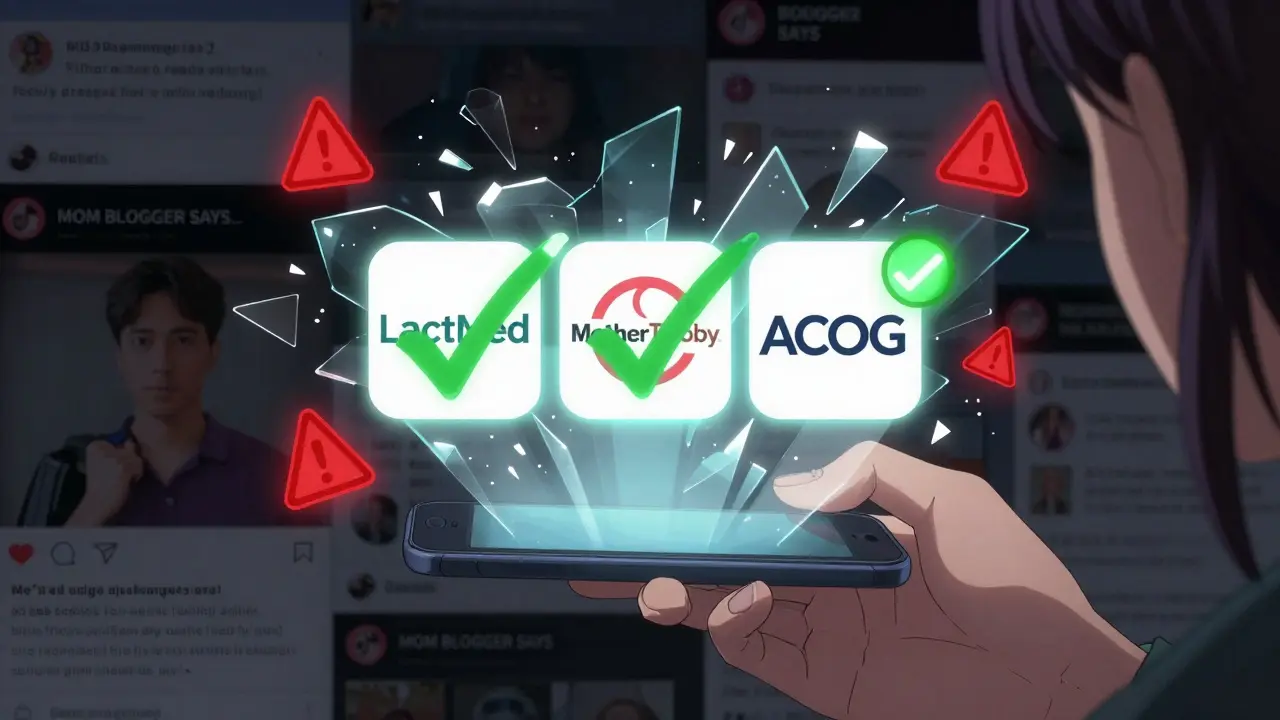
- Cross-reference with trusted databases - Use three gold-standard sources: LactMed (from the National Library of Medicine), MotherToBaby (run by OTIS), and the ACOG guidelines. If all three agree, you can trust it. If they disagree, talk to your provider.
This system works. A 2025 study in the Journal of Medical Internet Research showed that after a 4.2-hour training, women improved their ability to spot accurate advice by 15.7%. That’s not magic. That’s just knowing what to look for.
Red Flags You Can’t Ignore
Here are the most common tricks used to fool you:
- “Natural” means safe - Herbal supplements, essential oils, and home remedies are not regulated. Only 0.3% of them are tested for safety in pregnancy. Just because it’s “natural” doesn’t mean it won’t harm your baby.
- Correlation = causation - “I took Zyrtec and my baby had eczema.” That doesn’t mean Zyrtec caused eczema. Eczema runs in families. Stress during pregnancy can cause it too. Without controlled studies, you can’t say.
- “All doctors are in on it” - Conspiracy claims like “Doctors hide the truth about medication risks” are designed to make you distrust experts. But real science doesn’t work that way. If a drug was dangerous, hundreds of researchers would publish it.
- Disguised ads - Over 42% of “educational” websites have hidden pharmaceutical sponsorships. If a site says “This medication is safe” but also sells it, they’re not your friend.
What to Do When You’re Unsure
You don’t have to figure this out alone. Here are three real, free, 24/7 resources:
- MotherToBaby - Call 1-866-626-6847. Talk to a specialist. They answer questions about every medication, supplement, and exposure.
- LactMed - Free database from the National Library of Medicine. Search any drug. It gives you human studies, animal data, and breastfeeding safety.
- ACOG Practice Bulletins - The American College of Obstetricians and Gynecologists updates these every year. They’re free to read online.
And if you’re still unsure? Talk to your OB-GYN or pharmacist. Don’t be embarrassed. Ask: “I read this online. Can you check if it’s true?” Most providers welcome the question. They’ve seen this before.
The Future Is Here - But You Still Need to Be Careful
There’s good news: tools are getting better. In 2024, the FDA launched a pilot AI tool that scans online content and flags inaccurate pregnancy medication claims with 83% accuracy. In 2025, NIH funded browser extensions that auto-check claims against OTIS databases. By late 2025, a new API will give real-time credibility scores for any medication mentioned online.
But here’s the catch: technology won’t fix human behavior. Misinformation spreads 3.7 times faster than corrections. People still believe emotional stories over data. So even with better tools, you still need to think critically.
The goal isn’t to avoid all online advice. It’s to use it wisely. The internet gives you access to more information than ever before. But that information isn’t all true. Your job isn’t to believe everything. It’s to ask: Where did this come from? Who says so? And how do I know?

Allison Priole
i just want to say thank you for writing this. as someone who was told to stop my asthma inhaler during pregnancy because 'it might harm the baby' (thanks, random reddit thread), i wish i had this guide. turns out, uncontrolled asthma was way more dangerous. we need more clear, calm, science-based info like this. seriously, someone should turn this into a printable one-pager for OB offices.
Casey Tenney
This is why we can't have nice things. People trust TikTok over peer-reviewed journals. If you can't read a study, don't make medical decisions.
Sandy Wells
I dont even know why we bother anymore. The internet is just a circus and everyone wants to be the clown. Just go to your doctor and stop scrolling
Bryan Woody
Let me guess - you're the kind of person who thinks 'natural' means 'safe' and 'pharmaceutical' means 'evil'. The FDA updated labeling in 2015 because the old system was a garbage fire of ambiguity. But nope, some blog with a lavender-scented candle in the background still says 'Category C = maybe kill your baby'. Newsflash: Category C meant 'we have no data' - not 'probably lethal'. Stop letting fearmongers sell you anxiety instead of facts.
Chris Dwyer
You did an amazing job breaking this down. Seriously. I shared this with my prenatal group and now we all have a checklist. I used to panic every time I saw a new post about Zoloft or metformin. Now I go straight to MotherToBaby. It’s like having a nurse in my pocket. If you’re reading this and you’re scared - take a breath. You’re not alone. And you don’t have to figure this out alone. This guide? It’s your lifeline.
Desiree LaPointe
Oh wow. A 15.7% improvement after 4.2 hours? That’s barely a blip. You’d think after decades of internet access, we’d be better than this. Clearly, human beings are just biological spam bots with uteruses. And now we’re letting algorithms decide what we believe? I’m not surprised. We’re one viral post away from a nationwide panic over ibuprofen. Again.
Thomas Jensen
They’re all in on it. The drug companies. The FDA. The doctors. They don’t want you to know that 90% of pregnancy meds are secretly linked to autism. That’s why they buried the 2022 NIH study. You think they’d let you read this if it was true? They changed the labels to confuse you. The real truth is out there - if you know where to look. I’ve been researching this for 7 years. I’ve got documents. I’ve got sources. You just have to be brave enough to see it.
matthew runcie
This was really helpful. I’ve been reading a lot of conflicting stuff and it’s exhausting. I’m going to bookmark MotherToBaby. Just knowing there’s a clear system helps. Thanks for not yelling. Just giving facts. That’s rare.
shannon kozee
The 5-step system works. I used it last week on a post about Zyrtec. Found the actual 2023 JAMA study. Turns out it’s Category Safe. I felt smarter. And less scared.
Shaun Wakashige
i just want to say i hate my life
Solomon Kindie
The real issue here isn't misinformation its the collapse of epistemic authority in the postmodern era where lived experience replaces empirical evidence and emotional resonance trumps statistical significance we are not just misinformed we are epistemically adrift and this is why the internet is the perfect vessel for the decay of rational discourse
Natali Shevchenko
I think about how much we used to rely on community wisdom - midwives, grandmothers, village healers. Now we have algorithms. And they’re not designed to protect us. They’re designed to keep us scrolling. The irony is that we’re drowning in information, yet starved of wisdom. The real question isn’t whether a drug is safe - it’s whether we still trust each other enough to share truth. And maybe that’s the harder pill to swallow.
Johny Prayogi
I just saved this to my phone and showed my mom. She’s 65 and thought ibuprofen was banned. Now she’s like ‘ohhh so that’s why my OB said it was okay in the first trimester?’ 😊 We need more of this. Not fear. Just clarity. And maybe a meme. I’m making one right now: 'When you Google 'pregnancy meds' and get 37 memes and 1 study' 🤣
Nicole James
I’m not saying the FDA is lying... but... have you seen how many people are getting cancer from prenatal meds? And they’re all being silenced? And the 'gold standard' sources? They’re all funded by Big Pharma. Who’s funding MotherToBaby? Who’s funding LactMed? Who’s funding ACIG? It’s all connected. And the truth? It’s buried under layers of corporate-funded 'science'.
Nishan Basnet
As someone from India, I’ve seen this firsthand. My sister was told to stop her thyroid medication because a Facebook group said it 'caused deformities'. She nearly lost the baby from untreated hypothyroidism. We don’t have easy access to specialists here. Online advice isn’t just misleading - it’s lethal. This guide? It’s not just useful. It’s life-saving. I’ve translated parts into Hindi and shared it in three WhatsApp groups. Thank you for writing something that actually helps.