Every time you pick up a new medicine or open a food package, you’re making a decision that could mean the difference between feeling fine and ending up in the emergency room. For millions of people with allergies, reading labels isn’t just a habit-it’s a life-saving skill. But here’s the hard truth: allergens on labels are easy to miss, especially on prescriptions. The rules for food and medicine are completely different, and most people don’t know it.
What You’re Really Looking For on Food Labels
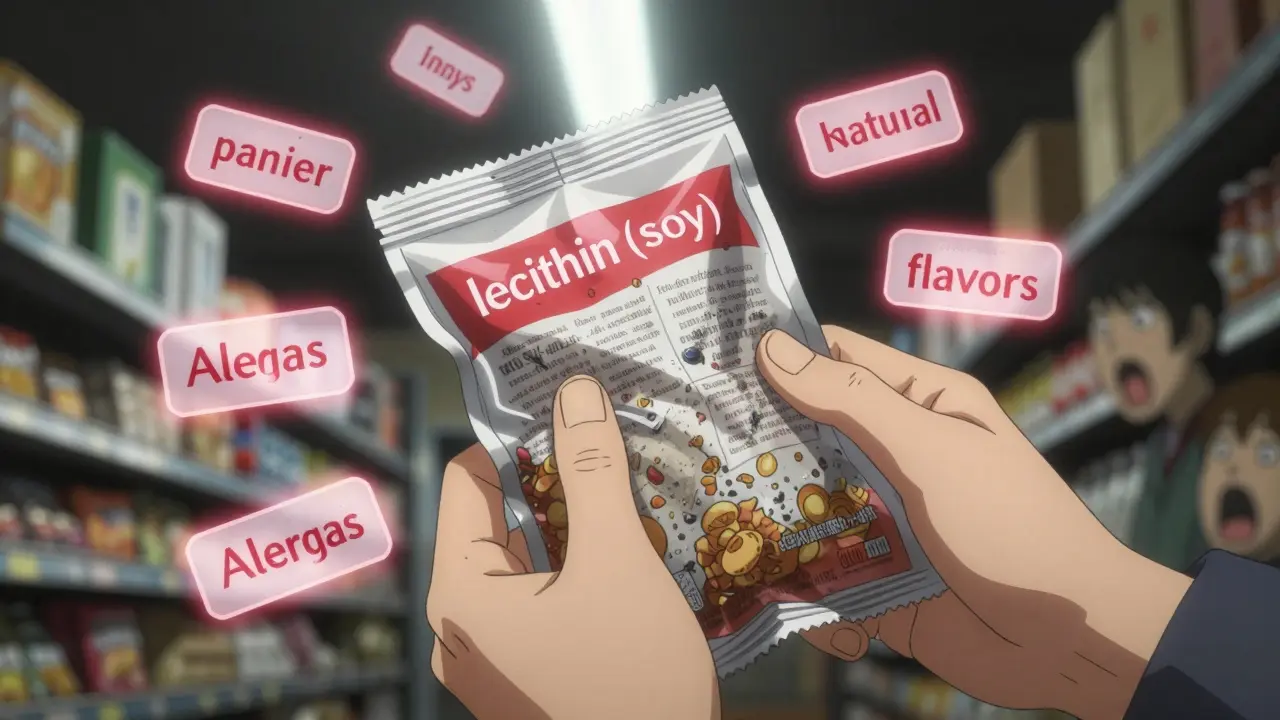
In the U.S., food manufacturers have to follow strict rules set by the FDA under the Food Allergen Labeling and Consumer Protection Act (FALCPA). Since 2023, nine major allergens must be clearly listed: milk, eggs, fish, crustacean shellfish, tree nuts, peanuts, wheat, soy, and sesame. That last one-sesame-was added after years of advocacy because it’s now known to affect over a million Americans. And it’s not optional. If a product contains even a tiny trace of one of these, it has to say so.You’ll find allergens listed in two places. First, look for a "Contains" statement right after the ingredient list. It might say "Contains: Milk, Soy, Tree Nuts." That’s your quick alert. But don’t stop there. Scroll back up and read the full ingredient list. Allergens often show up in parentheses next to their technical names. "Lecithin (soy)" or "casein (milk)" are common examples. If you see "natural flavors," "spices," or "starch," don’t assume they’re safe. Those can hide milk, soy, or wheat derivatives.
And then there’s the "may contain" warning. You’ve seen it: "May contain traces of peanuts." These are voluntary. Companies use them to cover themselves in case of accidental cross-contact during production. But here’s the problem: 63% of people think this means the allergen was intentionally added. It’s not. It means the factory also makes peanut butter, and a little might have gotten into your cereal. Still, if you’re highly allergic, treat "may contain" like a red flag. Don’t risk it.
Prescription Labels Are a Different Game
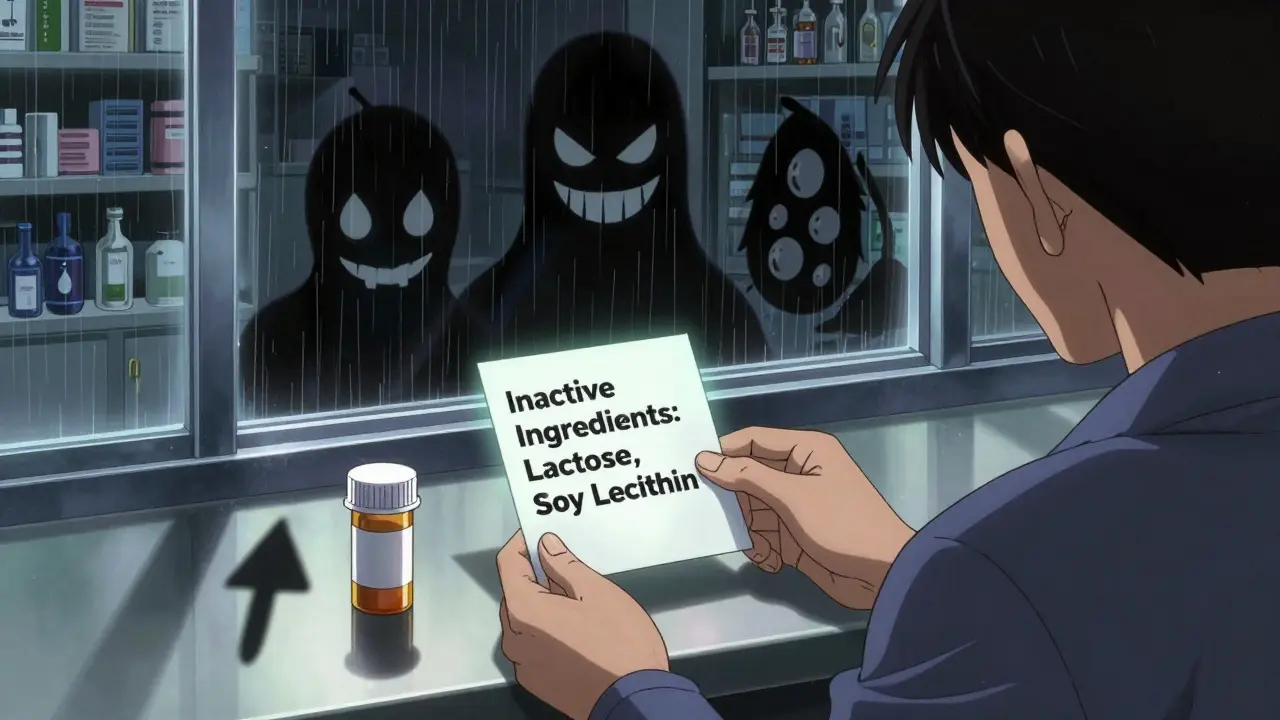
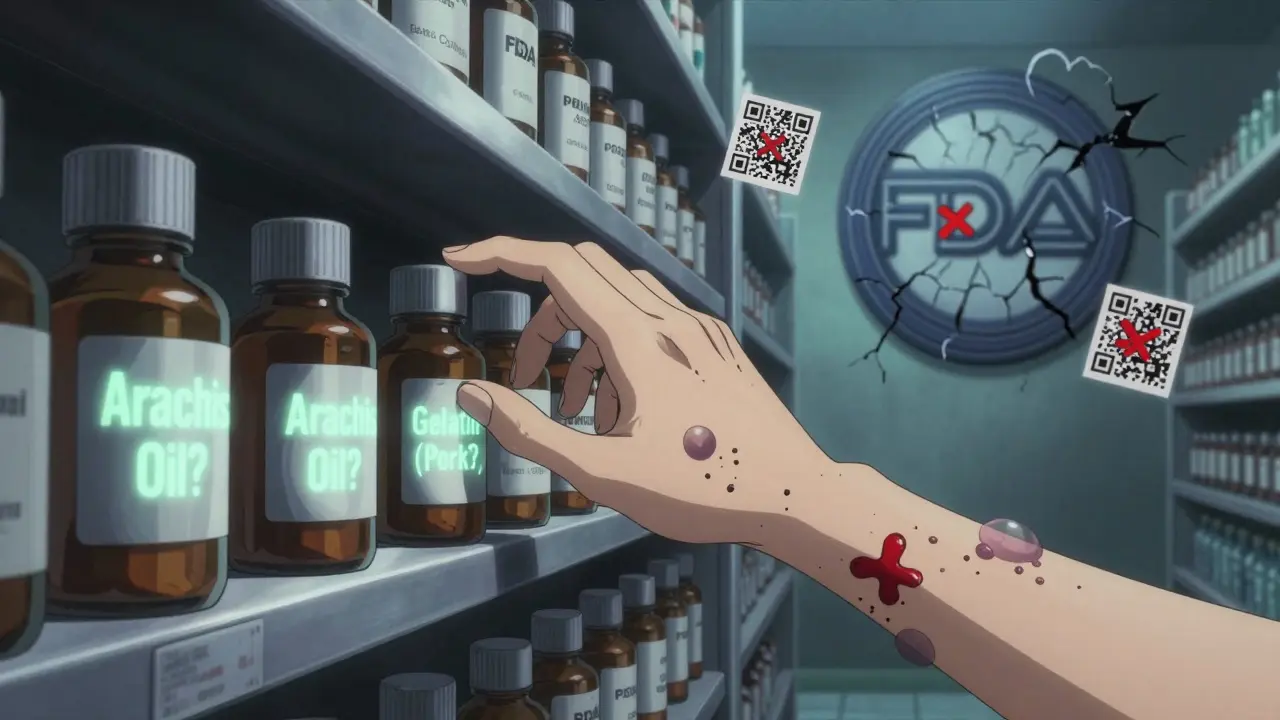
This is where things get dangerous. While food labels are tightly controlled, medicines are not. There’s no federal law requiring drug makers to list allergens in inactive ingredients. That means your prescription pill might contain lactose (a milk derivative), peanut oil, soy lecithin, or even gelatin from pork-all without any warning on the bottle.Pharmacists know this. That’s why they’re your best ally. When you pick up a new prescription, ask: "What are the inactive ingredients?" Don’t wait for them to offer it. Most people don’t ask, and that’s how reactions happen. Even if you’ve taken the same generic drug before, the manufacturer might have changed. Generic pills aren’t all the same. One brand might use cornstarch; another might use wheat starch. Same active ingredient. Different filler. Same risk.
Look at the printed insert that comes with your medication. It’s usually a tiny booklet. Flip to the section labeled "Inactive Ingredients" or "Excipients." That’s where you’ll find the truth. If you don’t get one, call the pharmacy. They can print it for you. Some pharmacies now offer digital inserts via email or apps. Use them.
Common Hidden Allergens in Medications
You might think you’re safe if you avoid peanuts and dairy. But here are the sneaky ones that catch people off guard:- Lactose - Found in over 20% of oral medications. It’s a milk sugar. Even if you’re lactose intolerant, you might not react. But if you have a true milk protein allergy, this can trigger anaphylaxis.
- Soy lecithin - Used as a binder in tablets. Often listed as "lecithin" without specifying the source. Soy is a top allergen.
- Peanut oil - Rare, but still used in some injectables and topical creams. It’s not always labeled as "peanut." It might say "arachis oil."
- Shellfish-derived glucosamine - Found in joint supplements. If you’re allergic to shrimp or crab, this can be a problem.
- Red dye #40 - Sometimes linked to reactions in sensitive individuals. Not a food allergen, but it’s an ingredient that can cause issues.
And don’t forget about topical products. Creams, ointments, and patches can contain allergens too. If you have eczema or a skin rash, and something keeps making it worse, check the ingredient list on the tube. Lanolin (from sheep’s wool) and fragrances are common triggers.
How to Build a Safe Label-Reading Habit
You don’t need to be an expert. You just need a system. Here’s how to make it automatic:- Pause before you take it. Whether it’s a pill, a snack, or a new skincare product-stop. Look. Read.
- Start with the "Contains" statement. On food, this is your first checkpoint. On medicine, skip this. Go straight to the inactive ingredients list.
- Know your allergens by their aliases. Casein = milk. Albumin = egg. Arachis = peanut. Hydrolyzed vegetable protein = could be soy or wheat.
- Check every time. Even if you’ve used the product for years. Formulas change. Manufacturers switch suppliers. A product you’ve safely eaten for five years might have a new ingredient this month.
- Use your phone. Apps like AllergyEats Scan let you take a picture of a label and instantly highlight allergens. They’re not perfect, but they’re better than guessing.
And here’s a pro tip: Keep a printed list of your allergens and your medication’s inactive ingredients in your wallet or phone notes. When you’re at the pharmacy, show it to the pharmacist. Say, "I’m allergic to X. Does this contain it?" That simple act cuts your risk in half.
What to Do When You Can’t Tell
Sometimes, the label is unclear. The ingredient list says "flavoring" or "natural color." You’re not sure. What then?Don’t guess. Call the manufacturer. Most have a customer service line listed on the package. Ask: "Does this product contain [allergen]?" Write down their answer. If they say "I don’t know," ask for a written response. If they won’t give it, avoid the product. Companies that hide behind vague language aren’t trustworthy.
For imported foods, be extra careful. Labels from other countries don’t follow U.S. rules. A chocolate bar from Italy might say "lecithin" without saying it’s from soy. The FDA found that 43% of imported foods in 2023 had incomplete allergen labeling. If you’re unsure, don’t risk it.
Why This Matters More Than You Think
Food allergy reactions cause over 200,000 emergency room visits in the U.S. every year. And 78% of those happen because families thought the food was safe. That’s not bad luck. That’s a labeling gap.Prescription errors are even harder to track. The FDA doesn’t require allergen reporting for drugs, so there’s no public database. But doctors and pharmacists know: 4% of adults have a documented allergy to a medication ingredient. Many don’t even know what it is. They just know they got sick after taking something.
And the cost? Beyond health-it’s financial. Allergen-related food recalls cost the industry over $1.2 billion a year. That’s because labels are the last line of defense. When they fail, people get hurt. And when people get hurt, trust breaks down.
That’s why brands with clear, bold, redundant labeling-like a "Contains" statement AND allergens in parentheses-get 4.7-star reviews. And why products with vague labels get 3.2 stars. People vote with their wallets. And they vote with their health.
What’s Changing Soon
The FDA is working on new rules. By 2025, they may require standardized wording for "may contain" labels. They’re also considering adding mustard and celery to the list of required allergens. And they’re pushing for better digital labeling-QR codes on packages that link to full ingredient lists with allergen filters.But until then, the burden is on you. No app, no law, no pharmacist can replace your own attention. You’re the final checkpoint. And that’s not a burden-it’s power.
Are food and medicine allergen labels the same?
No. Food labels are strictly regulated by the FDA and must clearly list the nine major allergens. Medicine labels are not required to list allergens in inactive ingredients. You must ask your pharmacist or check the package insert for drug ingredients.
Can I trust "may contain" warnings on food?
"May contain" labels are voluntary and indicate possible cross-contact, not intentional inclusion. If you have a severe allergy, treat them as warnings. They’re not reliable enough to guarantee safety, but they’re better than nothing. Always prioritize products with clear "Contains" statements.
What should I do if I react to a medication I’ve taken before?
Stop taking it immediately and contact your doctor. Then, call the pharmacy and ask for the inactive ingredients of the exact batch you took. Generic drugs can change manufacturers without changing the name. The new version might have a different filler that triggered your reaction.
Is sesame always labeled on food?
Yes, since January 2023, U.S. law requires sesame to be clearly labeled on food products, either in the ingredient list (e.g., "sesame oil") or in a "Contains" statement. If you don’t see it, the product is non-compliant and should be avoided.
Can I rely on a product being safe just because it’s labeled "allergen-free"?
No. There’s no official definition for "allergen-free" in the U.S. Some companies use it loosely. Always check the ingredient list and the "Contains" statement yourself. Look for third-party certifications like GFCO (Gluten-Free Certification Organization) or FARE’s Safe Snack Guide for more reliable assurance.

Peter Sharplin
Just had a friend go into anaphylaxis last month because they trusted the "may contain" label on a granola bar. Turns out the factory makes peanut butter in the same line. Scary stuff. Always double-check the inactive ingredients on meds too-I didn’t know lactose was in half my prescriptions until my allergist pointed it out. Now I print the inserts and keep them in my wallet.
Pro tip: Use the FDA’s DailyMed app. It pulls the exact inactive ingredient list from the manufacturer’s submission. No guessing.
And sesame? Yeah, it’s finally required. But if you see "natural flavors" and you’re allergic to it? Call the company. They’re legally obligated to answer.
Labels are the last line of defense. Treat them like your life depends on it-because they do.
SWAPNIL SIDAM
My cousin died from a pill with lactose. No warning. Just a tiny white tablet. No one told us. Now I read every label like it’s a bomb defusal manual. And I don’t trust "allergen-free" labels. None of them are regulated. Just say no to assumptions.
Mohammed Rizvi
Man, I used to think "lecithin" was just some fancy word for soy lecithin. Then I learned it could be sunflower, egg, or soy-and no one has to tell you which. So now I avoid anything with just "lecithin" on it. Same with "natural flavors." That’s just corporate speak for "we don’t want you to know what’s in here."
And don’t even get me started on gelatin. Pork-based. In capsules. No warning. Just pray you’re not Muslim, Jewish, or allergic.
Allie Lehto
OMG I just realized I’ve been taking ibuprofen with gelatin capsules for YEARS and I’m allergic to pork. How is this even legal?? I’m so mad. My skin breaks out every time I take it. I thought it was stress. Turns out it’s the capsule. I’m calling my doctor tomorrow. This is a nightmare. 😭
Uche Okoro
The regulatory asymmetry between food and pharmaceutical labeling is a systemic failure rooted in antiquated statutory frameworks. The Food Allergen Labeling and Consumer Protection Act (FALCPA) imposes mandatory disclosure thresholds for eight major allergens, yet the Federal Food, Drug, and Cosmetic Act (FDCA) grants pharmaceutical manufacturers de facto exemption from allergen disclosure under 21 CFR § 201.57. This creates a dangerous epistemic asymmetry wherein consumers are empowered to parse food labels but rendered epistemically vulnerable in pharmaceutical contexts.
Moreover, the absence of standardized nomenclature for excipients-e.g., "lecithin" without source specification-constitutes a violation of the principle of informed consent. The FDA’s voluntary guidance on allergen labeling for drugs (2018) lacks enforcement teeth. Until the FDA codifies allergen disclosure for excipients under 21 CFR Part 201, pharmacovigilance will remain reactive rather than preventive.
And let’s not forget the international dimension: imported products often bypass U.S. labeling requirements entirely. A 2023 GAO report found 43% of imported foods had incomplete allergen labeling. The same likely holds for pharmaceuticals sourced from offshore compounding labs. We need mandatory blockchain-based ingredient traceability. Not a suggestion. A necessity.
shivam utkresth
Back home in India, we don’t even have allergen labeling on most medicines. I had a friend who had a peanut reaction from a cough syrup-"peanut oil" wasn’t listed, just "vegetable oil." The pharmacist didn’t even know it was a problem. We need global standards. Not just U.S. rules.
And honestly? I don’t trust "may contain" labels anywhere. My mom avoids anything with "natural flavors" because she’s allergic to celery. But in India, celery isn’t even on the radar. We’re all just guessing. I wish more people knew this wasn’t just an American problem.
Ryan W
U.S. regulations are overkill. Why does sesame need its own label? We’ve been eating it for centuries. People are just too sensitive now. And don’t get me started on the "may contain" nonsense. If you’re that allergic, don’t eat anything. Simple. Stop blaming corporations for your overreactions. We don’t need QR codes on every candy bar. This is why America is collapsing.
Shawn Raja
Here’s the real truth: labels are a placebo. They make us feel safe, but they’re not safety. The system is broken because it was designed for people who don’t have allergies. The FDA doesn’t care about your anaphylaxis-they care about profit margins and liability. That’s why they let companies hide behind "natural flavors" and "lecithin."
Real safety? It’s knowing your allergens by heart. It’s calling the manufacturer. It’s keeping a printed list. It’s refusing to take anything you can’t verify.
And if you think this is just about food? Think again. Your antidepressant might have lactose. Your blood pressure pill might have soy. Your vitamin D? Gelatin from pigs. You’re not just reading labels-you’re fighting a silent war. And you’re the only soldier.
Josh josh
bro i just checked my advil and it says "lecithin" and i have a soy allergy and i just realized i’ve been taking this for 5 years and never thought twice lmao
Henry Jenkins
I’ve been reading labels for over a decade now. I’ve had reactions to soy lecithin in vitamins, lactose in migraine meds, and even a shellfish-derived glucosamine supplement that nearly put me in the ER. But here’s what I’ve learned: the system isn’t designed to protect you. It’s designed to minimize lawsuits. That’s why "may contain" exists-it’s a legal shield, not a warning.
So you have to become your own regulator. I keep a spreadsheet. Every medication I take, every food I buy. I log the batch number, the manufacturer, the inactive ingredients, and the date. I cross-reference with DailyMed, the FDA’s database, and even email manufacturers directly. It’s tedious. But it’s saved my life.
And here’s the thing nobody talks about: the psychological toll. You start to distrust everything. You feel like a paranoid outsider. You avoid restaurants, parties, even family dinners. That’s the hidden cost of being allergic in a world that doesn’t want to see your problem.
But I’d rather be called paranoid than dead. So I keep reading. I keep asking. I keep documenting. Because if I don’t, who will?
And if you’re reading this and you’ve never checked your meds? Do it today. Not tomorrow. Today.