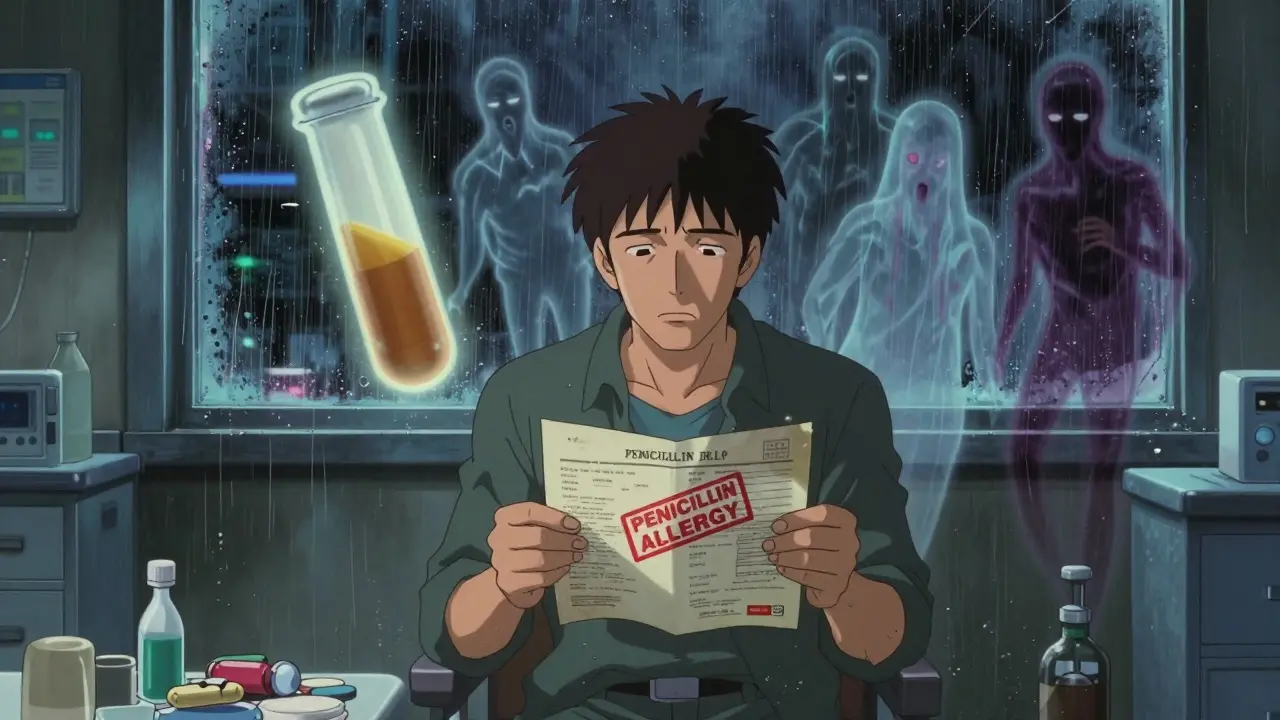
More than 10% of Americans say they’re allergic to penicillin. But here’s the shocking truth: over 95% of them aren’t. If you’ve been told you’re allergic to penicillin-or any antibiotic-based on a childhood rash, a stomach ache, or a doctor’s guess, you might be carrying a label that’s putting your health at risk. And it’s not just you. Millions of people worldwide are stuck with false drug allergy labels, and it’s making infections harder to treat, driving up costs, and fueling antibiotic resistance.
Why a False Allergy Label Is More Dangerous Than You Think
A penicillin allergy label sounds harmless. You avoid the drug, you’re safe, right? Not exactly. When you’re labeled allergic, doctors can’t use the safest, most effective antibiotics. Instead, they turn to broader-spectrum drugs like vancomycin, clindamycin, or fluoroquinolones. These aren’t just less effective-they’re more likely to cause side effects, trigger C. diff infections, and push bacteria toward resistance. The CDC reports that false penicillin allergy labels lead to 50,000 extra cases of C. diff each year in the U.S. alone. That’s not a typo. That’s 50,000 people getting dangerously ill because a harmless reaction from 30 years ago is still in their medical record. Hospitals see it too: patients with false allergy labels stay longer, cost $1,000 more per admission, and are more likely to be readmitted. And here’s the kicker: true penicillin allergy is rare. Only 1-2% of people who report it actually have an IgE-mediated reaction-the kind that causes anaphylaxis. The rest? They had a rash after a virus, nausea from a stomach bug, or a reaction to something else entirely. But once that label sticks, it rarely gets removed.How Do You Know If Your Allergy Label Is Real?
The only way to find out is through testing. There’s no blood test, no quick scan, no app that can tell you for sure. You need a medical evaluation that includes your history and, in most cases, a controlled challenge. The first step is a detailed interview. Doctors use tools like PEN-FAST to score your risk:- P - Was the reaction 5 or more years ago? (Yes = 0 points)
- E - Was it anaphylaxis or angioedema? (No = 0 points)
- N - Was there no skin testing or challenge done? (Yes = 0 points)
- FAST - Was it a non-severe reaction like a rash? (Yes = 0 points)
What Does Drug Allergy Testing Actually Involve?
There are two main paths: skin testing and direct oral challenge. Both are safe, fast, and done under supervision. Skin testing is the gold standard for immediate reactions. A tiny amount of penicillin (or its components) is placed on your skin, then lightly pricked. If you’re allergic, you’ll get a red, itchy bump within 15-20 minutes. If nothing happens, they do a deeper intradermal test. Together, these tests are 98% accurate at ruling out true IgE allergies. Direct oral challenge skips the skin test and gives you a small, then full, dose of amoxicillin under observation. You’re monitored for 60-90 minutes. If you feel fine, you’re cleared. This approach works for low-risk patients and is used in clinics that don’t have allergists on staff. A 2023 study in Singapore followed 331 patients with suspected penicillin allergies. After testing, 75% were found to have false labels. Of those, 94% tolerated the challenge without issue. Only 2% had mild reactions-mostly a rash that went away on its own.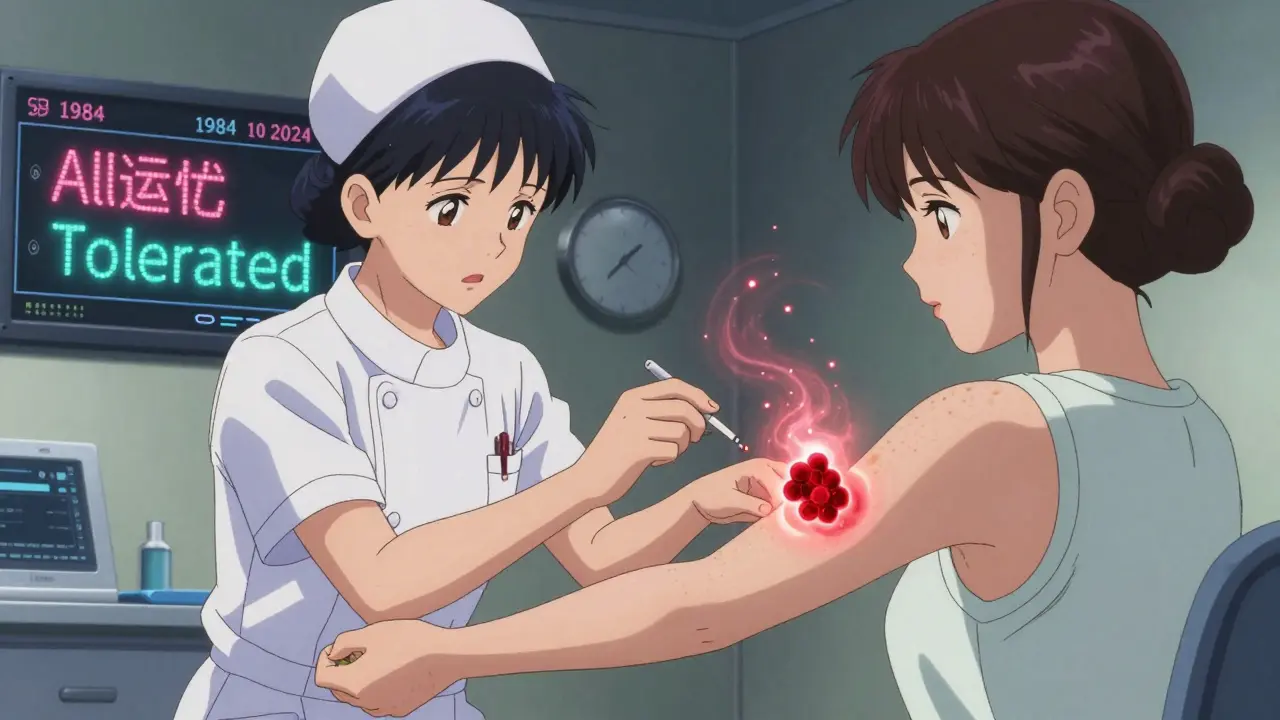
Who Can Do This Testing? And Where?
You don’t need to see an allergist to get started. More hospitals and primary care clinics are training nurses and general practitioners to run de-labeling programs. The University of Pennsylvania’s Penicillin Allergy Relief Program has safely de-labeled over 1,800 patients since 2020-with zero severe reactions. If your doctor doesn’t offer testing, ask for a referral. Many hospitals now have dedicated allergy de-labeling clinics. The CDC’s Allergy Alert Initiative, launched in 2024, is funding 12 regional centers focused on safety-net hospitals, where these services are most needed. Even telemedicine is working. A 2024 study in the Netherlands showed that 897 patients completed remote assessments with a 96% success rate. If you’re low risk, you might be able to do the challenge at home with video check-ins and a local pharmacy dispensing the dose.What Happens After You’re Cleared?
Getting cleared isn’t the end-it’s the start of better care. Once you’re de-labeled, your medical record gets updated. The label changes from “Penicillin Allergy” to “Penicillin Tolerated” or “No True Allergy.” That means next time you have a sinus infection, UTI, or pneumonia, your doctor can prescribe amoxicillin or cephalexin-the first-line treatments that work faster, cost less, and are easier on your gut. No more Z-Paks that give you diarrhea. No more IV antibiotics that require hospital stays. One patient in Massachusetts, a 68-year-old with a 40-year-old penicillin label, avoided three hospitalizations for complicated UTIs after being cleared. Over two years, he saved over $28,000 in care costs.Why Don’t More People Get Tested?
The biggest barrier isn’t fear-it’s access. Fewer than 40% of eligible patients get tested. Why?- Doctors don’t know how to order it.
- Patients are scared of having a reaction.
- Wait times can be 14 weeks or longer.
- Electronic health records make it hard to update allergy status.
- Some hospitals don’t stock the right test formulations.

What If You React During Testing?
Reactions during testing are rare-and almost always mild. The most common is a small rash. In very few cases, someone might get hives or mild wheezing. That’s why testing is done in a setting with emergency equipment and trained staff. Epinephrine is always on hand. If you react, they treat it and update your label correctly. That’s better than living with a false label. One Reddit user, PenicillinCurious22, shared: “I had a rash at age 5. I was told I was allergic. I took Z-Pak for every infection and got stomach issues every time. After testing, I took amoxicillin for a sinus infection-zero problems. I finally feel like I can trust my body again.”What About Other Antibiotics?
Penicillin is the most common false label, but the same applies to other beta-lactams: amoxicillin, ampicillin, cephalexin, and even some cephalosporins. Cross-reactivity is often overestimated. You can be allergic to one penicillin and not another. Testing helps you know exactly which drugs are safe. Don’t assume “all penicillins are the same.” Your label should be specific: “Allergic to amoxicillin” is very different from “Allergic to penicillin.”What Should You Do Next?
If you’ve been told you’re allergic to penicillin or another antibiotic:- Check your medical record. What exactly does it say?
- Think back: Was the reaction more than 10 years ago? Was it a rash? Did you have a fever or virus at the time?
- Ask your doctor: “Can I be tested to see if I’m still allergic?”
- If they say no, ask for a referral to an allergy clinic or an antimicrobial stewardship program.
- Bring this information with you. You’re not asking for a favor-you’re asking for evidence-based care.
Can you outgrow a penicillin allergy?
Yes. Most people who had a penicillin allergy in childhood lose their sensitivity over time. Studies show that 80% of people who were allergic at age 5 are no longer allergic by age 30. That’s why retesting is recommended for anyone with a childhood label, even if they’ve avoided the drug for decades.
Is drug allergy testing covered by insurance?
In most cases, yes. Skin testing and oral challenges are covered by Medicare, Medicaid, and private insurers when ordered by a licensed provider. Since false allergy labels increase long-term costs, insurers are increasingly incentivizing de-labeling. Always check with your provider, but don’t assume it’s not covered.
Can I test myself at home?
No. Never take a drug you think you’re allergic to without medical supervision. Even low-risk challenges require monitoring for at least 60 minutes. Some telehealth programs now offer remote guidance with a local pharmacy dispensing the dose, but the challenge must still be observed by a healthcare professional.
What if I had a severe reaction in the past?
If you had anaphylaxis, swelling of the throat, or trouble breathing, you should still be evaluated by an allergist. But even then, many people with severe reactions turn out to have misdiagnosed causes-like a viral rash or reaction to another medication. Testing can confirm whether the reaction was truly IgE-mediated or something else.
How long does the whole process take?
For low-risk patients, a direct oral challenge can be done in one visit-about 90 minutes total. Skin testing takes about 30 minutes, followed by the challenge later that day or the next. Most people get cleared in one or two appointments. Wait times vary, but many clinics now offer same-week slots for low-risk cases.

Gran Badshah
Bro i had a rash at 7 and got labeled allergic. Took z-pack for 15 years. Got c. diff twice. Finally got tested last year - turned out i was fine. Amoxicillin for a sinus infection? Easy. No more diarrhea, no more $800 bills. Why isn’t this common knowledge?
Ellen-Cathryn Nash
It’s insane that we’re still letting doctors play guesswork with people’s lives. This isn’t just medical negligence - it’s systemic laziness dressed up as tradition. I’ve seen patients die from avoidable infections because someone didn’t bother to update a 40-year-old note. And now we’re surprised antibiotic resistance is climbing? Wake up. This is preventable carnage.
Samantha Hobbs
OMG I JUST REALIZED I’M ONE OF THEM. I got a rash after penicillin when I was 6. I’ve been avoiding all antibiotics like they’re poison. My dentist just gave me amoxicillin last week and I was sweating bullets. I’m calling my doctor tomorrow. This post saved me from another decade of unnecessary suffering 💀
Nicole Beasley
So if you had a rash as a kid and it wasn’t hives or swelling… you’re probably fine?? 😱 I’m 29 and have been told I’m allergic since I was 4. My mom still freaks out when I even mention antibiotics. I’m gonna get tested. Like… immediately. This is wild. 🤯
sonam gupta
India has same problem. Doctors label everyone allergic. No testing. People die because they give expensive useless drugs. Why dont government fix this. Simple test can save millions. Stop wasting money on wrong medicine
Julius Hader
I work in a hospital and we’ve started running de-labeling clinics. It’s honestly one of the most rewarding things I’ve done. People cry when they find out they can finally take amoxicillin again. One guy said he’d been on IV antibiotics every time he got sick since he was 12. He got cleared last month. Now he’s hiking in Colorado. That’s the kind of win we need more of.
Vu L
Wait so you’re telling me the entire medical system is just… guessing? And we’re okay with that? I mean sure, 95% of people aren’t allergic - but what if I’m the 5%? What if I die because some nurse didn’t feel like calling an allergist? This sounds like a bad episode of House.
James Hilton
So let me get this straight - we’ve got a $28k savings, 50k fewer C. diff cases, and less antibiotic resistance… but people still won’t get tested because they’re ‘afraid’? Bro. You’re scared of a 90-minute doctor visit more than you’re scared of dying from superbugs? 😂
Mimi Bos
i just found out my mom has a penicillin label from 1978. she had a rash after the flu. she’s 72. i’m taking her to get tested next week. i dont even know how to thank you for this post. my phone is full of screenshots now. p.s. i typed this with one hand because i just spilled coffee on my keyboard. oops.