
Medication Dry Eye Risk Assessor
Your Dry Eye Risk Assessment
Based on your medications and lifestyle factors
Immediate Actions
Loading recommendations...
Long-term Strategy
Loading recommendations...
Expected Timeline for Improvement
Initial improvements expected with consistent use of preservative-free tears and environmental adjustments.
Omega-3 supplements begin stabilizing tear film. Warm compresses improve gland function.
Prescription treatments reach full effectiveness if needed. Significant symptom reduction possible.
Your eyes feel like they are filled with sand. You blink, but the burning doesn’t stop. If you recently started a new prescription or have been taking daily medication for years, this might not just be bad luck-it could be your medicine. Medication-induced dry eye is a common side effect where drugs disrupt natural tear production or composition, leading to irritation and blurred vision. It affects roughly 25-30% of all dry eye cases, jumping to 40% in people over 65 who often take multiple prescriptions at once.
This isn't something you just have to live with. Understanding why your meds cause this issue is the first step to fixing it. By adjusting your lubrication routine and tweaking your lifestyle, you can get relief without necessarily stopping essential treatments.
Why Your Medicine Is Drying Out Your Eyes
To fix the problem, you need to know what’s breaking. Medications don’t usually dry out eyes by accident; they interfere with specific biological processes. There are four main ways this happens.
- Anticholinergic effects: Many drugs block nervous system signals that tell your lacrimal glands to produce tears. Less signal means less fluid.
- Glandular changes: Some medications impair the meibomian glands, which are tiny oil-producing glands in your eyelids responsible for the lipid layer of tears. Without this oil layer, your tears evaporate too quickly.
- Systemic dehydration: Diuretics (water pills) make your whole body lose fluid, including your eyes.
- Tear film instability: Certain drugs alter the chemical makeup of tears or introduce irritants that break down the protective layer on your eye surface.
Knowing which mechanism is at play helps you choose the right treatment. For example, if your drug causes glandular changes, simple water-based drops won’t help as much as therapies that restore the oil layer.
The Usual Suspects: Common Medications Linked to Dry Eyes
If you are wondering if your specific pill is the culprit, check against these frequent offenders. These categories account for the majority of reported cases.
| Medication Class | Common Examples | Primary Mechanism |
|---|---|---|
| Antihistamines | Diphenhydramine (Benadryl), Loratadine (Claritin), Cetirizine (Zyrtec) | Blocks tear production signals |
| Antidepressants | Amitriptyline, Sertraline (Zoloft), Fluoxetine (Prozac) | Anticholinergic effects reducing fluid |
| Blood Pressure Meds | Metoprolol, Atenolol, Hydrochlorothiazide, Furosemide (Lasix) | Systemic dehydration or reduced blood flow |
| Anti-Acne Drugs | Isotretinoin (Accutane) | Severe meibomian gland dysfunction |
| Glaucoma Drops | Latanoprost, Timolol, Dorzolamide | Preservative toxicity (BAK) |
A critical note on glaucoma drops: up to 47% of patients experience burning and dryness due to benzalkonium chloride (BAK), a common preservative in eye drops that can damage the ocular surface. Switching to preservative-free formulations can drop that discomfort rate to just 16%.
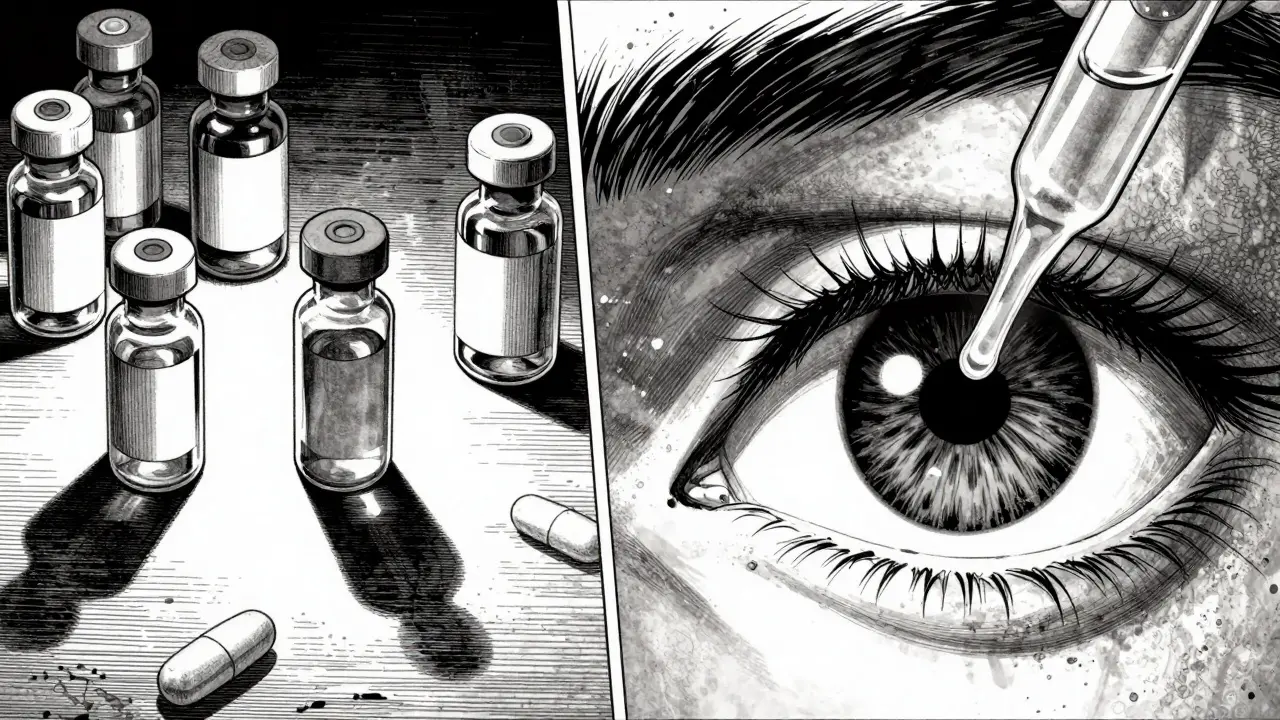
Lubrication Strategies That Actually Work
Not all eye drops are created equal. When your medication is drying you out, using the wrong drops can sometimes make things worse. Here is how to build an effective lubrication routine.
Switch to Preservative-Free Artificial Tears
If you use drops more than four times a day, standard bottles with preservatives can irritate your eyes further. Ophthalmologists recommend preservative-free artificial tears used 4-6 times daily. These come in single-use vials that eliminate toxic buildup. For patients using glaucoma meds, applying preservative-free tears 15 minutes before and after their prescription drops has shown a 78% improvement in symptoms in clinical studies.
Warm Compresses and Lid Massage
If your medication affects your oil glands (like isotretinoin or certain antidepressants), water-based drops aren't enough. You need to unclog the glands. Apply a warm compress for 10-15 minutes twice daily, followed by gentle lid massage. This improves meibomian gland function in 65% of cases involving glandular changes.
Prescription Options for Stubborn Cases
When over-the-counter methods fail, doctors may prescribe stronger treatments:
- Cyclosporine ophthalmic emulsion (Restasis): Increases tear production by 15-20% after 6 months of consistent use.
- Lifitegrast ophthalmic solution (Xiidra): Reduces inflammation and symptoms by 30% in trials.
- Punctal plugs: Tiny inserts that block tear drainage, increasing tear volume by 40-50%. Temporary collagen plugs work well for 3-6 months to test effectiveness.
Lifestyle Tweaks to Boost Tear Health
Lubrication treats the symptom, but lifestyle changes support your eyes' ability to heal themselves. Small shifts in your environment and habits can significantly reduce evaporation and irritation.
Control Your Environment
Dry air is the enemy of dry eyes. Keep indoor humidity between 40-60% using a humidifier. This simple change reduces tear evaporation by 25%. Also, avoid direct airflow. Don’t sit directly under air conditioning vents or point car fans at your face. Maintaining airflow below 0.15 m/s near your eyes cuts evaporation by another 30%.
The 20-20-20 Rule
If you take antihistamines or antidepressants, you likely blink less when focusing. Practice the 20-20-20 rule: every 20 minutes, look at something 20 feet away for 20 seconds. This resets your blink rate and reduces digital eye strain symptoms by 35%.
Dietary Support with Omega-3s
What you eat impacts your tear quality. Supplementing with 1,000-2,000 mg of EPA/DHA omega-3 fatty acids daily improves tear film stability in 60% of patients within three months. This is especially helpful if you are on diuretics that dehydrate your system.
Quit Smoking
If you smoke, this is non-negotiable. Tobacco smoke exacerbates dry eye symptoms by 45% in medication users. The good news? Improvement typically starts within 2-4 weeks of quitting.

Working With Your Doctor: A Strategic Approach
Don’t just suffer in silence. Expert consensus emphasizes a systematic approach rather than just adding more drops. Here is how to talk to your healthcare provider.
- Review Your Meds: Ask if there are alternatives with fewer ocular side effects. Dr. Vicente Diaz notes that changing the medication type or dosage is often better than just masking symptoms with lubricants.
- Consider Dose Reduction: In 55% of cases, lowering the dose alleviates dry eye symptoms without compromising the primary health benefit.
- Coordinate Care: See both your prescribing physician and an eye care specialist. Abruptly stopping blood pressure meds or antidepressants can be dangerous. A coordinated plan ensures safety while addressing eye health.
Remember, eliminating the offending medication can reverse symptoms and prevent further deterioration in 70-80% of cases where substitution is possible.
Real-Life Expectations and Timeline
Managing medication-induced dry eye takes patience. Here is what to expect:
- Weeks 1-4: You should see initial improvement with consistent use of preservative-free tears and lifestyle changes.
- Months 1-3: Omega-3 supplements begin to stabilize your tear film. Warm compresses start improving gland function.
- Months 3-6: Prescription anti-inflammatories like Restasis reach full therapeutic effect.
Adherence is key. Studies show that 60% of success depends on sticking to the complete regimen, not just using drops when it hurts. Proper technique matters too-tilt your head back 45 degrees, pull your lower lid down, and apply drops without touching your eye to improve effectiveness by 25%.
Can I stop my medication if it causes dry eyes?
Never stop prescribed medication abruptly without consulting your doctor. While switching to an alternative or reducing the dose can help, sudden cessation of drugs like antidepressants or blood pressure meds can be dangerous. Always coordinate with your prescribing physician and an eye specialist.
Are preservative-free eye drops really necessary?
Yes, if you use drops more than four times a day. Preservatives in standard bottles can irritate the ocular surface over time. Preservative-free single-dose vials eliminate this risk and are recommended by ophthalmologists for chronic dry eye management.
How long does it take for dry eye treatments to work?
Initial relief from artificial tears is immediate but temporary. Omega-3 supplements typically show results in 3 months. Prescription anti-inflammatories like cyclosporine (Restasis) can take 3-6 months to reach full effectiveness. Consistency is crucial during this period.
Do glaucoma drops always cause dry eyes?
Not always, but up to 47% of patients experience issues due to the BAK preservative. Switching to preservative-free glaucoma formulations can reduce this rate to 16%. Ask your eye doctor if a preservative-free option is available for your condition.
Can diet really help with medication-induced dry eyes?
Yes. Omega-3 fatty acids (EPA/DHA) improve tear film stability in 60% of patients within three months. This is particularly beneficial for those taking diuretics or other medications that cause systemic dehydration. Aim for 1,000-2,000 mg daily.
