
DOAC Dosing Decision Tool
Note: Calculated using the Cockcroft-Gault formula.
Using blood thinners when your kidneys aren’t working well is a tightrope walk. Direct Oral Anticoagulants, known as DOACs, are oral medications that prevent blood clots by targeting specific clotting factors, have become the go-to choice for preventing strokes in patients with atrial fibrillation. They replaced warfarin for most people because they don’t require constant blood tests and have fewer food interactions. But here’s the catch: your kidneys help clear these drugs from your body. If your kidneys are impaired, the drug stays in your system longer, raising the risk of dangerous bleeding. If you under-dose, you risk a stroke. Getting it right isn’t just about following a label; it requires precise calculation and understanding which drug behaves best in kidney disease.
Why Kidney Function Changes Everything for DOACs
The reason renal impairment matters so much is pharmacokinetics-the way your body handles the drug. Unlike warfarin, which is mostly processed by the liver, DOACs rely heavily on the kidneys to exit the body. The four main DOACs approved for stroke prevention in atrial fibrillation are apixaban (Eliquis), rivaroxaban (Xarelto), dabigatran (Pradaxa), and edoxaban (Savaysa). Each has a different percentage of renal elimination. For example, dabigatran is up to 80% renally excreted, making it very sensitive to kidney function changes. Apixaban is only about 27% renally excreted, which makes it more forgiving in patients with reduced kidney function.
As of 2023, DOACs account for 87% of oral anticoagulant prescriptions for stroke prevention, surpassing warfarin entirely. However, among patients prescribed these drugs, between 11.5% and 44.6% have chronic kidney disease (CKD). This overlap means clinicians are frequently navigating this high-risk zone. The core problem is that standard doses can lead to supratherapeutic levels-too much drug in the blood-which directly increases the risk of major bleeding events like gastrointestinal hemorrhage or intracranial bleeding.
The Golden Rule: Use Cockcroft-Gault, Not eGFR
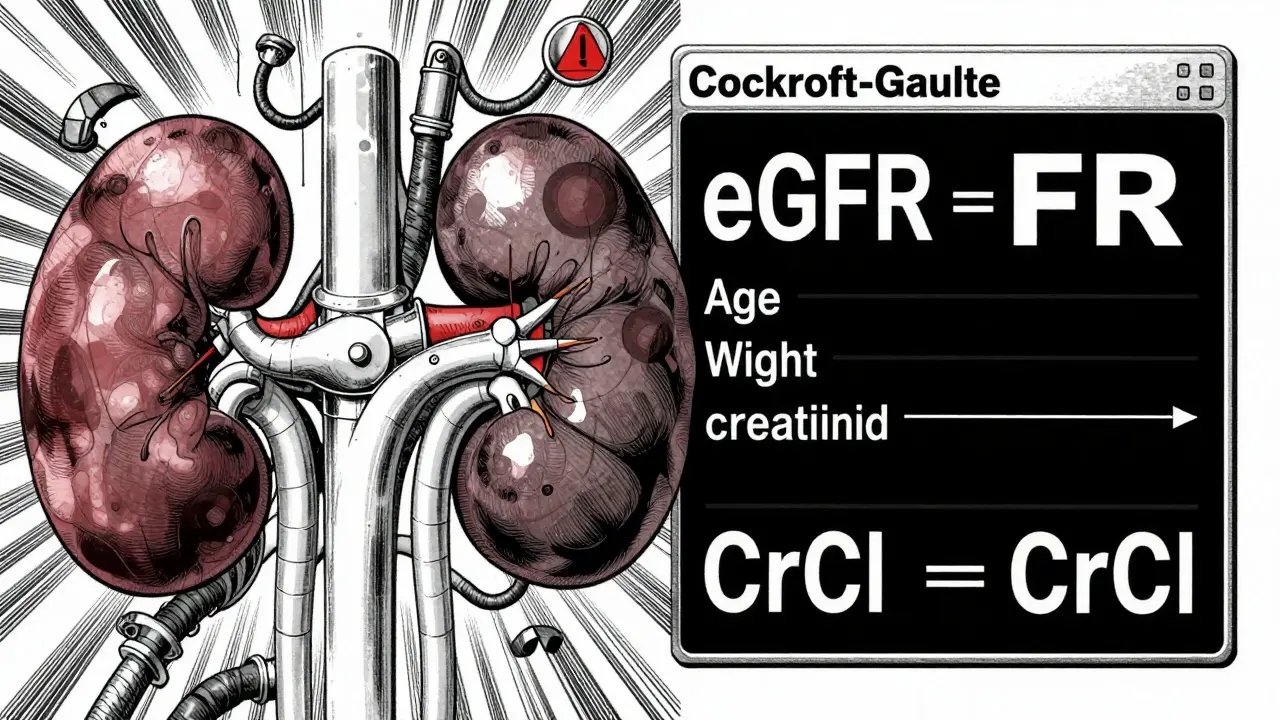
This is the single most common mistake made in prescribing DOACs for patients with kidney issues. You must calculate creatinine clearance (CrCl) using the Cockcroft-Gault formula, which is a mathematical equation developed in 1976 to estimate creatinine clearance based on age, weight, sex, and serum creatinine. Do not use estimated glomerular filtration rate (eGFR). While eGFR is standard for staging chronic kidney disease, it is not validated for drug dosing decisions. The FDA specifically recommends the Cockcroft-Gault equation for renal dose adjustments since 1998.
Why does this distinction matter? In elderly or low-body-weight patients, eGFR often overestimates kidney function compared to Cockcroft-Gault. Using eGFR might lead you to believe a patient’s kidneys are functioning well enough for a full dose, when in reality, their CrCl is lower, putting them at risk for toxicity. The formula accounts for lean body mass, which is crucial because muscle mass produces creatinine. A frail 80-year-old woman will have a different clearance rate than a muscular 50-year-old man with the same serum creatinine level. Always double-check your calculation manually if you suspect the automated lab result (which usually reports eGFR) doesn't match the patient's clinical picture.
Dosing Adjustments for Each DOAC
Each DOAC has specific thresholds where you must adjust the dose or stop the medication entirely. These limits are strict for a reason. Here is how the four major agents break down:
- Apixaban: Standard dose is 5 mg twice daily. Reduce to 2.5 mg twice daily if the patient meets at least two of these three criteria: age ≥80 years, body weight ≤60 kg, or serum creatinine ≥1.5 mg/dL (133 μmol/L). It is contraindicated if CrCl is less than 15 mL/min. Interestingly, apixaban is the only DOAC with some evidence supporting its use in end-stage renal disease (ESRD) on hemodialysis, though guidelines remain cautious.
- Rivaroxaban: Requires dose adjustment for CrCl 15-50 mL/min depending on the indication. It is generally not recommended for patients with stage 5 CKD or those on dialysis due to lack of safety data and higher bleeding risks.
- Dabigatran: Reduce dose to 75 mg twice daily if CrCl is 15-30 mL/min. Contraindicated if CrCl is less than 15 mL/min. Because it is highly renally cleared, it accumulates quickly in kidney failure.
- Edoxaban: Reduce dose to 30 mg daily if CrCl is 15-50 mL/min. Contraindicated if CrCl is less than 15 mL/min.
| Drug | Standard Dose | Reduced Dose Criteria | Contraindicated Below |
|---|---|---|---|
| Apixaban | 5 mg BID | ≥2 of: Age ≥80, Weight ≤60kg, Cr ≥1.5mg/dL | CrCl < 15 mL/min |
| Rivaroxaban | 15-20 mg Daily | CrCl 15-50 mL/min (varies by indication) | CrCl < 15 mL/min |
| Dabigatran | 150 mg BID | CrCl 15-30 mL/min → 75 mg BID | CrCl < 15 mL/min |
| Edoxaban | 60 mg Daily | CrCl 15-50 mL/min → 30 mg Daily | CrCl < 15 mL/min |
Choosing the Right Agent in Advanced Kidney Disease
When you hit the gray area of severe renal impairment (CrCl 15-29 mL/min) or end-stage renal disease (ESRD), the choice becomes more nuanced. Apixaban currently holds the strongest safety profile. A 2020 review in the Journal of the American Heart Association found that apixaban was associated with a lower risk of major bleeding compared to warfarin in patients with advanced CKD or ESRD. Warfarin, traditionally used in dialysis patients, carries a high risk of vascular calcification and intracranial hemorrhage, offering little proven benefit over the risks.
However, be careful with "standard" apixaban doses in these patients. There are documented cases of life-threatening gastrointestinal bleeding in ESRD patients who were given 5 mg twice daily even though they met criteria for reduction. The consensus among nephrologists and cardiologists is leaning toward apixaban 2.5 mg twice daily for AFib patients on hemodialysis, but this remains off-label and requires shared decision-making with the patient about the risks.
Rivaroxaban and dabigatran are generally avoided in ESRD due to the lack of robust trial data and higher accumulation risks. Edoxaban also lacks strong evidence in the dialysis population. If a patient has a CrCl greater than 30 mL/min, all DOACs are considered safe and non-inferior to warfarin, so you can choose based on other factors like cost, pill burden, or patient preference.

Pitfalls and Practical Monitoring Strategies
Inappropriate dosing is the leading cause of adverse events in this population. A multicenter study published in JAMA Internal Medicine found that 37.2% of DOAC prescriptions in CKD patients had dosing errors. The biggest culprit? Failing to recalculate renal function regularly. Kidney function can decline rapidly during acute illness, dehydration, or after starting new medications like NSAIDs or ACE inhibitors.
To avoid side effects, implement these practical steps:
- Calculate CrCl manually: Don’t trust the eGFR on the lab report. Use the Cockcroft-Gault formula every time you prescribe or renew a DOAC in a patient over 65 or with known kidney issues.
- Use the ABC mnemonic for Apixaban: Remember Age ≥80, Body weight ≤60 kg, Creatinine ≥1.5 mg/dL. If any two apply, drop the dose to 2.5 mg.
- Monitor annually at minimum: Check serum creatinine and calculate CrCl at least once a year. In unstable patients, check every 3-6 months.
- Beware of drug interactions: P-glycoprotein inhibitors (like amiodarone or verapamil) can increase DOAC levels, compounding the risk in renal impairment.
- Consider virtual clinics: Telehealth anticoagulation monitoring has shown a 22.7% reduction in adverse events by ensuring consistent follow-up and timely dose adjustments.
If a patient presents with signs of bleeding, such as unexplained bruising, dark stools, or fatigue, check their coagulation status immediately. While there are no routine reversal agents for all DOACs, idarucizumab reverses dabigatran, and andexanet alfa can reverse factor Xa inhibitors like apixaban and rivaroxaban in life-threatening emergencies.
What’s Next in DOAC Research?
The landscape is shifting. The AXIOS trial, which aimed to compare apixaban versus warfarin in hemodialysis patients, was terminated early due to poor enrollment, but its pharmacodynamic data released in 2024 provided insights into how apixaban behaves in zero-kidney-function scenarios. Meanwhile, the RENAL-AF trial results expected in 2025 may provide clearer guidance on warfarin versus DOACs in severe renal impairment. By 2026, we expect more specific labeling for all stages of CKD, potentially expanding the safe use of DOACs in dialysis populations. Until then, stick to the guidelines, calculate carefully, and prioritize patient safety over convenience.
Can I use eGFR instead of Cockcroft-Gault for DOAC dosing?
No. You should never use eGFR for DOAC dosing decisions. The FDA and major cardiology guidelines specifically require the use of the Cockcroft-Gault formula to estimate creatinine clearance (CrCl). eGFR often overestimates kidney function in elderly or low-weight patients, which can lead to dangerous overdosing of anticoagulants.
Which DOAC is safest for patients on dialysis?
Apixaban is currently considered the safest option for patients with end-stage renal disease (ESRD) on hemodialysis. Studies show it has a lower risk of major bleeding compared to warfarin in this population. However, it is still used off-label in many regions, and the typical dose is reduced to 2.5 mg twice daily. Rivaroxaban and dabigatran are generally avoided in dialysis patients due to higher bleeding risks.
How often should I check kidney function for a patient on DOACs?
You should assess renal function before starting a DOAC and at least annually thereafter. For patients with existing chronic kidney disease or those whose condition is unstable, check serum creatinine and recalculate CrCl every 3 to 6 months. Any significant change in health, such as dehydration or new medications, warrants an immediate re-evaluation.
What are the criteria for reducing apixaban dosage?
Apixaban dose should be reduced from 5 mg to 2.5 mg twice daily if the patient meets at least two of the following three criteria: age 80 years or older, body weight 60 kg or less, or serum creatinine 1.5 mg/dL or higher. This rule applies regardless of the calculated CrCl, provided it is not below 15 mL/min.
Is warfarin better than DOACs for kidney disease?
For most patients with mild to moderate renal impairment (CrCl >30 mL/min), DOACs are preferred over warfarin due to better safety profiles and ease of use. In end-stage renal disease, warfarin has historically been used, but recent data suggests apixaban may be safer with less intracranial bleeding. Warfarin carries risks of vascular calcification and requires frequent monitoring, making it less ideal unless specific contraindications exist for DOACs.

Amelia Vaughan
You people really need to stop guessing with these drugs. It is not a game. If you ignore the kidney numbers, you kill patients. Simple as that.
Kevin S
Great post! 👍 This is so helpful for anyone dealing with AFib and kidney issues. Thanks for sharing this info! 🙌
Madison Jones
This is incredibly important information!! I cannot stress enough how vital it is to use the Cockcroft-Gault formula!!! So many doctors just look at the eGFR on the lab report and move on!!! It leads to such dangerous mistakes!!! Please share this widely!!! We need more awareness about this specific calculation method!!! It saves lives!!! ❤️
Sarah Grenberg
The distinction between eGFR and CrCl is often overlooked in busy clinical settings. However, precision matters immensely here. Apixaban remains the most forgiving option for those with reduced renal function, provided we adhere strictly to the dosing criteria. Let us prioritize patient safety above all else.
Brian Lee
I totally agree with the points made here. Its easy to forget that dabigatran is mostly cleared by kidneys. You have to be super careful with elderly patients who might have lower muscle mass but same creatinine levels. The Cockcroft Gault formula really does make a difference in these cases. Good write up overall.
Jake Williams
Typical American healthcare mess. Doctors are too lazy to do the math themselves so they trust the computer which gives them the wrong number. Then when the patient bleeds out, they act surprised. Fix your system before blaming the drug labels.
Nilesh Mandani
It is interesting how pharmacokinetics changes everything. In my experience, the overlap of CKD and AFib is growing rapidly. We must understand that standard doses are not one size fits all. The body handles these drugs differently based on weight and age. It requires a deeper philosophical approach to medicine rather than just following protocols blindly.
Guy Birtwhistle
Look, I respect the science here, but let's keep it real. Most of us aren't nephrologists. We get a lab slip that says eGFR 45 and we prescribe accordingly. Blaming the prescriber for using the standard metric provided by the hospital system is a bit rich. But sure, calculate manually every time if you have nothing better to do.
Kenny Pines
Haha, true that 😂. But seriously, apixaban seems like the safest bet for now until we get more data on dialysis patients. Hope the RENAL-AF trial results come out soon so we can stop guessing 🤞.