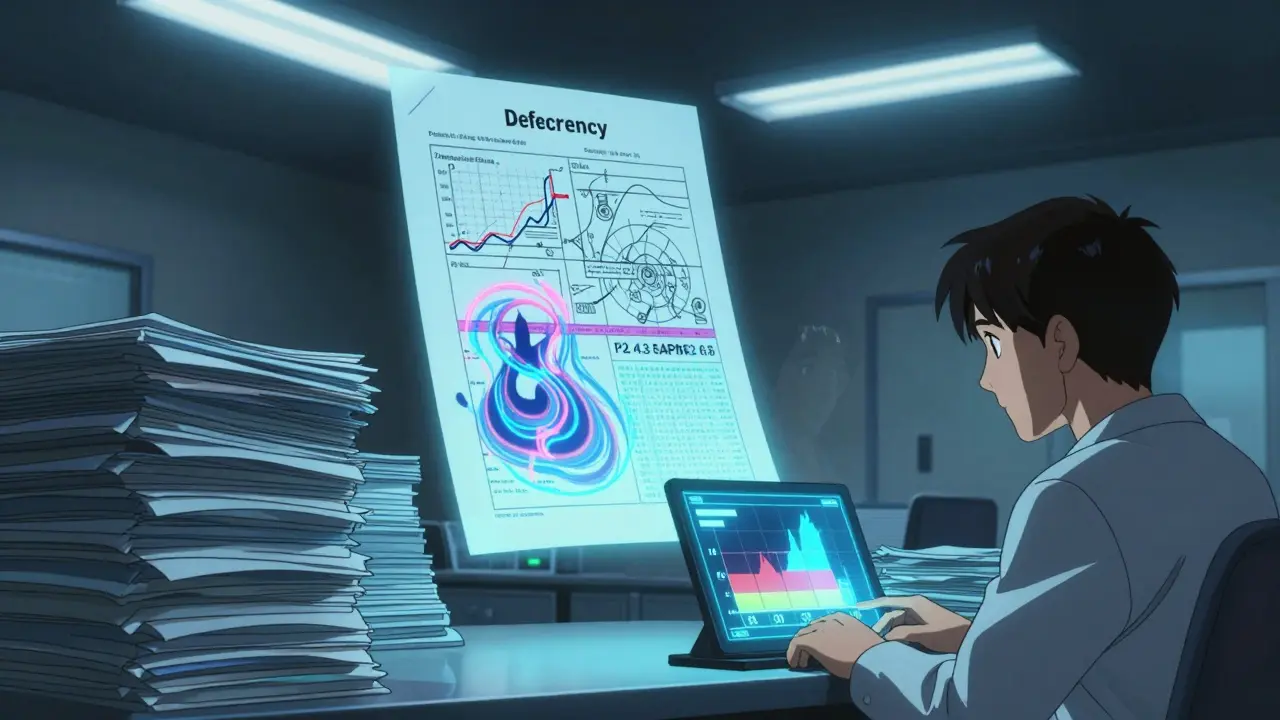
When a company submits an Abbreviated New Drug Application (ANDA) to the U.S. Food and Drug Administration (FDA), they’re not just asking for permission to sell a generic version of a brand-name drug. They’re asking to prove their product is identical in safety, strength, and performance. If the FDA finds even one gap in that proof, they send a deficiency letter. And for many generic drugmakers, especially new ones, that letter is a major setback.
Over 70% of ANDAs that don’t get approved on the first try get rejected because of quality issues. These aren’t minor paperwork errors. They’re technical failures in how the drug is made, tested, or characterized. The FDA doesn’t send these letters lightly. Each one means the applicant must pause, fix the problem, and resubmit - often adding 12 to 18 months to the timeline. And for a drug that could be worth hundreds of millions in annual sales, that delay can cost over $1 million.
What’s in a Deficiency Letter?
A deficiency letter from the FDA is not a rejection. It’s a detailed roadmap of what’s missing. The agency breaks down each issue by category: drug substance (the active ingredient), drug product (the final pill or injection), and bioequivalence (how the body absorbs the drug). Each section has specific expectations, and failing even one can trigger a letter.
The most common problem? Dissolution testing. About 23% of deficiency letters cite issues with how the drug dissolves in lab conditions. That might sound technical, but it’s critical. If your generic pill doesn’t dissolve the same way as the brand-name version under different pH levels - like in the stomach versus the intestine - it won’t work the same in patients. Many companies use outdated lab equipment or test only at one pH, not the three required (1.2, 4.5, and 6.8). The FDA expects you to match the reference drug’s dissolution profile across all conditions. If you don’t, they’ll call it out.
Top 5 Deficiency Areas in Generic Drug Submissions
Based on FDA data from 2023-2024, here are the five biggest trouble spots:
- Unqualified Impurities - 20% of deficiency letters. Every drug has trace impurities. The problem isn’t their presence - it’s whether you’ve tested them for safety. If you can’t prove an impurity is below toxic thresholds using ICH guidelines (like M7 for mutagenic impurities), the FDA will ask for more data. This often means running new toxicology studies, which can take over a year.
- Drug Substance (DS) Sameness - 19%. You must prove your active ingredient is chemically identical to the brand’s. For simple molecules, this is straightforward. But for peptides, complex salts, or polymorphs? You need advanced tools like circular dichroism, size-exclusion chromatography, and Fourier-transform infrared spectroscopy. Many applicants skip these tests because they’re expensive - and then get hit with a deficiency.
- Drug Product Critical Quality Attributes (CQAs) - 14%. These are the measurable properties that affect safety and performance: hardness, disintegration time, coating uniformity. If your tablet crumbles too fast or doesn’t release the drug at the right rate, you’ll get flagged. Modified-release products are especially vulnerable. One company lost 14 months because their delayed-release coating didn’t hold up under humidity testing.
- Analytical Method Validation - 16.5%. You can’t just say “we tested it.” You must prove your testing method is accurate, precise, specific, and stable. Many submissions include raw data without validation reports. The FDA wants to see how you confirmed your HPLC or GC method works - not just the numbers.
- Elemental Impurities - 13%. ICH Q3D sets limits for heavy metals like lead, cadmium, and arsenic. If your manufacturing process uses stainless steel equipment or catalysts, you must prove those metals aren’t leaching into your product. A single unaddressed impurity can delay approval.
Why Some Companies Keep Getting Hit
It’s not always about money. It’s about experience. Companies with fewer than 10 approved ANDAs have deficiency rates 22% higher than those with 50 or more. Why? They don’t know what the FDA expects until they’re told.
One common mistake? Treating development like academic research. A regulatory consultant with 25 years of experience told me that nearly half of DS sameness deficiencies come from using lab-scale methods that don’t reflect commercial production. If you make 100 grams in your lab but plan to produce 100 kilograms in the factory, the FDA will ask: “How do you know it’s the same?”
Another big issue: poor documentation. Applications with vague explanations get flagged. If you say “we followed guidelines,” but don’t show how, you’re asking for trouble. The FDA reviews 3,000+ ANDAs a year. They’re not guessing - they’re looking for proof. Detailed development reports reduce deficiencies by 27%.
Complex Products Are the Biggest Challenge
Not all generics are created equal. A simple aspirin tablet? Low risk. A topical cream for eczema? Medium. A peptide-based injectable with a modified-release profile? High risk.
Peptide drugs, modified-release tablets, and complex injectables make up only 22% of ANDA submissions - but they account for 38% of deficiency letters. Why? Because they’re harder to characterize. A peptide’s 3D structure affects how it works. If your version aggregates differently than the brand’s, it could be less effective - or even dangerous. The FDA now requires multiple analytical techniques to prove structural similarity. Most applicants don’t have the equipment or expertise to do this.
Modified-release products are another minefield. They’re designed to release the drug slowly over time. But if your coating breaks down too fast under high humidity, or your granules don’t mix evenly during manufacturing, you’ll get a deficiency. One company submitted 3 times before getting approval - each time, the issue was different: first, dissolution; second, manufacturing consistency; third, impurity profile.
How to Avoid the Deficiency Trap
There’s no magic trick. But there are proven strategies:
- Use pre-submission meetings. Companies that request a formal meeting with the FDA before submitting see deficiency rates 32% lower. These aren’t optional. They’re your best chance to hear what the reviewers will look for.
- Invest in analytical capabilities. Don’t outsource everything. If you can’t run HPLC, GC-MS, or circular dichroism in-house, partner with a lab that can. The FDA expects you to know your product inside and out.
- Follow ICH guidelines strictly. ICH Q3A, Q3B, Q3D, and M7 aren’t suggestions. They’re the standard. If your impurity report doesn’t align with them, you’re already behind.
- Test under real-world conditions. Don’t just test dissolution at pH 6.8. Test it at 4.5 and 1.2 too. Use Apparatus 2 for immediate-release, Apparatus 3 or 4 for extended-release. The FDA has clear guidance on this - read it.
- Build a regulatory team. One person can’t handle everything. You need someone who understands chemistry, another who knows manufacturing, and a third who’s fluent in FDA expectations. Many small companies try to do it all with one contractor - and pay the price later.
The Future Is Changing
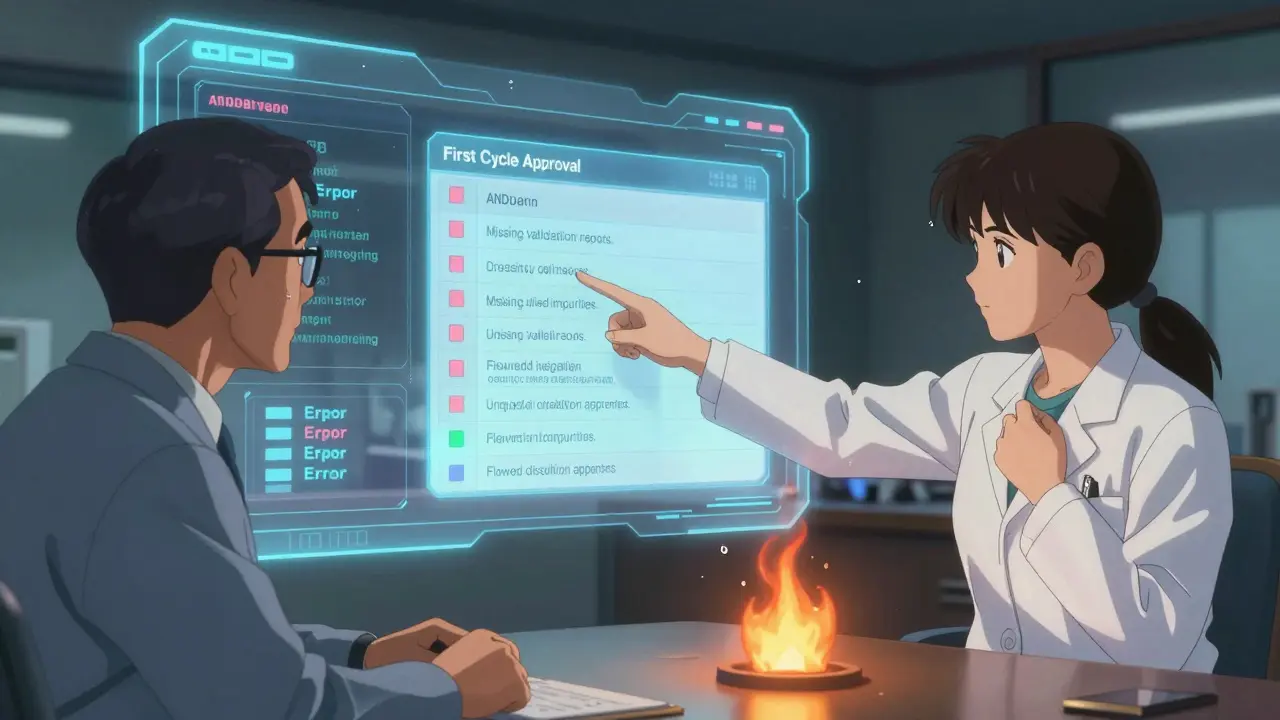
The FDA isn’t standing still. In 2023, they launched the First Cycle Generic Drug Approval Initiative - a push to get more products approved on the first try. They’ve created specialized review teams for complex products, released new template responses for common deficiencies, and are testing AI tools to catch errors before submission.
By late 2026, the FDA plans to roll out AI-assisted pre-screening. Early tests show it can spot 35% of common mistakes - like missing validation reports or wrong dissolution apparatus - before the application even reaches a reviewer. That means applicants who don’t prepare properly will be caught faster.
Meanwhile, the Competitive Generic Therapy (CGT) program is helping. Drugs that get CGT designation get priority review and targeted guidance. Those applications have a 73% first-cycle approval rate - compared to the industry average of 52%. If you’re developing a high-need generic, apply for CGT. It’s worth the effort.
Bottom Line
Deficiency letters aren’t punishment. They’re feedback. And if you treat them that way, you can turn them into a roadmap to approval. The most successful generic companies don’t just submit applications - they build relationships, invest in science, and learn from every letter they receive.
The data is clear: preparation beats luck. If you know the top five deficiency areas, test rigorously, document thoroughly, and talk to the FDA early - you can cut your approval time in half. And in the $110 billion generic drug market, that’s not just a win. It’s the only way to compete.
What happens after I get a deficiency letter from the FDA?
After receiving a deficiency letter, you must respond in writing within 30 days, outlining how you’ll fix each issue. You’ll need to submit revised data, updated protocols, or new test results. The FDA will then review your response. If they’re satisfied, they’ll approve your application. If not, you may get another deficiency letter or a complete response letter (CRL), which typically means the application is not approvable without major changes.
Can I appeal a deficiency letter?
You can’t formally appeal a deficiency letter - it’s not a rejection. But you can request a meeting with the FDA to discuss their findings. This is often called a “Type C meeting.” You can present new data, clarify misunderstandings, or ask for clarification on their expectations. Many companies use this to avoid a second deficiency letter. If you believe the FDA misinterpreted your data, this is your best path forward.
How long does it take to resolve a deficiency letter?
It varies. Simple issues like missing documentation can be fixed in 3-6 weeks. Complex problems - like unqualified impurities requiring new toxicology studies - can take 12-18 months. On average, resolving a deficiency adds 8-14 months to the approval timeline. The key is to act quickly and accurately. Delays often come from waiting too long to start fixing the problem.
Do deficiency letters apply to all generic drugs?
Yes - all ANDAs are subject to deficiency letters. But they’re far more common for complex products: peptides, modified-release tablets, topical creams, and injectables. Simple immediate-release pills (like generic aspirin or metformin) have lower deficiency rates because their chemistry and manufacturing are well-understood. The more complex the product, the higher the chance of a deficiency.
What’s the difference between a deficiency letter and a complete response letter (CRL)?
A deficiency letter identifies specific issues that can be fixed with additional data or clarification. A complete response letter (CRL) means the application cannot be approved in its current form - even after fixing the listed issues. A CRL often signals deeper problems, like flawed study design, insufficient manufacturing controls, or major safety concerns. While a deficiency letter is a detour, a CRL is a roadblock that requires major rework.
For companies new to ANDA submissions, the path isn’t easy - but it’s predictable. Learn the common pitfalls. Build your team. Test early. Talk to the FDA. And don’t treat a deficiency letter as failure. Treat it as the first step toward approval.

Byron Duvall
So let me get this straight - the FDA is just using these deficiency letters to scare small companies out of the market?
I’ve heard this before - they don’t actually care about patient safety. They care about protecting Big Pharma’s monopoly. Every time a generic gets delayed, brand-name drug prices stay high. Coincidence? Nah. This whole system is rigged.
And don’t even get me started on those ‘pre-submission meetings.’ You think they’re there to help? Nah. They’re just gathering intel on your R&D so Big Pharma can copy it later.
I’ve seen it happen. A startup spends 2 years and $5M building a peptide drug. Gets a deficiency letter. Fixes it. Gets approved. Two months later, a big pharma company releases the EXACT SAME DRUG with a different name. FDA didn’t stop them. Why? Because they’re in bed together.
You think this is about science? It’s about control. And if you’re not part of the club, you’re just cannon fodder.
Katherine Farmer
This post reads like a corporate compliance manual dressed up as educational content.
Dissolution testing at three pH levels? Please. The FDA’s expectations are arbitrary, inconsistent, and often contradictory across review divisions. I’ve seen identical methods accepted in one office and rejected in another - same reviewer, different day.
And don’t even mention ICH guidelines as if they’re gospel. ICH Q3D? The limits are based on outdated toxicology models from the 90s. We’re using AI-driven predictive toxicology now, but the FDA still demands HPLC data from 2018 protocols.
The real issue? No transparency. No public database of what each reviewer actually wants. You’re playing blindfolded darts in a room full of moving targets.
And yet, somehow, the same 3-4 consulting firms keep getting all the approvals. Coincidence? Or do they have backdoor access to reviewer preferences? I’ll let you decide.
Miranda Anderson
I’ve worked in generic drug development for over a decade, and honestly? This post is accurate but way too polite.
The truth is, most companies don’t fail because they’re incompetent. They fail because they’re underfunded, understaffed, and pressured to cut corners to hit a timeline that’s impossible.
I’ve seen labs skip dissolution testing at pH 1.2 because the equipment was broken and they didn’t have budget to fix it. I’ve seen validation reports written in Word instead of PDF because the IT department wouldn’t approve the software. I’ve seen teams submit with incomplete impurity profiles because the toxicology lab was backed up for 8 months.
The FDA doesn’t care about your budget. They don’t care if you’re a 5-person startup. They care about the data. And if the data isn’t perfect? You get a letter.
The real tragedy? The people who get hit hardest aren’t the bad actors. They’re the good ones trying to do the right thing with too little.
We need to stop pretending this is a level playing field. It’s not. And until we fix that, we’re just delaying access to affordable medicine for millions.
Gigi Valdez
The analysis presented here is methodical and grounded in empirical data, which is commendable.
However, the underlying assumption - that regulatory compliance is primarily a technical challenge - overlooks systemic inefficiencies in the approval infrastructure.
The FDA’s review capacity has not scaled proportionally with the volume of submissions. With over 3,000 ANDAs annually, reviewers are operating at 120% workload capacity. This leads to inconsistent interpretations, delayed feedback cycles, and increased variability in deficiency outcomes.
Furthermore, the reliance on legacy analytical methods (e.g., Apparatus 2 for extended-release) persists despite validated alternatives. Regulatory inertia, not scientific necessity, drives these standards.
A more effective approach would involve modular submission frameworks, real-time digital feedback loops, and tiered review pathways based on product complexity - not arbitrary categorizations.
The current system is not broken. It is merely obsolete.
Sneha Mahapatra
I read this and felt so much sadness.
Behind every deficiency letter is a team of scientists working 80-hour weeks. A parent skipping dinner to run HPLC. A lab tech crying because they can’t afford the right column for their GC-MS. A small company in Mumbai or Cincinnati or Manila betting everything on one shot.
We talk about ‘impurities’ and ‘dissolution profiles’ like they’re abstract concepts. But they’re not. They’re people. They’re dreams. They’re hope.
This system isn’t just about science. It’s about justice.
If we truly believe in access to medicine - real, affordable, life-saving medicine - then we have to stop treating these submissions like exams and start treating them like partnerships.
The FDA doesn’t need more rules. They need more compassion.
🙏
bill cook
I work at a small generic company and I just got my 3rd deficiency letter this year.
I’m not mad. I’m not even surprised.
But I’m tired.
Every time we fix one thing, another pops up. We spent $200k on a new dissolution apparatus. Got a letter saying we didn’t validate the method under humidity. We spent $150k on that. Got a letter saying our reference standard wasn’t certified to USP 45. We spent $75k on that. Now they want a stability study for a drug we’re not even selling yet.
I’m not asking for a medal. I just want to know: when do we stop playing whack-a-mole?
And why does it feel like the FDA’s job is to say ‘no’ instead of helping us say ‘yes’?
Sophia Rafiq
Dissolution testing is the #1 issue because everyone cuts corners on it. You think you can get away with pH 6.8 only? Nope. FDA sees it. Every time.
And don’t even think about skipping Apparatus 3 for modified release. I saw a company get deferred for 11 months because they used a paddle instead of a reciprocating cylinder.
Validation reports? If it’s not signed off by a QC lead with 10+ years in pharma, it’s garbage.
ICH M7? If your impurity profile doesn’t have a threshold justification with a 95% CI, you’re already in trouble.
Simple. No fluff. Do it right or don’t submit.
Noah Cline
This is why I hate the FDA.
They don’t want generics. They want to keep prices high.
The ‘deficiency letter’ is just a fancy word for ‘pay us more.’
You think they care about impurities? They care about your bank account.
Small companies go bankrupt. Big companies buy them. Then they raise prices.
This isn’t regulation. It’s economic warfare.
And the worst part? You can’t even talk about it. Say the wrong thing on LinkedIn and you get blacklisted.
Welcome to pharma. Where the rules are made to keep you poor.
Lisa Fremder
I’m sick of hearing about how ‘hard’ it is for US companies to get approved.
You think India and China have it easy? They’re dumping substandard generics into our market every day.
The FDA isn’t being harsh. They’re being smart.
If you can’t meet our standards, don’t submit.
We don’t need cheap drugs that kill people.
We need safe ones.
If you can’t afford to do it right, go sell aspirin in a third-world country.
This isn’t a charity. It’s a public health mandate.
Sumit Mohan Saxena
As someone who has reviewed over 400 ANDA submissions from Indian manufacturers, I can confirm that the most common deficiency is not technical - it is cultural.
Many applicants submit documentation written in English as a second language, with unclear methodology descriptions, inconsistent terminology, and unstructured data presentation.
This is not a fault of the FDA. It is a failure of training.
The solution is not more regulations. It is structured pre-submission training programs - led by former FDA reviewers - that teach how to communicate scientific data clearly, precisely, and in alignment with regulatory expectations.
A well-documented application, even if technically imperfect, can be approved faster than a technically perfect but poorly written one.
Clarity > Complexity. Always.
Brandon Vasquez
I want to say thank you to the people who wrote this.
I’ve been in this industry for 15 years. I’ve seen too many good people burn out because they thought they were failing.
But you’re not failing. You’re learning.
Every deficiency letter is a teacher. Every delay is a chance to build something stronger.
You don’t need to be perfect. You just need to be honest.
Show your data. Own your gaps. Ask for help.
The FDA isn’t your enemy. They’re the gatekeepers of trust. And trust is built one honest submission at a time.
Keep going. You’ve got this.