Blood Thinner & NSAID Risk Calculator
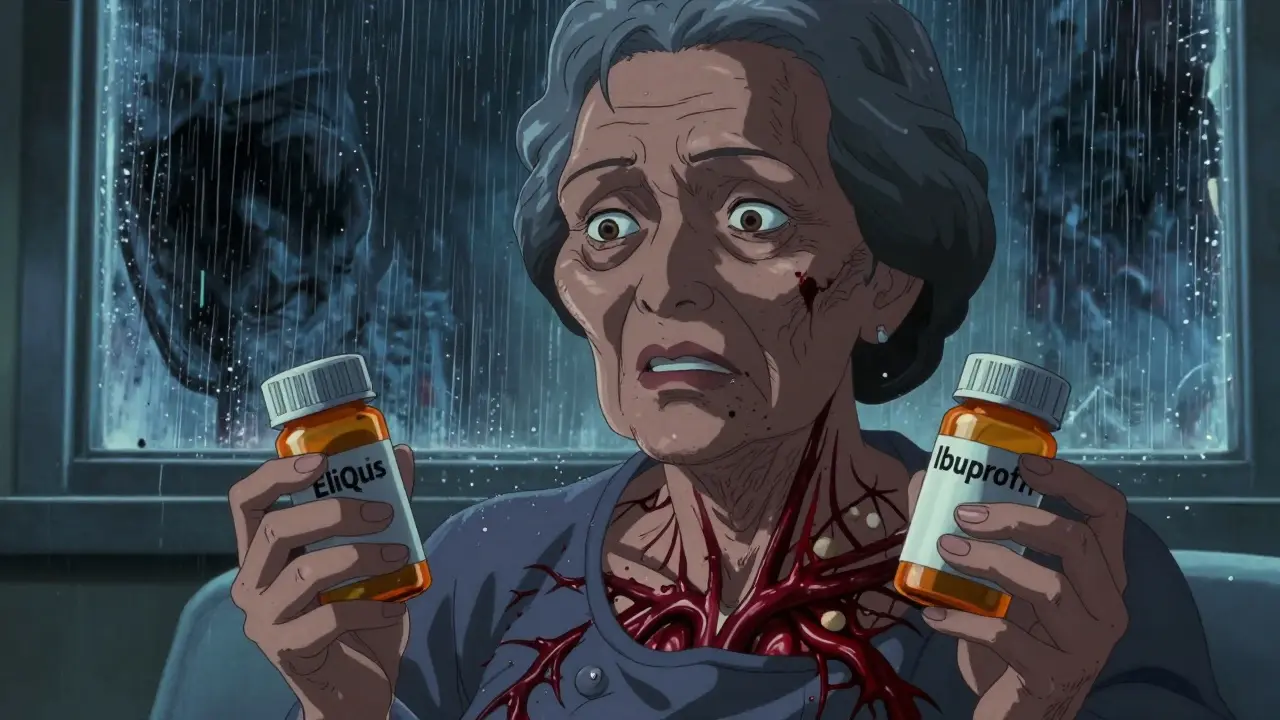
Every year, millions of people take blood thinners to prevent strokes, clots, or heart attacks. At the same time, just as many reach for ibuprofen, naproxen, or aspirin to ease aching joints, headaches, or back pain. What most don’t realize is that combining these two types of drugs isn’t just a minor risk-it’s a life-threatening mistake.
How Blood Thinners and NSAIDs Work Together to Cause Bleeding
Blood thinners don’t actually make your blood thinner. They slow down your body’s ability to form clots. That’s the point. If you have atrial fibrillation, a mechanical heart valve, or a history of deep vein thrombosis, this helps prevent deadly clots from forming. Common blood thinners include warfarin, apixaban (Eliquis), rivaroxaban (Xarelto), dabigatran (Pradaxa), and edoxaban (Savaysa). NSAIDs-nonsteroidal anti-inflammatory drugs-are different. They reduce pain and swelling by blocking enzymes called COX-1 and COX-2. But here’s the catch: COX-1 is also needed for platelets to stick together and seal cuts. When NSAIDs block COX-1, platelets can’t do their job. That’s why people on NSAIDs sometimes bruise easily or bleed longer from minor cuts. Put them together, and you’re hitting the body’s clotting system from two sides. Blood thinners delay clot formation. NSAIDs stop platelets from working. The result? A perfect storm for uncontrolled bleeding.The Real Numbers Behind the Danger
It’s not theoretical. In 2020, a study of over 200,000 patients tracked over 10 years found that taking NSAIDs with a blood thinner made internal bleeding more than twice as likely. That’s not a small increase. That’s a 109% higher chance of bleeding somewhere in your body. The risk doesn’t stop there. The type of NSAID matters:- Naproxen increased bleeding risk by 4.1 times
- Diclofenac raised it by 3.3 times
- Ibuprofen still pushed it up by 1.8 times
Why This Combination Is So Common
You’d think doctors would just avoid prescribing both. But here’s the problem: people need pain relief. About 12 million Americans take blood thinners long-term. Over 17 million use NSAIDs daily. Many of those people are older adults with arthritis, back pain, or joint damage. It’s not rare for someone on Eliquis for AFib to also have osteoarthritis in their knees. They grab ibuprofen off the shelf because it’s easy, cheap, and feels like it works. A 2022 study found that 20-30% of people on blood thinners still use NSAIDs regularly. Even worse, only 43% of them knew it was dangerous. Two-thirds thought occasional use was fine. Pharmacies don’t help. You can buy naproxen or ibuprofen without a prescription. No warning label says, “Don’t take this if you’re on a blood thinner.” The FDA does require black box warnings on NSAID packaging since 2005-but most people never read them.
What Happens When People Ignore the Warning
Real stories tell the truth better than statistics. One Reddit user on r/anticoagulants shared that after taking ibuprofen for a toothache while on apixaban, he ended up in the ER with a hemoglobin drop from 14.2 to 8.7. He needed a blood transfusion. Another patient described waking up with black, tarry stools-classic signs of GI bleeding-and didn’t realize it was linked to his daily Advil. Emergency rooms see this often. About 12% of all anticoagulant-related ER visits involve NSAID use. Many patients say things like, “I only took one pill,” or “I thought it was safe since I didn’t take it every day.” But even a single dose can tip the balance, especially if someone’s INR is already high or they’re dehydrated.What You Should Do Instead
The safest pain reliever for people on blood thinners? Acetaminophen (Tylenol). It doesn’t affect platelets or clotting. It’s not perfect-it won’t reduce inflammation like NSAIDs-but it’s far safer. Just don’t overdo it. Stick to 3,000 mg per day max. Higher doses can hurt your liver, especially if you drink alcohol or have other liver issues. For inflammation or swelling, try non-drug options:- Ice packs for joints
- Physical therapy or gentle stretching
- Topical creams with menthol or capsaicin
- Compression sleeves or supportive braces
- Prescribe a proton pump inhibitor (like omeprazole) to protect your stomach
- Order frequent INR checks
- Adjust your blood thinner dose temporarily

What Your Doctor Should Be Doing
Doctors aren’t always on top of this either. Many still think COX-2 inhibitors like celecoxib (Celebrex) are safe alternatives. But recent data shows they still carry elevated bleeding risk-just slightly less than traditional NSAIDs. The American College of Chest Physicians still recommends avoiding all NSAIDs in patients on anticoagulants. Good practice includes:- Asking every patient on blood thinners: “Do you take any pain meds?”
- Documenting NSAID use in the chart-even if it’s OTC
- Providing written instructions on pain relief alternatives
- Reinforcing the message at every visit
What to Do If You’ve Already Taken Both
If you took ibuprofen yesterday while on Eliquis, don’t panic. One dose rarely causes immediate bleeding. But watch for signs:- Unusual bruising or bleeding gums
- Dark, tarry stools
- Red or pink urine
- Headache, dizziness, confusion (possible brain bleed)
- Feeling unusually tired or short of breath
Why This Isn’t Getting Better
We’ve known about this danger for decades. Studies from the 1990s warned about warfarin and NSAIDs. Yet here we are in 2026, and people are still mixing them. Why? Because pain is real. Arthritis is common. OTC drugs are everywhere. And the warning labels? They’re buried in tiny print. The FDA’s 2024 pain management initiative is trying to fix this by pushing for safer alternatives. But until then, the responsibility falls on you. You need to know your meds. You need to ask questions. And you need to speak up if your doctor doesn’t. This isn’t about being perfect. It’s about being informed. One pill can change everything.Can I take Tylenol while on blood thinners?
Yes, acetaminophen (Tylenol) is generally the safest pain reliever for people on blood thinners because it doesn’t affect platelets or clotting. But don’t exceed 3,000 mg per day. Higher doses can damage your liver, especially if you drink alcohol or have existing liver disease.
Is aspirin safe if I’m on a blood thinner?
No, aspirin is not safe to take with blood thinners unless specifically prescribed by your doctor. Aspirin is an NSAID that irreversibly blocks platelet function, and combining it with anticoagulants significantly raises bleeding risk. Even low-dose aspirin for heart protection should only be used under strict medical supervision.
What about topical NSAIDs like gels or creams?
Topical NSAIDs (like diclofenac gel) are absorbed in much smaller amounts than pills, so they carry less risk. But they’re not risk-free. Some studies show they can still raise bleeding risk slightly, especially if used on large areas or broken skin. Talk to your doctor before using them, especially if you’re on a strong blood thinner.
Can I take NSAIDs once in a while if I’m on a blood thinner?
There’s no safe "occasional" use. Even one dose of an NSAID can increase bleeding risk, especially if your INR is high, you’re dehydrated, or you’re older. The guidelines say to avoid NSAIDs entirely unless absolutely necessary and under close medical supervision. Don’t assume a single pill won’t hurt.
How long should I stop NSAIDs before surgery?
It depends on the NSAID. Stop ibuprofen at least 2 days before surgery, naproxen 2-3 days, and piroxicam 10 days. These are based on how long each drug stays active in your body. Always check with your surgeon or doctor-they’ll give you exact instructions based on your meds and procedure.
Do all blood thinners have the same interaction risk with NSAIDs?
Yes. Whether you’re on warfarin, Eliquis, Xarelto, Pradaxa, or another anticoagulant, combining it with an NSAID increases bleeding risk. The mechanism is the same: NSAIDs hurt platelet function, and blood thinners slow clotting. The combination is dangerous regardless of which anticoagulant you take.

Aaron Pace
I took ibuprofen for my knee pain last week while on Xarelto... 🤦♂️ Turns out I was one bad bruise away from the ER. Now I use ice packs and Tylenol. Don't be like me. 😅
Adebayo Muhammad
The systemic failure here is not pharmacological-it's epistemological. We have commodified pain relief to the point where self-medication is a cultural ritual, and medical literacy is treated as optional. The FDA's black box warnings? A performative gesture. The real tragedy is not the bleeding-it's that we've normalized ignorance as convenience.
Sean Callahan
i was just gonna say... i took a couple ibuprofen after my back flare-up and didn't think twice... then i started bruising like crazy and thought i was getting sick. turns out it was the combo. i didn't even know this was a thing. now i'm scared to take anything. 🤕
Jeff Mirisola
This is one of those topics that should be taught in high school health class. Not just for older folks-anyone on meds, even young people with AFib after an infection, needs to know this. I’ve seen too many people think 'natural' means 'safe.' It doesn't. Knowledge saves lives.
Susan Purney Mark
Thank you for this. My mom was on warfarin and took naproxen for her arthritis for years. She never knew it was dangerous. She’s fine now, but we almost lost her. Please, if you’re reading this and take blood thinners-ask your pharmacist. Seriously. 💙
Ian Kiplagat
Topical NSAIDs? Still risky. Saw a case in London where a guy used diclofenac gel daily on his back. Ended up with a GI bleed. Absorption ≠ safety. 🤷♂️
amber carrillo
Acetaminophen is the way to go. Just don't go overboard.
Joey Pearson
You got this. Switching to Tylenol was the best decision I ever made. My joint pain didn't vanish, but my bleeding risk did. Small changes = big wins. 💪
Roland Silber
I’ve been on Eliquis for 4 years. I used to take Advil like candy. After reading this, I went to my doctor and got a list of non-drug options. Ice packs, physical therapy, even acupuncture helped. I didn’t realize how much I was relying on pills for comfort. Now I’m more mindful. It’s not just about meds-it’s about rethinking pain.
Patrick Jackson
I just... I can’t believe how many people are walking around with this ticking time bomb in their medicine cabinet. 🤯 I mean, we have AI that can diagnose cancer, but we still let people buy naproxen like candy with no warning? This isn’t negligence. It’s a societal betrayal. I’m not mad. I’m heartbroken.
Pranay Roy
This is all a Big Pharma scam. They make the blood thinners, then they make the NSAIDs, then they pretend they’re safe together. The real danger? The hospitals. They profit from ER visits. They want you bleeding. They want you transfused. They want you hooked. Wake up.
Joe Prism
I’ve been on warfarin since 2018. I stopped NSAIDs cold. Used to think Tylenol was weak. Now I know it’s wisdom. Sometimes the quiet choice is the strongest one.
Bridget Verwey
So let me get this straight: you’re telling me the FDA knew this was a problem in 2005... and we’re still here? 😒 I’m not impressed. Just say it: the system is broken. And we’re the ones paying for it with blood.